
41,95 €
inkl. MwSt.
Sofort per Download lieferbar
21 °P sammeln

Andere Kunden interessierten sich auch für
") Rethinking What Works with Offenders (eBook, ePUB)41,95 €
Rethinking What Works with Offenders (eBook, ePUB)41,95 €") Desistance and Societies in Comparative Perspective (eBook, PDF)41,95 €
Desistance and Societies in Comparative Perspective (eBook, PDF)41,95 €") Comparing Pathways of Desistance (eBook, PDF)45,95 €
Comparing Pathways of Desistance (eBook, PDF)45,95 €") Reimagining Probation Practice (eBook, ePUB)39,95 €
Reimagining Probation Practice (eBook, ePUB)39,95 €") Rehabilitation (eBook, PDF)48,95 €
Rehabilitation (eBook, PDF)48,95 €") Peer Mentoring in Criminal Justice (eBook, PDF)44,95 €
Peer Mentoring in Criminal Justice (eBook, PDF)44,95 €") Desistance Transitions and the Impact of Probation (eBook, PDF)25,95 €
Desistance Transitions and the Impact of Probation (eBook, PDF)25,95 €
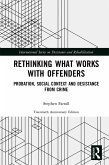






When it was published twenty years ago, Rethinking What Works with Offenders made a major contribution to criminological knowledge on why people stopped offending, and the impact the probation service had on the desistance process. Unlike other studies that had relied on official conviction data, it was the first to make use of self-reported data, including interviews with men and women on probation, and their supervising Probation Officers. It reconceptualised probation outcomes in terms of degrees of success rather than as 'successful' or 'unsuccessful' and offered important policy implications of these conclusions.
The Twentieth Anniversary edition contains the original text along with a new Foreword by Shadd Maruna and Fergus McNeill, locating the book historically and assessing its continued importance to Criminology. It also includes a new chapter by the author reporting on the key findings of the follow-up interviews in 2004 and 2010-12, reflecting on key developments in the field and developing a theory of assisted desistance. Furthermore, it features four new commentaries from Mark Halsey, Isabelle F.-Dufour, Martine Herzog-Evans and José Cid reflecting on the importance and legacy of the book.
This book presents an important and challenging range of findings on 'what works' in probation and with offenders and remains essential reading for anybody professionally concerned with the present and future of probation.
The Twentieth Anniversary edition contains the original text along with a new Foreword by Shadd Maruna and Fergus McNeill, locating the book historically and assessing its continued importance to Criminology. It also includes a new chapter by the author reporting on the key findings of the follow-up interviews in 2004 and 2010-12, reflecting on key developments in the field and developing a theory of assisted desistance. Furthermore, it features four new commentaries from Mark Halsey, Isabelle F.-Dufour, Martine Herzog-Evans and José Cid reflecting on the importance and legacy of the book.
This book presents an important and challenging range of findings on 'what works' in probation and with offenders and remains essential reading for anybody professionally concerned with the present and future of probation.
Dieser Download kann aus rechtlichen Gründen nur mit Rechnungsadresse in A, B, BG, CY, CZ, D, DK, EW, E, FIN, F, GR, HR, H, IRL, I, LT, L, LR, M, NL, PL, P, R, S, SLO, SK ausgeliefert werden.
"This new edition of "Rethinking what works with offenders" is an opportunity to take stock of the exceptional contribution of this flagship book to the study of desistance."
Isabelle F.-Dufour, Laval University, Canada
"Some books are a turning point in your research interests and Rethinking What Works with Offenders encouraged me to devote more time to reading the desistance literature and to undertaking research on desistance that we were able to carry out in the next decade."
José Cid, University of Barcelona, Spain,
"...it is the skillful weaving of the agentic and structural/rule-driven dimensions involved in the probation-probationer dyad that stands as one of the lasting legacies of the book."
Mark Halsey, Flinders University, Melbourne, Australia.
Isabelle F.-Dufour, Laval University, Canada
"Some books are a turning point in your research interests and Rethinking What Works with Offenders encouraged me to devote more time to reading the desistance literature and to undertaking research on desistance that we were able to carry out in the next decade."
José Cid, University of Barcelona, Spain,
"...it is the skillful weaving of the agentic and structural/rule-driven dimensions involved in the probation-probationer dyad that stands as one of the lasting legacies of the book."
Mark Halsey, Flinders University, Melbourne, Australia.