0,00 €
0,00 €
inkl. MwSt.
Sofort per Download lieferbar

0 °P sammeln
0,00 €
Als Download kaufen
0,00 €
inkl. MwSt.
Sofort per Download lieferbar
0 °P sammeln
Jetzt verschenken
Alle Infos zum eBook verschenken
0,00 €
inkl. MwSt.
Sofort per Download lieferbar
Alle Infos zum eBook verschenken
0 °P sammeln

Andere Kunden interessierten sich auch für
") Revitalizing the United Nations (eBook, ePUB)0,00 €
Revitalizing the United Nations (eBook, ePUB)0,00 €") The Future of the United States-Australia Alliance (eBook, PDF)31,95 €
The Future of the United States-Australia Alliance (eBook, PDF)31,95 €") The India-Pakistan Nuclear Relationship (eBook, PDF)48,95 €
The India-Pakistan Nuclear Relationship (eBook, PDF)48,95 €") The Russia-Ukraine War of 2022 (eBook, PDF)41,95 €
The Russia-Ukraine War of 2022 (eBook, PDF)41,95 €") Understanding Russian Strategic Behavior (eBook, PDF)38,95 €
Understanding Russian Strategic Behavior (eBook, PDF)38,95 €") The Politics of Nuclear Disarmament (eBook, PDF)39,95 €
The Politics of Nuclear Disarmament (eBook, PDF)39,95 €") The Russia-Ukraine War (eBook, PDF)107,95 €
The Russia-Ukraine War (eBook, PDF)107,95 €

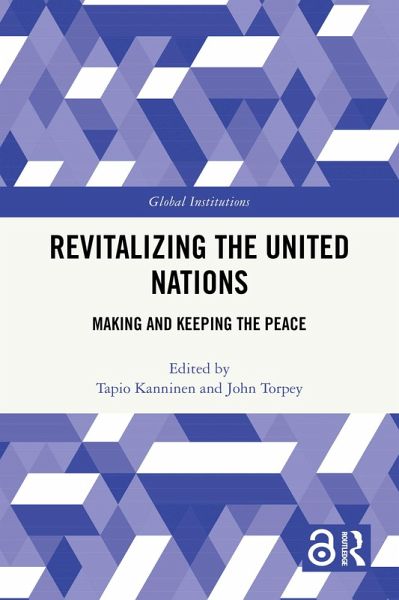
This book explores whether the United Nations (UN) is relevant in resolving wars when the permanent members of the UN Security Council are directly or indirectly involved. It examines solutions to major wars by applying and testing the UN's vast experience in mediating and deploying peacekeeping, demilitarization, truce monitoring, UN temporary administration, and other tools. While some observers see the organization in deep decline as the Security Council cannot agree to stop the wars in Ukraine and Gaza, the expert contributors to this volume make the case that until the start of this century the UN played a critically important role in resolving and freezing major conflicts, and the renewal of the organization could be based on these and other successful precedents. This volume will be of interest to scholars and students of global governance, security studies, and the history of the UN in the maintenance of international peace and security. It will also be of great interest to practitioners at the UN and its partner organizations, as well as to diplomats around the world.
The Open Access version of this book, available at http://www.taylorfrancis.com, has been made available under a Creative Commons Attribution-Non Commercial-No Derivatives (CC BY-NC-ND) 4.0 license.
The Open Access version of this book, available at http://www.taylorfrancis.com, has been made available under a Creative Commons Attribution-Non Commercial-No Derivatives (CC BY-NC-ND) 4.0 license.
Dieser Download kann aus rechtlichen Gründen nur mit Rechnungsadresse in A, B, BG, CY, CZ, D, DK, EW, E, FIN, F, GR, HR, H, IRL, I, LT, L, LR, M, NL, PL, P, R, S, SLO, SK ausgeliefert werden.