39,95 €
inkl. MwSt.
Sofort per Download lieferbar
20 °P sammeln

Andere Kunden interessierten sich auch für
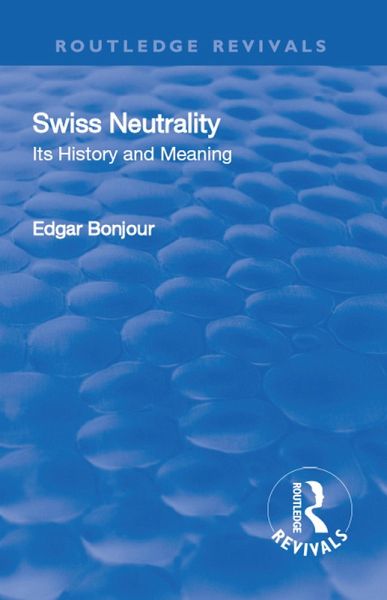
 (eBook, ePUB)") Revival: Swiss Neutrality (1946) (eBook, ePUB)39,95 €
Revival: Swiss Neutrality (1946) (eBook, ePUB)39,95 €") Swiss Foreign Policy (eBook, PDF)43,95 €
Swiss Foreign Policy (eBook, PDF)43,95 € (eBook, PDF)") Revival: Quangos: Trends, Causes and Consequences (2001) (eBook, PDF)27,95 €
Revival: Quangos: Trends, Causes and Consequences (2001) (eBook, PDF)27,95 €") Liberal Neutrality (eBook, PDF)33,95 €
Liberal Neutrality (eBook, PDF)33,95 €") The Permanent Under-Secretary for Foreign Affairs, 1854-1946 (eBook, PDF)43,95 €
The Permanent Under-Secretary for Foreign Affairs, 1854-1946 (eBook, PDF)43,95 €") The Japanese-Soviet Neutrality Pact (eBook, PDF)42,95 €
The Japanese-Soviet Neutrality Pact (eBook, PDF)42,95 €") Towards a Federal Europe (eBook, PDF)30,95 €
Towards a Federal Europe (eBook, PDF)30,95 €







Up to a generation ago, the Swiss citizen lived with a feeling of security in foreign relations which we can hardly credit today. Neutrality has come to be taken so much for granted as the fundamental principle of the Federal constitution, and had been so generally recognized in Europe, that it seemed unthreatened and even inviolable. It blended with the republican and democratic ideal to form a national myth of almost religious sanctity. As the axiom of Swiss foreign policy, it had certainly suffered attack both in theory and in fact, but since such crises had always been successfully overcome, Switzerland's faith in the inviolability of her neutrality had merely been confirmed. It was as if the country were girdled with high, protecting ramparts, behind which its people could go about their lawful occasions unmolested. It was in this period of calm in Switzerland's foreign relations that international law assiduously sought a formula for the theory of neutrality.
Dieser Download kann aus rechtlichen Gründen nur mit Rechnungsadresse in A, B, BG, CY, CZ, D, DK, EW, E, FIN, F, GR, HR, H, IRL, I, LT, L, LR, M, NL, PL, P, R, S, SLO, SK ausgeliefert werden.