
42,95 €
42,95 €
inkl. MwSt.
Sofort per Download lieferbar

21 °P sammeln
42,95 €
Als Download kaufen
42,95 €
inkl. MwSt.
Sofort per Download lieferbar
21 °P sammeln
Jetzt verschenken
Alle Infos zum eBook verschenken
42,95 €
inkl. MwSt.
Sofort per Download lieferbar
Alle Infos zum eBook verschenken
21 °P sammeln

Andere Kunden interessierten sich auch für
") Revivals, Nationalism, and Linguistic Discrimination (eBook, ePUB)42,95 €
Revivals, Nationalism, and Linguistic Discrimination (eBook, ePUB)42,95 €") Linguistic Discrimination in US Higher Education (eBook, PDF)38,95 €
Linguistic Discrimination in US Higher Education (eBook, PDF)38,95 €") Linguistic Diversity and Discrimination (eBook, PDF)42,95 €
Linguistic Diversity and Discrimination (eBook, PDF)42,95 €") Heritage Language Policies around the World (eBook, PDF)44,95 €
Heritage Language Policies around the World (eBook, PDF)44,95 €") All English Accents Matter (eBook, PDF)19,95 €
All English Accents Matter (eBook, PDF)19,95 €") Discourse and Discrimination (eBook, PDF)49,95 €
Discourse and Discrimination (eBook, PDF)49,95 €") Racialized Identities in Second Language Learning (eBook, PDF)46,95 €
Racialized Identities in Second Language Learning (eBook, PDF)46,95 €
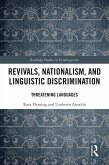






Is linguistic revival beneficiary to the plight of newly emerging, peripheral or even 'threatened' cultures? Or is it a smokescreen that hides the vestiges of ethnocentric ideologies, which ultimately create a hegemonic relationship? This book takes a critical look at revival exercises of special historical and geopolitical significance, and argues that a critical and cautious approach to revival movements is necessary.
The cases of Sinhala, Kazakh, Mongolian, Catalan, and even Hong Kong Cantonese show that it is not through linguistic revival, but rather through political representation and economic development, that the peoples in question achieve competitiveness and equality amongst their neighbors. On the other hand, linguistic revival in these and other contexts can, and has been, used to support nationalist or ethnocentric agendas, to the detriment of other groups, recreating the same dynamics that generated the argument for revival in the first place. This book argues that respect for linguistic and other diversity, multilingualism and multiculturalism, is not compatible with linguistic revival that mirrors nation-building and essentializing identity construction.
The cases of Sinhala, Kazakh, Mongolian, Catalan, and even Hong Kong Cantonese show that it is not through linguistic revival, but rather through political representation and economic development, that the peoples in question achieve competitiveness and equality amongst their neighbors. On the other hand, linguistic revival in these and other contexts can, and has been, used to support nationalist or ethnocentric agendas, to the detriment of other groups, recreating the same dynamics that generated the argument for revival in the first place. This book argues that respect for linguistic and other diversity, multilingualism and multiculturalism, is not compatible with linguistic revival that mirrors nation-building and essentializing identity construction.
Dieser Download kann aus rechtlichen Gründen nur mit Rechnungsadresse in A, B, BG, CY, CZ, D, DK, EW, E, FIN, F, GR, HR, H, IRL, I, LT, L, LR, M, NL, PL, P, R, S, SLO, SK ausgeliefert werden.