14,95 €
14,95 €
inkl. MwSt.
Sofort per Download lieferbar

7 °P sammeln
14,95 €
Als Download kaufen
14,95 €
inkl. MwSt.
Sofort per Download lieferbar
7 °P sammeln
Jetzt verschenken
Alle Infos zum eBook verschenken
14,95 €
inkl. MwSt.
Sofort per Download lieferbar
Alle Infos zum eBook verschenken
7 °P sammeln

Andere Kunden interessierten sich auch für
") The Revolution Is for the Children (eBook, ePUB)19,95 €
The Revolution Is for the Children (eBook, ePUB)19,95 €") Prostitution, Modernity, and the Making of the Cuban Republic, 1840-1920 (eBook, ePUB)18,95 €
Prostitution, Modernity, and the Making of the Cuban Republic, 1840-1920 (eBook, ePUB)18,95 €") Climate and Catastrophe in Cuba and the Atlantic World in the Age of Revolution (eBook, ePUB)22,95 €
Climate and Catastrophe in Cuba and the Atlantic World in the Age of Revolution (eBook, ePUB)22,95 €") Rice in the Time of Sugar (eBook, ePUB)16,95 €
Rice in the Time of Sugar (eBook, ePUB)16,95 €") The Cuban Connection (eBook, ePUB)14,95 €
The Cuban Connection (eBook, ePUB)14,95 €") Cuban Revolution in America (eBook, ePUB)14,95 €
Cuban Revolution in America (eBook, ePUB)14,95 €") The War of 1898 (eBook, ePUB)19,95 €
The War of 1898 (eBook, ePUB)19,95 €




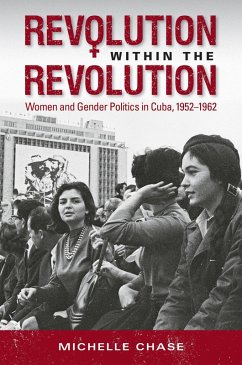
A handful of celebrated photographs show armed female Cuban insurgents alongside their compañeros in Cuba’s remote mountains during the revolutionary struggle. However, the story of women’s part in the struggle’s success has only now received comprehensive consideration in Michelle Chase’s history of women and gender politics in revolutionary Cuba. Restoring to history women’s participation in the all-important urban insurrection, and resisting Fidel Castro’s triumphant claim that women’s emancipation was handed to them as a “revolution within the revolution,” Chase’s work demonstrates that women’s activism and leadership was critical at every stage of the revolutionary process. Tracing changes in political attitudes alongside evolving gender ideologies in the years leading up to the revolution, Chase describes how insurrectionists mobilized familiar gendered notions, such as masculine honor and maternal sacrifice, in ways that strengthened the coalition against Fulgencio Batista. But, after 1959, the mobilization of women and the societal transformations that brought more women and young people into the political process opened the revolutionary platform to increasingly urgent demands for women’s rights. In many cases, Chase shows, the revolutionary government was simply formalizing popular initiatives already in motion on the ground thanks to women with a more radical vision of their rights.
Dieser Download kann aus rechtlichen Gründen nur mit Rechnungsadresse in A, D ausgeliefert werden.