33,95 €
inkl. MwSt.
Sofort per Download lieferbar
17 °P sammeln

Andere Kunden interessierten sich auch für
 (eBook, PDF)") The Soviet Union and Revolutionary Iran (RLE Iran D) (eBook, PDF)52,95 €
The Soviet Union and Revolutionary Iran (RLE Iran D) (eBook, PDF)52,95 €") Young People, Border Spaces and Revolutionary Imaginations (eBook, PDF)39,95 €
Young People, Border Spaces and Revolutionary Imaginations (eBook, PDF)39,95 €") Counter Revolutionary Egypt (eBook, PDF)39,95 €
Counter Revolutionary Egypt (eBook, PDF)39,95 €") An Analysis of Hanna Batatu's The Old Social Classes and the Revolutionary Movements of Iraq (eBook, PDF)7,99 €
An Analysis of Hanna Batatu's The Old Social Classes and the Revolutionary Movements of Iraq (eBook, PDF)7,99 €") Women, Power and Politics in 21st Century Iran (eBook, PDF)52,95 €
Women, Power and Politics in 21st Century Iran (eBook, PDF)52,95 €") A Political Sociology of Twenty-First Century Revolutions and Resistances (eBook, PDF)44,95 €
A Political Sociology of Twenty-First Century Revolutions and Resistances (eBook, PDF)44,95 €") The Role of Female Combatants in the Nicaraguan Revolution and Counter Revolutionary War (eBook, PDF)22,95 €
The Role of Female Combatants in the Nicaraguan Revolution and Counter Revolutionary War (eBook, PDF)22,95 €




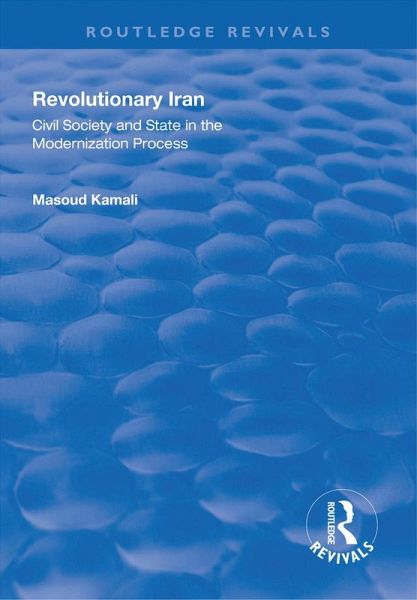
First published in 1998, Revolutionary Iran investigates two major political transformations in the modern history of Iran: the Constitutional Revolution of 1905-09 and the Islamic Revolution 1976-79 and their relation to the modernization of Iran in this century. It addresses a core question: Why did the clergy not take political power in the Constitutional Revolution when Iran was a traditional society and they played a key leadership role in the revolution; yet they succeeded in the more modern Iran of 1979.
Characterization of socio-economic relationships between the two major influential groups of civil society in Iran and their role in political transformation is considered central for answering such a question. The book deals with revolution in terms of relationships between civil society and state; which, it is argued, are central to analysing and understanding modern movements in Iran and other Islamic countries. The major contribution of the book can be summarized as follows:
Characterization of socio-economic relationships between the two major influential groups of civil society in Iran and their role in political transformation is considered central for answering such a question. The book deals with revolution in terms of relationships between civil society and state; which, it is argued, are central to analysing and understanding modern movements in Iran and other Islamic countries. The major contribution of the book can be summarized as follows:
- It identifies a socio-political division of power and influence between state and civil society during a long period of Iran's Islamic history as the key theoretical basis for understanding modern transformations of Iranian society. Such a division has, so far, been largely ignored.
- It explores the clergy and bazaris as the social basis of civil society in Iran, and challenges Gellner's viewpoint that an Islamic civil society is an impossibility.
- It argues that the modernization of religion and the creation of modern political theories by the clergy were both crucial means for defeating a modern authoritarian state and seizing political power.
- It identifies the main social group without whom the Islamic Revolution of Iran would not have achieved political victory, i.e., the dispossessed.
- It presents a theoretical basis for analysing and understanding new Islamic movements in the Islamic world.
Dieser Download kann aus rechtlichen Gründen nur mit Rechnungsadresse in A, B, BG, CY, CZ, D, DK, EW, E, FIN, F, GR, HR, H, IRL, I, LT, L, LR, M, NL, PL, P, R, S, SLO, SK ausgeliefert werden.