160,95 €
inkl. MwSt.
Sofort per Download lieferbar
80 °P sammeln

Andere Kunden interessierten sich auch für
") Genetics and Biotechnology of Lactic Acid Bacteria (eBook, PDF)160,95 €
Genetics and Biotechnology of Lactic Acid Bacteria (eBook, PDF)160,95 €") DNA Replication (eBook, PDF)80,95 €
DNA Replication (eBook, PDF)80,95 €") Genetics and Evolution of Aging (eBook, PDF)160,95 €
Genetics and Evolution of Aging (eBook, PDF)160,95 €") Mathematical Population Genetics 1 (eBook, PDF)104,95 €
Mathematical Population Genetics 1 (eBook, PDF)104,95 €") Advanced Research on Plant Lipids (eBook, PDF)160,95 €
Advanced Research on Plant Lipids (eBook, PDF)160,95 €") Cereals: Novel Uses and Processes (eBook, PDF)112,95 €
Cereals: Novel Uses and Processes (eBook, PDF)112,95 €") Chemistry and Biology of Pteridines and Folates (eBook, PDF)112,95 €
Chemistry and Biology of Pteridines and Folates (eBook, PDF)112,95 €
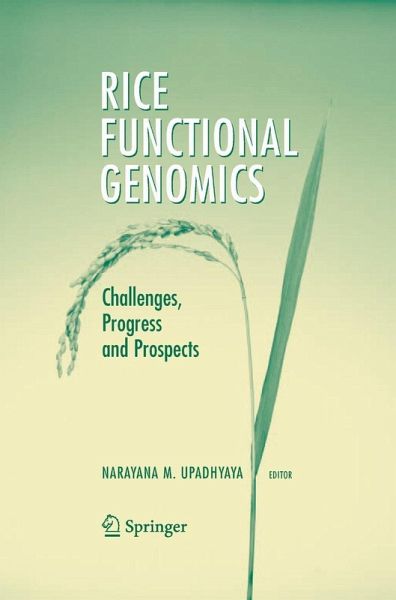
Rice has been chosen as a model cereal for functional genomics by the international scientific community because the ease with which it can be transformed, its well understood genetics with detailed genome physical maps, and dense molecular markers. In addition, there is great similarities in gene sequence, gene structure, gene order, and gene function among all the cereals and grasses. Genes identified in rice as being important will also be important in other cereals and any understanding of rice genes is directly applicable to the genes of other cereals. This book details rice functional genomics. It takes a multi-pronged genome-wide approach using structural similarities, expression profiles, and mutant phenotypes. Coverage includes the current status of genome sequencing and annotation, various tools, and resources being developed worldwide in the form of expressed sequence tags (ESTs), full-length cDNA, gene expression profiles and gene tagging.
Dieser Download kann aus rechtlichen Gründen nur mit Rechnungsadresse in A, B, BG, CY, CZ, D, DK, EW, E, FIN, F, GR, HR, H, IRL, I, LT, L, LR, M, NL, PL, P, R, S, SLO, SK ausgeliefert werden.
From the reviews:
"This book represents an excellent set of (reviewed) reviews that explains what is happening in the world of rice genomic research now. ... This is a useful book for genetic resources workers because understanding the way in which the genome works is generating huge numbers of mutants required for forward (from phenotype to genome sequence) and reverse genetics (genome sequence to phenotype)." (D. Vaughan, Genetic Resources and Crop Evolution, Vol. 54, 2007)
"This book represents an excellent set of (reviewed) reviews that explains what is happening in the world of rice genomic research now. ... This is a useful book for genetic resources workers because understanding the way in which the genome works is generating huge numbers of mutants required for forward (from phenotype to genome sequence) and reverse genetics (genome sequence to phenotype)." (D. Vaughan, Genetic Resources and Crop Evolution, Vol. 54, 2007)