2,99 €
2,99 €
inkl. MwSt.
Sofort per Download lieferbar

0 °P sammeln
2,99 €
Als Download kaufen
2,99 €
inkl. MwSt.
Sofort per Download lieferbar
0 °P sammeln
Jetzt verschenken
Alle Infos zum eBook verschenken
2,99 €
inkl. MwSt.
Sofort per Download lieferbar
Alle Infos zum eBook verschenken
0 °P sammeln

Andere Kunden interessierten sich auch für
") Communication Disorders, A Simple Guide To The Condition, Diagnosis, Treatment And Related Conditions (eBook, ePUB)2,99 €
Communication Disorders, A Simple Guide To The Condition, Diagnosis, Treatment And Related Conditions (eBook, ePUB)2,99 €") Muscle Tension Dysphonia, A Simple Guide To The Condition, Diagnosis, Treatment And Related Conditions (eBook, ePUB)2,99 €
Muscle Tension Dysphonia, A Simple Guide To The Condition, Diagnosis, Treatment And Related Conditions (eBook, ePUB)2,99 € A Simple Guide To The Condition, Diagnosis, Treatment And Related Conditions (eBook, ePUB)") Otosclerosis, (Thickened Ear Bones) A Simple Guide To The Condition, Diagnosis, Treatment And Related Conditions (eBook, ePUB)2,99 €
Otosclerosis, (Thickened Ear Bones) A Simple Guide To The Condition, Diagnosis, Treatment And Related Conditions (eBook, ePUB)2,99 €") Cholesteatoma, A Simple Guide To The Condition, Diagnosis, Treatment And Related Conditions (eBook, ePUB)2,99 €
Cholesteatoma, A Simple Guide To The Condition, Diagnosis, Treatment And Related Conditions (eBook, ePUB)2,99 € A Simple Guide To The Condition, Diagnosis, Treatment And Related Conditions (eBook, ePUB)") Dysarthria, (Motor Speech Disorder) A Simple Guide To The Condition, Diagnosis, Treatment And Related Conditions (eBook, ePUB)2,99 €
Dysarthria, (Motor Speech Disorder) A Simple Guide To The Condition, Diagnosis, Treatment And Related Conditions (eBook, ePUB)2,99 €") Meniere Man: The Self Help Book For Meniere's Disease (eBook, ePUB)9,49 €
Meniere Man: The Self Help Book For Meniere's Disease (eBook, ePUB)9,49 € A Simple Guide To The Condition, Diagnosis, Treatment And Related Conditions (eBook, ePUB)") Motion Sickness, (Travel Sickness) A Simple Guide To The Condition, Diagnosis, Treatment And Related Conditions (eBook, ePUB)2,99 €
Motion Sickness, (Travel Sickness) A Simple Guide To The Condition, Diagnosis, Treatment And Related Conditions (eBook, ePUB)2,99 €

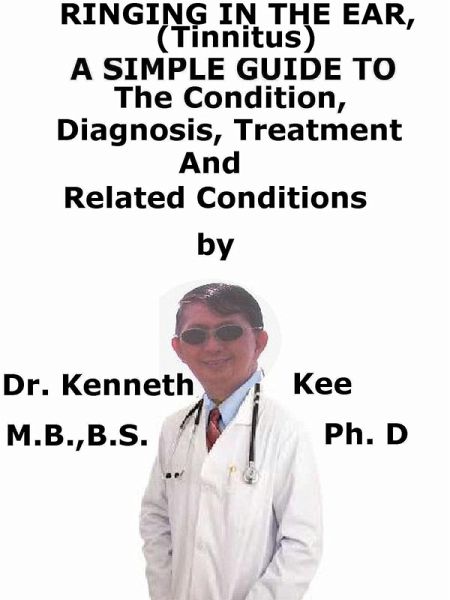
Ringing in Ears (Tinnitus) is the medical symptom of awareness of sound in the human ear or head when there is no outside source of the sounds. It is not a sickness but a symptom of an underlying disorder. Tinnitus is often called ringing in the ears but it may also sound like blowing, humming, roaring, buzzing, hissing, whistling, or sizzling. The sounds the patient hears can be soft or noisy. The patient may even believe he or she is hearing air escaping, water running, the inside of a seashell, or musical notes. Nearly every body notices a mild form of tinnitus once in a while that only lasts a few minutes. Constant or returning tinnitus is upsetting and makes it difficult to focus or sleep. Almost 12 % of men who are 65 to 74 years of age are affected by tinnitus. 1. Construction site workers 2. MP3 player users 3. Rock concert audiences 4. Gun and rifle users Causes It is not known precisely what induces a person to "hear" sounds with no external source of the noise. Tinnitus may happen with hearing loss. Occasionally, it is an indication of high blood pressure, an allergy, or anemia. Infrequently, tinnitus is a sign of a severe disorder like a tumor or aneurysm. The causes of Ringing in Ears (Tinnitus) are: 1. Hearing loss is the most frequent cause. Age or trauma to the ear (through noise, drugs, or chemicals) induce the injury of the segment of the ear for hearing (the cochlea) becomes destroyed. Hearing loss can happen from loud noises Because the cochlea does not transmit the normal signals to the brain, the brain becomes perplexed and basically produces its own sound (the tinnitus) to make up for the lack of normal sound signals. 2. Ear damage is normally noticed in both ears because both ears are normally exposed 3. The bad effects of extremely loud noise from firearms, high intensity music or other sources are a very frequent cause of tinnitus because of hearing nerve injury. 4. Ear infections or excess wax in the ear Foreign objects in the ear can produce the ringing sound. 5. Drugs such as aspirin (if overused), amino glycoside antibiotics and quinine may injure the hearing nerve. Alcohol, caffeine, antibiotics, aspirin, or other drugs can also induce ear noises. 6. Brain tumor called an acoustic neuroma which develops on the nerve that supplies hearing can induce tinnitus. 7. Meniere's disease -- an inner ear disorder that affects hearing loss and dizziness his tinnitus normally affects one ear unlike the hearing loss in both ears. The sound that they recognize in the ear or head has been mentioned as: 1. Ringing, 2. Whistling, 3. Vacuuming, 4. Hammering, 5. Buzzing Ringing in Ears (Tinnitus) is diagnosed: 1. Complete history and physical examination of the head and neck 2. A complete hearing test (audiogram) 3. Auditory brainstem response 4. Brain scan such as a computerized tomography (CT) scan or magnetic resonance imaging (MRI) Tinnitus can be hidden by other sounds: 1. Low-level music, ticking clocks, or other noises may assist the patient not perceive the tinnitus. 2. Tinnitus is often more obvious when the patient goes to bed at night because the environment is quieter. 3. Any noise in the room, like a humidifier, white noise machine, or dishwasher, can assist mask tinnitus 4. The patient must be taught methods to relax. The most frequent treatments are: 1. There may be physical injury to the inner ear or ear drum, in which case surgery may be essential. 2. If no physical injury is discovered, the doctor will give different drugs. Some doctors assert to be able to decrease the ringing by combining an inner-ear injection of lignocaine. Vagal nerve stimulation in the patient produced a decrease in tinnitus lasting for 2 mths TABLE OF CONTENT Introduction Chapter 1 Ringing in Ears (Tin...
Dieser Download kann aus rechtlichen Gründen nur mit Rechnungsadresse in A, B, CY, CZ, D, DK, EW, E, FIN, F, GR, H, IRL, I, LT, L, LR, M, NL, PL, P, R, S, SLO, SK ausgeliefert werden.