0,00 €
inkl. MwSt.
Erscheint vor. 22.01.26
0 °P sammeln

Andere Kunden interessierten sich auch für
") Risk, Resilience, and Recovery Across Global Education Systems (eBook, ePUB)0,00 €
Risk, Resilience, and Recovery Across Global Education Systems (eBook, ePUB)0,00 €") Civil Society and International Students in Japan (eBook, PDF)39,95 €
Civil Society and International Students in Japan (eBook, PDF)39,95 €") Contextualising Educational Studies in India (eBook, PDF)41,95 €
Contextualising Educational Studies in India (eBook, PDF)41,95 €") Reimagining Education in the Middle East (eBook, PDF)42,95 €
Reimagining Education in the Middle East (eBook, PDF)42,95 €") Public Policy in a Divided Society (eBook, PDF)33,95 €
Public Policy in a Divided Society (eBook, PDF)33,95 €") Global Corruption Report: Education (eBook, PDF)51,95 €
Global Corruption Report: Education (eBook, PDF)51,95 €") Risk, Education and Culture (eBook, PDF)39,95 €
Risk, Education and Culture (eBook, PDF)39,95 €




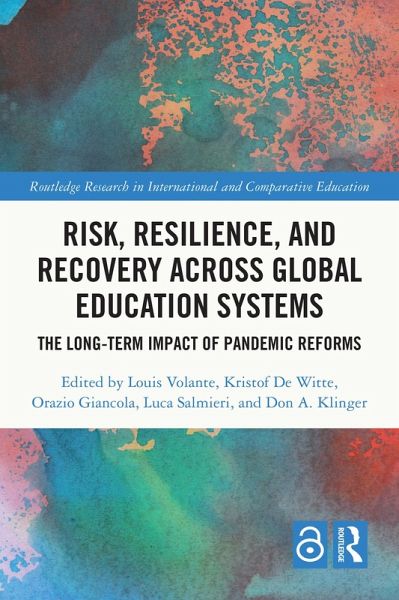
This book provides a critical review of the long-term effectiveness of education and social protection policies enacted by G10 countries in response to the global pandemic.
The COVID-19 pandemic caused the most significant disruption to education systems since the devastation of World War II. Successive waves and variants of the coronavirus resulted in school closures and spurred a range of policy interventions across national education systems to combat both the cognitive (i.e., achievement in reading, mathematics, and science) and non-cognitive (socioemotional development, mental and physical health) impacts on student achievement and wellbeing. This book aims to evaluate the long-term efficacy of such interventions, drawing on an analysis of a cross-section of nine industrialized countries: the United Kingdom, France, Germany, Italy, Sweden, Netherlands, Belgium, Canada, and Japan. It further offers cross-national insights for policymakers and discusses the critical importance of broader notions of academic resilience in a post-pandemic world. Ultimately, this volume aims to identify national policies that have helped to buffer students from the long-term challenges associated with the aftermath of the pandemic.
A timely and important text, it will be of interest to researchers and policymakers in education policy, pandemic response, impact evaluation, and student mental health.
The COVID-19 pandemic caused the most significant disruption to education systems since the devastation of World War II. Successive waves and variants of the coronavirus resulted in school closures and spurred a range of policy interventions across national education systems to combat both the cognitive (i.e., achievement in reading, mathematics, and science) and non-cognitive (socioemotional development, mental and physical health) impacts on student achievement and wellbeing. This book aims to evaluate the long-term efficacy of such interventions, drawing on an analysis of a cross-section of nine industrialized countries: the United Kingdom, France, Germany, Italy, Sweden, Netherlands, Belgium, Canada, and Japan. It further offers cross-national insights for policymakers and discusses the critical importance of broader notions of academic resilience in a post-pandemic world. Ultimately, this volume aims to identify national policies that have helped to buffer students from the long-term challenges associated with the aftermath of the pandemic.
A timely and important text, it will be of interest to researchers and policymakers in education policy, pandemic response, impact evaluation, and student mental health.
Dieser Download kann aus rechtlichen Gründen nur mit Rechnungsadresse in A, B, BG, CY, CZ, D, DK, EW, E, FIN, F, GR, HR, H, IRL, I, LT, L, LR, M, NL, PL, P, R, S, SLO, SK ausgeliefert werden.