49,95 €
inkl. MwSt.
Sofort per Download lieferbar
25 °P sammeln

Andere Kunden interessierten sich auch für
") Ritual in Human Evolution and Religion (eBook, ePUB)49,95 €
Ritual in Human Evolution and Religion (eBook, ePUB)49,95 €") Religious and Non-Religious Perspectives on Happiness and Wellbeing (eBook, PDF)41,95 €
Religious and Non-Religious Perspectives on Happiness and Wellbeing (eBook, PDF)41,95 €") The Psychology of Slow Living (eBook, PDF)38,95 €
The Psychology of Slow Living (eBook, PDF)38,95 €") Religious and Non-Religious Perspectives on Happiness and Wellbeing (eBook, ePUB)41,95 €
Religious and Non-Religious Perspectives on Happiness and Wellbeing (eBook, ePUB)41,95 €") Foundations of Islamic Psychology (eBook, PDF)45,95 €
Foundations of Islamic Psychology (eBook, PDF)45,95 €") Antisemitism Explained (eBook, PDF)33,95 €
Antisemitism Explained (eBook, PDF)33,95 €") Islamic Psychology (eBook, PDF)45,95 €
Islamic Psychology (eBook, PDF)45,95 €

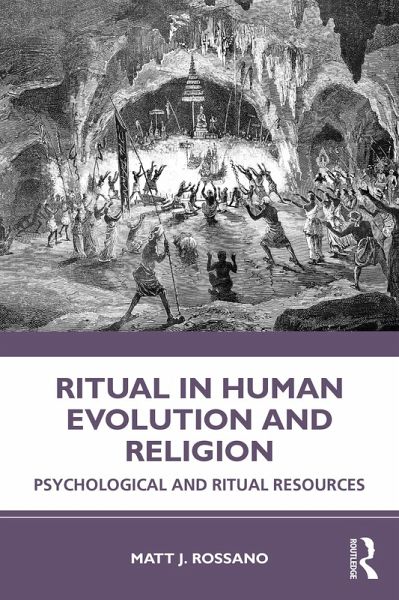
This book explores the role of ritual in social life, human evolution, and religion. It explains the functions and purpose of varied rituals across the world by arguing they are mechanisms of 'resource management', providing a descriptive tool for understanding rituals and generating predictions about ritual survival.
By showing how rituals have resulted from the need to cultivate social resources necessary to sustain cooperative groups, Rossano presents a unique examination of the function of rituals and how they cultivate, mobilize, and direct psychological resources. Rossano examines rituals from a diverse range of historical contexts, including the Greco-Romans, Soviet Russians, and those in 'crisis cults'. The book shows how rituals address societal and community problems by cultivating three psychological resources - commitment to communal values, goodwill (both of humans and supernatural agents) and social support or social capital. Holding communities together in the face of threat, disaster, or apathy is one of ritual's primary functions, and the author describes how our ancestors used ritual to become the highly social, inter-dependent primate that is Homo sapiens.
Including examples from all over the world and providing detailed descriptions of both past and current ritual practices, this is fascinating reading for students and academics in psychology, sociology, religion, anthropology, and sociology.
By showing how rituals have resulted from the need to cultivate social resources necessary to sustain cooperative groups, Rossano presents a unique examination of the function of rituals and how they cultivate, mobilize, and direct psychological resources. Rossano examines rituals from a diverse range of historical contexts, including the Greco-Romans, Soviet Russians, and those in 'crisis cults'. The book shows how rituals address societal and community problems by cultivating three psychological resources - commitment to communal values, goodwill (both of humans and supernatural agents) and social support or social capital. Holding communities together in the face of threat, disaster, or apathy is one of ritual's primary functions, and the author describes how our ancestors used ritual to become the highly social, inter-dependent primate that is Homo sapiens.
Including examples from all over the world and providing detailed descriptions of both past and current ritual practices, this is fascinating reading for students and academics in psychology, sociology, religion, anthropology, and sociology.
Dieser Download kann aus rechtlichen Gründen nur mit Rechnungsadresse in A, B, BG, CY, CZ, D, DK, EW, E, FIN, F, GR, HR, H, IRL, I, LT, L, LR, M, NL, PL, P, R, S, SLO, SK ausgeliefert werden.
"Rossano has long been recognized as a pioneering scholar in the evolutionary study of religion and once again he is leading the way with his most recent book. With his usual deftness, insight, and clarity, Rossano offers a novel theory on the function of ritual. He not only explains how the functional benefits of ritual have favored its emergence and endurance in our evolutionary history, but he also shows why ritual remains socially powerful and relevant today." - Richard Sosis, James Barnett Professor of Humanistic Anthropology, University of Connecticut
"Why are rituals universal to all human societies, what purposes do they serve, and how and when did they first develop? In an important book, Matt Rossano resolves a century of anthropological debate, showing how rituals manage key emotional resources, thereby helping to create commitments to collective social memories and group identities. The result is no less than a major advance in our understanding of human origins." - David S. Whitley, author of Cave Paintings and the Human Spirit: The Origin of Creativity and Belief
"Rossano has been at the forefront of new endeavors marrying contemporary research efforts charting young children's social and cognitive proclivities with discoveries drawn from the emerging archaeological record left by our hominin ancestors. Here he applies his impressive breadth of knowledge to detailing a new proposal - that human ritual emerged to support psychological resources centered around social capital. Anyone interested in better understanding the human condition, and especially our proclivity for investing vast amounts of time, energy and finances in the puzzlingly strange acts of ritual that characterize any human group, will find much to farm here. It's a thought-provoking and highly enjoyable read." - Prof. Mark Nielsen, PhD; FAPS, School of Psychology, University of Queensland
"Why are rituals universal to all human societies, what purposes do they serve, and how and when did they first develop? In an important book, Matt Rossano resolves a century of anthropological debate, showing how rituals manage key emotional resources, thereby helping to create commitments to collective social memories and group identities. The result is no less than a major advance in our understanding of human origins." - David S. Whitley, author of Cave Paintings and the Human Spirit: The Origin of Creativity and Belief
"Rossano has been at the forefront of new endeavors marrying contemporary research efforts charting young children's social and cognitive proclivities with discoveries drawn from the emerging archaeological record left by our hominin ancestors. Here he applies his impressive breadth of knowledge to detailing a new proposal - that human ritual emerged to support psychological resources centered around social capital. Anyone interested in better understanding the human condition, and especially our proclivity for investing vast amounts of time, energy and finances in the puzzlingly strange acts of ritual that characterize any human group, will find much to farm here. It's a thought-provoking and highly enjoyable read." - Prof. Mark Nielsen, PhD; FAPS, School of Psychology, University of Queensland