35,95 €
35,95 €
inkl. MwSt.
Sofort per Download lieferbar

18 °P sammeln
35,95 €
Als Download kaufen
35,95 €
inkl. MwSt.
Sofort per Download lieferbar
18 °P sammeln
Jetzt verschenken
Alle Infos zum eBook verschenken
35,95 €
inkl. MwSt.
Sofort per Download lieferbar
Alle Infos zum eBook verschenken
18 °P sammeln

Andere Kunden interessierten sich auch für
") Routledge Handbook of Contemporary Sri Lanka (eBook, ePUB)35,95 €
Routledge Handbook of Contemporary Sri Lanka (eBook, ePUB)35,95 €") Routledge Handbook of Contemporary India (eBook, PDF)47,95 €
Routledge Handbook of Contemporary India (eBook, PDF)47,95 €") Routledge Handbook of Contemporary Brunei (eBook, PDF)43,95 €
Routledge Handbook of Contemporary Brunei (eBook, PDF)43,95 €") Routledge Handbook of the Vietnamese Diaspora (eBook, PDF)47,95 €
Routledge Handbook of the Vietnamese Diaspora (eBook, PDF)47,95 €") Routledge Handbook of Contemporary Pakistan (eBook, PDF)45,95 €
Routledge Handbook of Contemporary Pakistan (eBook, PDF)45,95 €") Routledge Handbook of South Asian Migrations (eBook, PDF)47,95 €
Routledge Handbook of South Asian Migrations (eBook, PDF)47,95 €") Routledge Handbook of Highland Asia (eBook, PDF)43,95 €
Routledge Handbook of Highland Asia (eBook, PDF)43,95 €

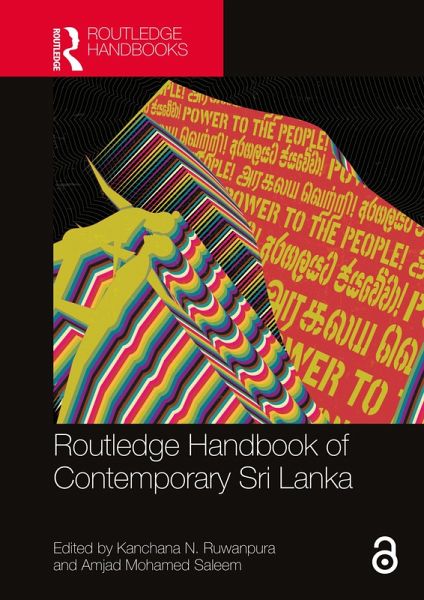
The Routledge Handbook of Contemporary Sri Lanka offers a comprehensive survey of issues facing the island country and an overview delineating some key moments in the country's contemporary polity, economy, and sociality.
This book outlines aspects and influences foundational to understanding a country defined by its economic and political turmoil, and rift with public distrust in today's shifting geopolitics. Chapters by various established scholars highlight this book's pivotal contribution in situating Sri Lanka's turmoil and deprivation in this current conjuncture.
The handbook is structured in seven parts:
Each part includes on average six chapters covering the social sciences and humanities to survey emerging and cutting-edge areas of the study of Sri Lanka. Multi-disciplinary in focus, the book also includes an introductory section and concluding section, which creates the space and platform for senior, mid-ranking, and junior academics to engage in dynamic conversation with each other about contemporary Sri Lanka. Including scholarship from Sri Lankan experts, the handbook creates academic output, which chimes with broader calls in academia on decolonising the academic landscape.
An important reference work, this handbook will be of interest to scholars and students from wideranging academic disciplines and a focus on Sri Lanka, Asian and South Asian studies, sociology, environmental politics, development, labour, management, political economy and anthropology.
The Open Access version of this book, available at http://www.taylorfrancis.com, has been made available under a Creative Commons Attribution-Non Commercial-No Derivatives (CC-BY-NC-ND) 4.0 license.
This book outlines aspects and influences foundational to understanding a country defined by its economic and political turmoil, and rift with public distrust in today's shifting geopolitics. Chapters by various established scholars highlight this book's pivotal contribution in situating Sri Lanka's turmoil and deprivation in this current conjuncture.
The handbook is structured in seven parts:
- Nations and Nationalism
- Politics, State and Institutions
- Economy and Political Economy
- Work and Life
- Environment and Environmental Politics
- Society, Social Systems, and Culture
- Moment of Flux, Looking Ahead
Each part includes on average six chapters covering the social sciences and humanities to survey emerging and cutting-edge areas of the study of Sri Lanka. Multi-disciplinary in focus, the book also includes an introductory section and concluding section, which creates the space and platform for senior, mid-ranking, and junior academics to engage in dynamic conversation with each other about contemporary Sri Lanka. Including scholarship from Sri Lankan experts, the handbook creates academic output, which chimes with broader calls in academia on decolonising the academic landscape.
An important reference work, this handbook will be of interest to scholars and students from wideranging academic disciplines and a focus on Sri Lanka, Asian and South Asian studies, sociology, environmental politics, development, labour, management, political economy and anthropology.
The Open Access version of this book, available at http://www.taylorfrancis.com, has been made available under a Creative Commons Attribution-Non Commercial-No Derivatives (CC-BY-NC-ND) 4.0 license.
Dieser Download kann aus rechtlichen Gründen nur mit Rechnungsadresse in A, B, BG, CY, CZ, D, DK, EW, E, FIN, F, GR, HR, H, IRL, I, LT, L, LR, M, NL, PL, P, R, S, SLO, SK ausgeliefert werden.
"Sri Lanka is at the cross-roads on many fronts. The Routledge Handbook of Contemporary Sri Lanka comes at as a boon to researchers on these different fronts by identifying issues involved in the many problems that confront Sri Lanka. The problems of Sri Lanka reflect the conditions in many developing countries. It is befuddled with economic crises resulting from inability to service sovereign debts, unresolved ethnic crises fomented by chauvinist leaders, heavy corruption that depletes the national treasury, a political shift towards authoritarianism, environmental depletion, drug problems, pervasive criminal violence and other situations of social disruption. These different areas are covered by leading experts. This superbly written research handbook serves as a tool to study not only Sri Lanka but to compare its problems with other developing states with similar problems. It serves as an introduction to scholars new to the field and as a book that provides fresh insights into different aspects of social and economic life in the island to the established researchers. It will remain the best guide to research on aspects of socio-economic issues in Sri Lanka."
Muthucumaraswamy Sornarajah, Emeritus Professor of Law, National University of Singapore
"This excellent and important volume brings together a broad range of contemporary scholars in a hard-hitting, multi-disciplinary analysis of Sri Lanka's current political and economic malaise. Thirty-five original chapters carefully and critically delineate the multiple factors which converged in the 2022 anti-government "struggle" (aragalaya) and its subsequent repression, and cautiously point the way forward to greater political, economic, social and environmental justice in Sri Lanka. This unique collection will be valuable to everyone who wants to understand Sri Lanka's contemporary situation, and indispensable both to scholars who study it and to policy-makers who attempt to redress it."
Jonathan S. Walters, Professor of Religion and George Hudson Ball Endowed Chair of Humanities, Whitman College, USA
"This is a valuable reference book on a country that defies easy readings. Sri Lanka is today in flux navigating political turmoil, environmental degradation, ethnic tensions, and economic hardships due to an unprecedented collapse of the economy. This volume of 35 essays and reflections captures this moment in all its unevenness, shedding light on the ambiguities that lace Sri Lankan society. The book moves from chapters dissecting nationalism, politics, and institutions to more specific topics on the economy and political economy, labour, environmental tensions and social and cultural formations. The contributions are sharp, well researched, theoretically informed and seamlessly connected. While different approaches and positions are represented, they share a commitment to an equitable, just, and ecologically sensitive country to be forged in the future. This is an inspiring volume and a reliable source for anyone interested in Sri Lanka today."
Nira Wickramasinghe, Chair and Professor of Modern South Asian Studies, Leiden University, The Netherlands
"[This book] describes itself as "a comprehensive survey of issues facing [Sri Lanka]." While it certainly does that, evidenced by the multitude of topics discussed by highly qualified authors, to simply call it a "handbook" is an understatement. The book is not merely "here is Sri Lanka and its issues." It is an indictment of the mistakes, spanning decades in some cases, that have led Sri Lanka to where it is today. [...] The book, spanning many topics, is best suited for readers familiar with the basics of the Sri Lankan context, especially those with a social science, humanities, or political science background. It is strongly critical of colonial influences and the Sinhala-Buddhist, patriarchal status quo in Sri Lanka. Furthermore, it is a summary of academic literature on its various topics, evident in the tendency to cite secondary literature throughout the chapters. [...] It is a one-stop shop that provides readers with a clear picture of current academic thinking on a diverse set of topics. From there, they can delve further into the subjects with the rich lists of sources in the references. Considering the dire situation in which Sri Lanka finds itself, it needs its citizens to have greater literacy in its affairs, both past and current. The Routledge Handbook is a fine step in that direction. "
G.A. Abayaratna, University of Colombo Review (Series III), Vol.5, No.2, 2024
"Once among the most promising societies in the Global South, Sri Lanka has been beset by daunting problems for decades. Readers interested in social scientific studies describing its current situation will find value in the many contributions on economic, environmental, and health policy in this collection. Essays detailing the sovereign debt crisis, agricultural labor conditions, multiple social inequalities, wetlands governance, health care provision, and urban development are particularly good. Chapters examining politics directly focus on the development of constitutional authority and issues of national and minority identities."
J. C. Hickman, Berry College, USA
Muthucumaraswamy Sornarajah, Emeritus Professor of Law, National University of Singapore
"This excellent and important volume brings together a broad range of contemporary scholars in a hard-hitting, multi-disciplinary analysis of Sri Lanka's current political and economic malaise. Thirty-five original chapters carefully and critically delineate the multiple factors which converged in the 2022 anti-government "struggle" (aragalaya) and its subsequent repression, and cautiously point the way forward to greater political, economic, social and environmental justice in Sri Lanka. This unique collection will be valuable to everyone who wants to understand Sri Lanka's contemporary situation, and indispensable both to scholars who study it and to policy-makers who attempt to redress it."
Jonathan S. Walters, Professor of Religion and George Hudson Ball Endowed Chair of Humanities, Whitman College, USA
"This is a valuable reference book on a country that defies easy readings. Sri Lanka is today in flux navigating political turmoil, environmental degradation, ethnic tensions, and economic hardships due to an unprecedented collapse of the economy. This volume of 35 essays and reflections captures this moment in all its unevenness, shedding light on the ambiguities that lace Sri Lankan society. The book moves from chapters dissecting nationalism, politics, and institutions to more specific topics on the economy and political economy, labour, environmental tensions and social and cultural formations. The contributions are sharp, well researched, theoretically informed and seamlessly connected. While different approaches and positions are represented, they share a commitment to an equitable, just, and ecologically sensitive country to be forged in the future. This is an inspiring volume and a reliable source for anyone interested in Sri Lanka today."
Nira Wickramasinghe, Chair and Professor of Modern South Asian Studies, Leiden University, The Netherlands
"[This book] describes itself as "a comprehensive survey of issues facing [Sri Lanka]." While it certainly does that, evidenced by the multitude of topics discussed by highly qualified authors, to simply call it a "handbook" is an understatement. The book is not merely "here is Sri Lanka and its issues." It is an indictment of the mistakes, spanning decades in some cases, that have led Sri Lanka to where it is today. [...] The book, spanning many topics, is best suited for readers familiar with the basics of the Sri Lankan context, especially those with a social science, humanities, or political science background. It is strongly critical of colonial influences and the Sinhala-Buddhist, patriarchal status quo in Sri Lanka. Furthermore, it is a summary of academic literature on its various topics, evident in the tendency to cite secondary literature throughout the chapters. [...] It is a one-stop shop that provides readers with a clear picture of current academic thinking on a diverse set of topics. From there, they can delve further into the subjects with the rich lists of sources in the references. Considering the dire situation in which Sri Lanka finds itself, it needs its citizens to have greater literacy in its affairs, both past and current. The Routledge Handbook is a fine step in that direction. "
G.A. Abayaratna, University of Colombo Review (Series III), Vol.5, No.2, 2024
"Once among the most promising societies in the Global South, Sri Lanka has been beset by daunting problems for decades. Readers interested in social scientific studies describing its current situation will find value in the many contributions on economic, environmental, and health policy in this collection. Essays detailing the sovereign debt crisis, agricultural labor conditions, multiple social inequalities, wetlands governance, health care provision, and urban development are particularly good. Chapters examining politics directly focus on the development of constitutional authority and issues of national and minority identities."
J. C. Hickman, Berry College, USA