46,95 €
inkl. MwSt.
Sofort per Download lieferbar
23 °P sammeln

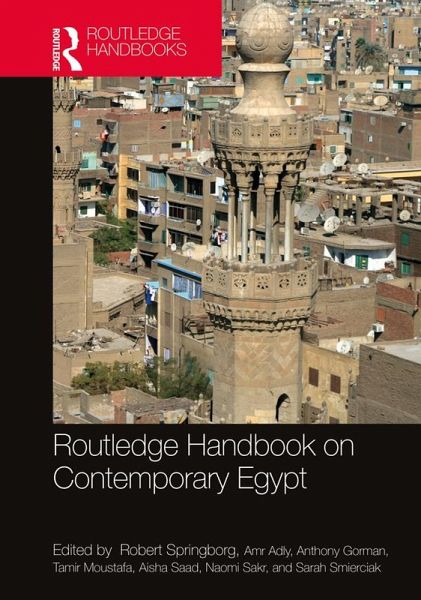
Investigating key features of contemporary Egypt, this volume includes Egypt's modern history, politics, economics, the legal system, environment, and its media and modes of cultural expression. It examines Egypt's capacities to meet developmental challenges, ranging from responding to globalization and regional competition to generating sufficient economic growth and political inclusion to accommodate the interests and demands of a rapidly growing population.
The macrohistory of Egypt is complemented by the microhistories of specific institutions and processes that constitute separate sections in this handbook. The chapters revolve around political economy: it is shaped by the people and their abilities, political and legal institutions, organization of the economy, natural and built environments, and culture and communication. Politics has been overwhelmingly authoritarian and coercive since the military seized power in 1952; consequently, the contributions address both the causes and consequences of unbalanced civil-military relations, military rule, and persisting authoritarianism in the political society.
This multidisciplinary handbook serves a dual purpose of introducing readers to Egypt's history and contemporary political economy and as a comprehensive key resource for postgraduate students and academics interested in modern Egypt.
The macrohistory of Egypt is complemented by the microhistories of specific institutions and processes that constitute separate sections in this handbook. The chapters revolve around political economy: it is shaped by the people and their abilities, political and legal institutions, organization of the economy, natural and built environments, and culture and communication. Politics has been overwhelmingly authoritarian and coercive since the military seized power in 1952; consequently, the contributions address both the causes and consequences of unbalanced civil-military relations, military rule, and persisting authoritarianism in the political society.
This multidisciplinary handbook serves a dual purpose of introducing readers to Egypt's history and contemporary political economy and as a comprehensive key resource for postgraduate students and academics interested in modern Egypt.
Dieser Download kann aus rechtlichen Gründen nur mit Rechnungsadresse in A, B, BG, CY, CZ, D, DK, EW, E, FIN, F, GR, HR, H, IRL, I, LT, L, LR, M, NL, PL, P, R, S, SLO, SK ausgeliefert werden.
"Dr. Robert Springborg, is a respected American scholar of the Middle East who has published or co-authored many books on Egypt and the region. For this volume, he has assembled a team of thirty-six other authors, all of whom have excellent credentials [...] The reader [...] will come away with the impression that the authors all know their individual topics extremely well. As someone who has lived in Egypt and followed developments there for decades, I learned many new facts from this book. [...] This volume presents a wealth of accurate information on a variety of topics related to Egypt."
William A. Rugh, Arab Media & Society, July 2021
William A. Rugh, Arab Media & Society, July 2021