42,95 €
42,95 €
inkl. MwSt.
Sofort per Download lieferbar

21 °P sammeln
42,95 €
Als Download kaufen
42,95 €
inkl. MwSt.
Sofort per Download lieferbar
21 °P sammeln
Jetzt verschenken
Alle Infos zum eBook verschenken
42,95 €
inkl. MwSt.
Sofort per Download lieferbar
Alle Infos zum eBook verschenken
21 °P sammeln

Andere Kunden interessierten sich auch für
") Ruling the Mongols of Manchuria (eBook, PDF)42,95 €
Ruling the Mongols of Manchuria (eBook, PDF)42,95 €") China and the Mongols (eBook, ePUB)37,95 €
China and the Mongols (eBook, ePUB)37,95 €") Chinese Government Leaders in Manchukuo, 1931-1937 (eBook, ePUB)39,95 €
Chinese Government Leaders in Manchukuo, 1931-1937 (eBook, ePUB)39,95 €") Manchuria (eBook, ePUB)33,95 €
Manchuria (eBook, ePUB)33,95 €") Empires of the Silk Road (eBook, ePUB)11,95 €
Empires of the Silk Road (eBook, ePUB)11,95 €") Taiwanese Identity in the 21st Century (eBook, ePUB)55,95 €
Taiwanese Identity in the 21st Century (eBook, ePUB)55,95 €") Life and Death in the Garden (eBook, ePUB)34,95 €
Life and Death in the Garden (eBook, ePUB)34,95 €



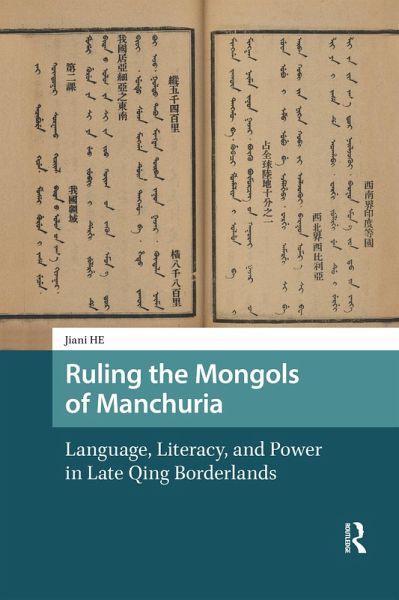
At the turn of the twentieth century, the Jirim League witnessed a linguistic struggle between Manchu, Mongol, Chinese, Japanese, and Russian powers. The Qing Empire envisioned a trilingual educational system, with the aim of improving the Jirim Mongols' ability to read Chinese, Manchu, and Mongolian. Through this policy, the Qing sought to transform loyal imperial subjects into modern patriotic nationals and incorporate them into an integrated and united China under a Manchu constitutional monarchy. The late Qing's language policy and strategy for ruling the Mongols of Manchuria was an attempt to address the enduring multilingual legacies in Qing administration and people's everyday life, growing local ethnic tensions, cross-boundary connections, imperial rivalries, and the rise of new ideas concerning nation, modern state, and international relations in East Asia. This book challenges the notion of Chinese language reform as a story of linear progression towards national monolingualism, highlights the power of multilingualism in Chinese nationalist discourse from a peripheral, non-Han Chinese perspective, and questions the extent to which national languages dominate the writing of history.
Dieser Download kann aus rechtlichen Gründen nur mit Rechnungsadresse in A, B, BG, CY, CZ, D, DK, EW, E, FIN, F, GR, HR, H, IRL, I, LT, L, LR, M, NL, PL, P, R, S, SLO, SK ausgeliefert werden.