44,95 €
inkl. MwSt.
Sofort per Download lieferbar
22 °P sammeln

Andere Kunden interessierten sich auch für
") The Routledge Handbook of Soviet and Russian Military Studies (eBook, ePUB)51,95 €
The Routledge Handbook of Soviet and Russian Military Studies (eBook, ePUB)51,95 €") Russian Cyber Operations (eBook, ePUB)24,95 €
Russian Cyber Operations (eBook, ePUB)24,95 €") Strategic Challenges in the Baltic Sea Region (eBook, ePUB)44,95 €
Strategic Challenges in the Baltic Sea Region (eBook, ePUB)44,95 €") The Russia-Ukraine War of 2022 (eBook, ePUB)44,95 €
The Russia-Ukraine War of 2022 (eBook, ePUB)44,95 €") NATO's Return to Europe (eBook, ePUB)27,95 €
NATO's Return to Europe (eBook, ePUB)27,95 €") The Russian Understanding of War (eBook, ePUB)24,95 €
The Russian Understanding of War (eBook, ePUB)24,95 €") NATO in Search of a Vision (eBook, ePUB)44,95 €
NATO in Search of a Vision (eBook, ePUB)44,95 €


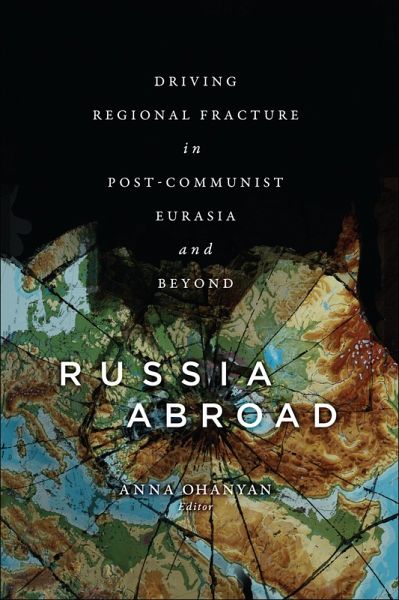
While we know a great deal about the benefits of regional integration, there is a knowledge gap when it comes to areas with weak, dysfunctional, or nonexistent regional fabric in political and economic life. Further, deliberate un-regioning, applied by actors external as well as internal to a region, has also gone unnoticed despite its increasingly sophisticated modern application by Russia in its peripheries.
This volume helps us understand what Anna Ohanyan calls fractured regions and their consequences for contemporary global security. Ohanyan introduces a theory of regional fracture to explain how and why regions come apart, consolidate dysfunctional ties within the region, and foster weak states. Russia Abroad specifically examines how Russia employs regional fracture as a strategy to keep states on its periphery in Eurasia and the Middle East weak and in Russia's orbit. It argues that the level of regional maturity in Russia's vast vicinities is an important determinant of Russian foreign policy in the emergent multipolar world order.
Many of these fractured regions become global security threats because weak states are more likely to be hubs of transnational crime, havens for militants, or sites of protracted conflict.
The regional fracture theory is offered as a fresh perspective about the post-American world and a way to broaden international relations scholarship on comparative regionalism.
This volume helps us understand what Anna Ohanyan calls fractured regions and their consequences for contemporary global security. Ohanyan introduces a theory of regional fracture to explain how and why regions come apart, consolidate dysfunctional ties within the region, and foster weak states. Russia Abroad specifically examines how Russia employs regional fracture as a strategy to keep states on its periphery in Eurasia and the Middle East weak and in Russia's orbit. It argues that the level of regional maturity in Russia's vast vicinities is an important determinant of Russian foreign policy in the emergent multipolar world order.
Many of these fractured regions become global security threats because weak states are more likely to be hubs of transnational crime, havens for militants, or sites of protracted conflict.
The regional fracture theory is offered as a fresh perspective about the post-American world and a way to broaden international relations scholarship on comparative regionalism.
Dieser Download kann aus rechtlichen Gründen nur mit Rechnungsadresse in A, D ausgeliefert werden.