0,00 €
0,00 €
inkl. MwSt.
Sofort per Download lieferbar

0 °P sammeln
0,00 €
Als Download kaufen
0,00 €
inkl. MwSt.
Sofort per Download lieferbar
0 °P sammeln
Jetzt verschenken
Alle Infos zum eBook verschenken
0,00 €
inkl. MwSt.
Sofort per Download lieferbar
Alle Infos zum eBook verschenken
0 °P sammeln

Andere Kunden interessierten sich auch für
") The EU and the South Caucasus: European Neighborhood Policies between Eclecticism and Pragmatism, 1991-2021 (eBook, PDF)26,99 €
The EU and the South Caucasus: European Neighborhood Policies between Eclecticism and Pragmatism, 1991-2021 (eBook, PDF)26,99 € Geopolitical Rivalries in the "Common Neighborhood" (eBook, PDF)26,99 €
") EU Energy and Climate Policy after COVID-19 and the Invasion of Ukraine (eBook, PDF)42,95 €
EU Energy and Climate Policy after COVID-19 and the Invasion of Ukraine (eBook, PDF)42,95 €") The EU's Common Foreign and Security Policy (eBook, PDF)29,95 €
The EU's Common Foreign and Security Policy (eBook, PDF)29,95 €") The EU and the European Security Strategy (eBook, PDF)29,95 €
The EU and the European Security Strategy (eBook, PDF)29,95 €") Understanding the EU's Norm and Policy Diffusion in ASEAN through Trade and Security Cooperation (eBook, PDF)42,95 €
Understanding the EU's Norm and Policy Diffusion in ASEAN through Trade and Security Cooperation (eBook, PDF)42,95 €") The Empowerment of EU Agencies in EU Border Management (eBook, PDF)42,95 €
The Empowerment of EU Agencies in EU Border Management (eBook, PDF)42,95 €







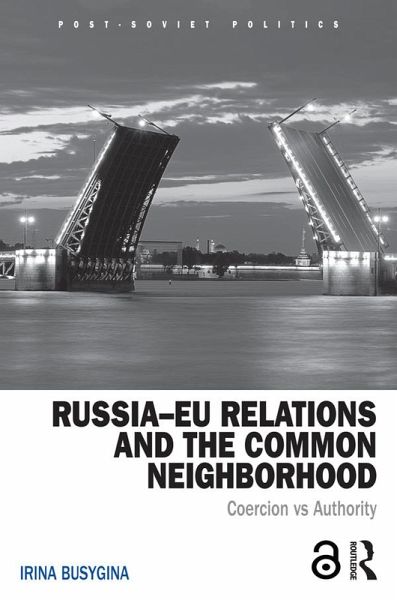
Examining Russia-EU relations in terms of the forms and types of power tools they use, this book argues that the deteriorating relations between Russia and the EU lie in the deep differences in their preferences for the international status quo. These different approaches, combined with economic interdependence and geographic proximity, means both parties experience significant difficulties in shaping strategy and formulating agendas with regards to each other.
The Russian leadership is well aware of the EU's "authority orientation" but fails to reliably predict foreign policy at the EU level, whilst the EU realizes Russia's "coercive orientation" in general, but cannot predict when and where coercive tools will be used next. Russia is gradually realizing the importance of authority, while the EU sees the necessity of coercion tools for coping with certain challenges. The learning process is ongoing but the basic distinction remains unchanged and so their approaches cannot be reconciled as long as both actors exist in their current form.
Using a theoretical framework and case studies including Belarus, Georgia and Ukraine, Busygina examines the possibilities and constraints that arise when the "power of authority" and the "power of coercion" interact with each other, and how this interaction affects third parties.
The Russian leadership is well aware of the EU's "authority orientation" but fails to reliably predict foreign policy at the EU level, whilst the EU realizes Russia's "coercive orientation" in general, but cannot predict when and where coercive tools will be used next. Russia is gradually realizing the importance of authority, while the EU sees the necessity of coercion tools for coping with certain challenges. The learning process is ongoing but the basic distinction remains unchanged and so their approaches cannot be reconciled as long as both actors exist in their current form.
Using a theoretical framework and case studies including Belarus, Georgia and Ukraine, Busygina examines the possibilities and constraints that arise when the "power of authority" and the "power of coercion" interact with each other, and how this interaction affects third parties.
Dieser Download kann aus rechtlichen Gründen nur mit Rechnungsadresse in A, B, BG, CY, CZ, D, DK, EW, E, FIN, F, GR, HR, H, IRL, I, LT, L, LR, M, NL, PL, P, R, S, SLO, SK ausgeliefert werden.