Sie sind bereits eingeloggt. Klicken Sie auf 2. tolino select Abo, um fortzufahren.
Bitte loggen Sie sich zunächst in Ihr Kundenkonto ein oder registrieren Sie sich bei bücher.de, um das eBook-Abo tolino select nutzen zu können.
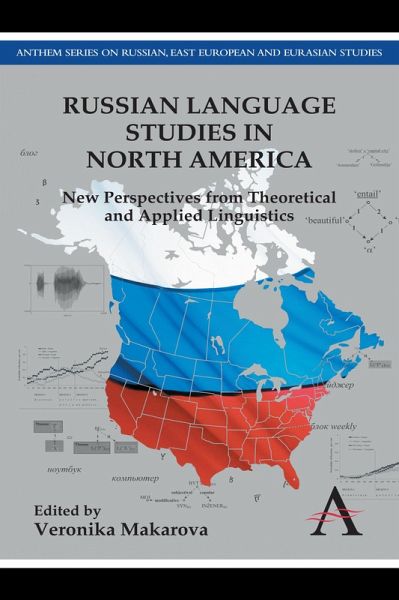
'Russian Language Studies in North America: New Perspectives from Theoretical and Applied Linguistics' offers a unique collection of research papers representing current directions in Russian language studies in Canada and the United States. Traditionally, Slavic and Russian studies in these countries have centered around literature, history, politics and culture. This volume reflects recent changes in Russian studies by focusing on language structure, language use and teaching methodology. The volume brings together several generations of scholars, from young promising researchers to those with long-established reputations in the field.…mehr
'Russian Language Studies in North America: New Perspectives from Theoretical and Applied Linguistics' offers a unique collection of research papers representing current directions in Russian language studies in Canada and the United States. Traditionally, Slavic and Russian studies in these countries have centered around literature, history, politics and culture. This volume reflects recent changes in Russian studies by focusing on language structure, language use and teaching methodology. The volume brings together several generations of scholars, from young promising researchers to those with long-established reputations in the field.
Dieser Download kann aus rechtlichen Gründen nur mit Rechnungsadresse in A, D ausgeliefert werden.
Die Herstellerinformationen sind derzeit nicht verfügbar.
Autorenporträt
Veronika Makarova is an Associate Professor in the Department of Languages and Linguistics and the Interdisciplinary Linguistics Program Chair at the University of Saskatchewan, Canada.
Inhaltsangabe
List of Tables and Figures; Introduction – Veronika Makarova; PART ONE: LANGUAGE STRUCTURES AND THEIR INTERFACE; 1. Phonetics. Tracing Emotions in Russian Vowels – Veronika Makarova and Valery A. Petrushin; 2. Phonology. Vowel–Zero Alternations in Russian Prepositions: Prosodic Constituency and Productivity – Lev Blumenfeld; 3. Morphology and Lexicology Interface. Latest Russian Neologisms: The Next Step towards Analytism? – Julia Rochtchina; 4. Syntax. Bi-nominative Sentences in Russian – Igor Mel’čuk; 5. Psycholinguistics. The Effect of Grammatical Gender in Russian Spoken-Word Recognition – Irina A. Sekerina; PART TWO: APPLIED LINGUISTIC AND SOCIOLINGUISTIC ANALYSIS; 6. Communicative Language Teaching and Russian: The Current State of the Field – William J. Comer; 7. Low-Proficiency Heritage Speakers of Russian: Their Interlanguage System as a Basis for Fast Language (Re)Building – Alla Smyslova; 8. Superior Speakers or “Super” Russian: OPI Guidelines Revisited – Ludmila Isurin; 9. Who Am I?: Cultural Identities among Russian-Speaking Immigrants of the Third (and Fourth?) Wave and their Effects on Language Attitudes – David R. Andrews; 10. Russian Language History in Canada. Doukhobor Internal and External Migrations: Effects on Language Development and Structure – Gunter Schaarschmidt; Afterword – Veronika Makarova; Index
Es gelten unsere Allgemeinen Geschäftsbedingungen: www.buecher.de/agb
Impressum
www.buecher.de ist ein Internetauftritt der buecher.de internetstores GmbH
Geschäftsführung: Monica Sawhney | Roland Kölbl | Günter Hilger
Sitz der Gesellschaft: Batheyer Straße 115 - 117, 58099 Hagen
Postanschrift: Bürgermeister-Wegele-Str. 12, 86167 Augsburg
Amtsgericht Hagen HRB 13257
Steuernummer: 321/5800/1497
USt-IdNr: DE450055826