41,95 €
41,95 €
inkl. MwSt.
Sofort per Download lieferbar

21 °P sammeln
41,95 €
Als Download kaufen
41,95 €
inkl. MwSt.
Sofort per Download lieferbar
21 °P sammeln
Jetzt verschenken
Alle Infos zum eBook verschenken
41,95 €
inkl. MwSt.
Sofort per Download lieferbar
Alle Infos zum eBook verschenken
21 °P sammeln

Andere Kunden interessierten sich auch für
") Russia's Geoeconomic Strategy for a Greater Eurasia (eBook, ePUB)41,95 €
Russia's Geoeconomic Strategy for a Greater Eurasia (eBook, ePUB)41,95 €") India's Economic Corridor Initiatives (eBook, PDF)42,95 €
India's Economic Corridor Initiatives (eBook, PDF)42,95 €") Mega-regionalism and Great Power Geo-economic Competition (eBook, PDF)41,95 €
Mega-regionalism and Great Power Geo-economic Competition (eBook, PDF)41,95 €") The Trade-Development Nexus in the European Union (eBook, PDF)41,95 €
The Trade-Development Nexus in the European Union (eBook, PDF)41,95 €") Coping with Power Dispersion? (eBook, PDF)45,95 €
Coping with Power Dispersion? (eBook, PDF)45,95 €") Transatlantic Regulation (eBook, PDF)39,95 €
Transatlantic Regulation (eBook, PDF)39,95 €") Brexit and the Future of the European Union (eBook, PDF)39,95 €
Brexit and the Future of the European Union (eBook, PDF)39,95 €


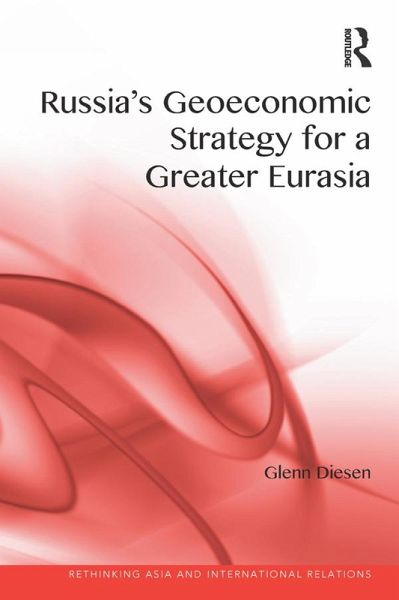
Moscow has progressively replaced geopolitics with geoeconomics as power is recognised to derive from the state's ability to establish a privileged position in strategic markets and transportation corridors. The objective is to bridge the vast Eurasian continent to reposition Russia from the periphery of Europe and Asia to the centre of a new constellation. Moscow's 'Greater Europe' ambition of the previous decades produced a failed Western-centric foreign policy culminating in excessive dependence on the West. Instead of constructing Gorbachev's 'Common European Home', the 'leaning-to-one-side' approach deprived Russia of the market value and leverage needed to negotiate a more favourable and inclusive Europe. Eurasian integration offers Russia the opportunity to address this 'overreliance' on the West by using the Russia's position as a Eurasian state to advance its influence in Europe.
Offering an account steeped in Russian economic statecraft and power politics, this book offers a rare glimpse into the dominant narratives of Russian strategic culture. It explains how the country's outlook adjusts to the ongoing realignment towards Asia while engaging in a parallel assessment of Russia's interactions with other significant actors. The author offers discussion both on Russian responses and adaptations to the current power transition and the ways in which the economic initiatives promoted by Moscow in its project for a 'Greater Eurasia' reflect the entrepreneurial foreign policy strategy of the country.
Offering an account steeped in Russian economic statecraft and power politics, this book offers a rare glimpse into the dominant narratives of Russian strategic culture. It explains how the country's outlook adjusts to the ongoing realignment towards Asia while engaging in a parallel assessment of Russia's interactions with other significant actors. The author offers discussion both on Russian responses and adaptations to the current power transition and the ways in which the economic initiatives promoted by Moscow in its project for a 'Greater Eurasia' reflect the entrepreneurial foreign policy strategy of the country.
Dieser Download kann aus rechtlichen Gründen nur mit Rechnungsadresse in A, B, BG, CY, CZ, D, DK, EW, E, FIN, F, GR, HR, H, IRL, I, LT, L, LR, M, NL, PL, P, R, S, SLO, SK ausgeliefert werden.