Sie sind bereits eingeloggt. Klicken Sie auf 2. tolino select Abo, um fortzufahren.
Bitte loggen Sie sich zunächst in Ihr Kundenkonto ein oder registrieren Sie sich bei bücher.de, um das eBook-Abo tolino select nutzen zu können.
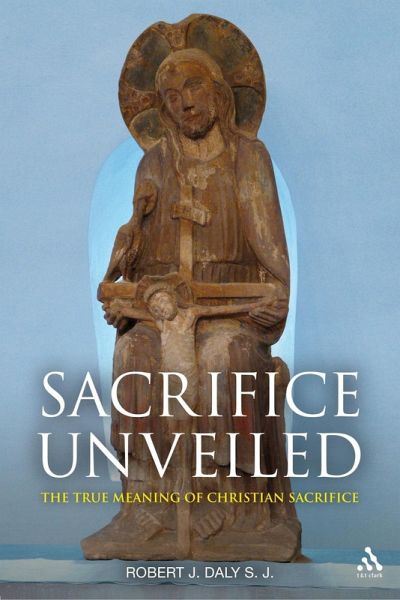
Most ideas of sacrifice, even specifically Christian ideas, as we saw in the Reformation controversies, have something to do with deprivation or destruction. But this is not authentic Christian sacrifice. Authentic Christian sacrifice, and ultimately all true sacrifice (whether one is conscious of it or not) begins with the self-offering of the Father in the gift-sending of the Son, continues with the loving "response" of the Son, in his humanity, and in the Spirit, to the Father and for us, and finally, begins to become real in our world when human beings, in the power of the same Spirit that…mehr
Most ideas of sacrifice, even specifically Christian ideas, as we saw in the Reformation controversies, have something to do with deprivation or destruction. But this is not authentic Christian sacrifice. Authentic Christian sacrifice, and ultimately all true sacrifice (whether one is conscious of it or not) begins with the self-offering of the Father in the gift-sending of the Son, continues with the loving "response" of the Son, in his humanity, and in the Spirit, to the Father and for us, and finally, begins to become real in our world when human beings, in the power of the same Spirit that was in Jesus, respond to love with love, and thus begin to enter into that perfectly loving, totally self-giving relationship that is the life of the triune God. The origins of this are in the Hebrew Bible, its revelatory high-points in Jesus and Paul, and its working out in the life of the Church, especially its Eucharistic Prayers. Special attention will be paid to the atonement, not just because atonement and sacrifice are often synonymous, but also because traditional atonement theology is the source of distortions that continue to plague Christian thinking about sacrifice. After exploring the possibility of finding a phenomenology of sacrificial atonement in Girardian mimetic theory, the book will end with some suggestions on how to communicate its findings to people likely to be put off from the outset by the negative connotations associated with "sacrifice."
Die Herstellerinformationen sind derzeit nicht verfügbar.
Autorenporträt
Robert J. Daly, S.J., Emeritus Professor of Theology at Boston College, is the author of Christian Sacrificeand The Origins of the Christian Doctrine of Sacrifice. His recent articles, mostly in Theological Studies, have focused on Eucharist, sacrifice, and atonement.
Inhaltsangabe
FOREWORD: The Problem of Christian Sacrifice A brief description of how this book came about. PART ONE: Unveiling Sacrifice 1. The Many Meanings of Sacrifice 2. A Trinitarian View of Sacrifice 3. The Sacrifice of the Mass Conclusion BRIDGE 1.A: Sacrifice in the Ancient World and in the Hebrew Scriptures 1. Sacrifice in the Ancient World 2. General Theory of Sacrifice 3. Sacrifice in the Hebrew Scriptures 4. From the Old Testament to the New BRIDGE 1.B: Sacrifice in the New Testament 1. The Synoptic Gospels 2. The Acts of the Apostles 3. The Pauline Theology of Sacrifice 4. The Temple as Community in Qumran and the New Testament 5. The Epistle to the Hebrews 6. The Gospel and First Letter of John 7. The History-of-Religions Context of "Worship in Spirit and in Truth" 8. The Book of Revelation 9. Summary of New Testament Teaching on Christian Sacrifice Excursus: Spiritualization and Institutionalization BRIDGE 1.C: Sacrifice in the Fathers of the Church 1. The Early Writings 2. The Apologists: Justin and Athenagoras 3. Irenaeus of Lyons 4. Hippolytus of Rome 5. The Early Treatises on the Passover 6. The Second-Century Acts of the Martyrs 7. The Alexandrian Tradition I: The Antecedents: Philo and Barnabas 8. The Alexandrian Tradition II: Christianity Coming of Age: Clement and Origen 9. Augustine of Hippo Conclusion PART TWO: Atonement and Sacrifice: The Distorting Veils - 99 1. Paul and Problems with Sacrificial Atonement 2. Anselm, Abelard, Aquinas, and Juliana of Norwich 3. The Sacrifice of the Mass 4. Sacrifice and the Reformation BRIDGE 2.A: Post-Reformation and Modernity: Two Contrasting Poles 1. Sacrifice among the Writers of Late (Post-Enlightenment) Modernity 2. Moment-of-Consecration Theology 3. Mass-Stipend Theology: Theology in Transition BRIDGE 2.B: Liturgical Renewal and Ecumenism 1. The Monasteries 2. Mystery Theology 3. Liturgical Conferences, Institutes, Academies and Societies 4. A High Point of Restorationism: The New Worship Books 5. The Constitution on the Sacred Liturgy BRIDGE 2.C: Sacrifice and Girardian Mimetic Theory: The End of Sacrifice? 1. General Introduction to Girardian Mimetic Theory 2. Grand Narratives in a Postmodern Age 3. Desire 4. Original Sin as Disordered Desire 5. Original Sin: A Scientific View 6. René Girard as Christian Theorist 7. A Phenomenology of Redemption: Imitate the Desire of Jesus 8. A Post-Scientific Epilogue PART THREE: Unveiling Sacrifice:
Es gelten unsere Allgemeinen Geschäftsbedingungen: www.buecher.de/agb
Impressum
www.buecher.de ist ein Internetauftritt der buecher.de internetstores GmbH
Geschäftsführung: Monica Sawhney | Roland Kölbl | Günter Hilger
Sitz der Gesellschaft: Batheyer Straße 115 - 117, 58099 Hagen
Postanschrift: Bürgermeister-Wegele-Str. 12, 86167 Augsburg
Amtsgericht Hagen HRB 13257
Steuernummer: 321/5800/1497
USt-IdNr: DE450055826