3,49 €
inkl. MwSt.
Sofort per Download lieferbar
0 °P sammeln

Andere Kunden interessierten sich auch für
 (eBook, ePUB)") Sandstorms And Deals: Donald Trump's Middle East Gamble (Essays, Reports and Analyses) (eBook, ePUB)26,99 €
Sandstorms And Deals: Donald Trump's Middle East Gamble (Essays, Reports and Analyses) (eBook, ePUB)26,99 €") Why Nuclear-Armed Pakistan Has Not Fought a War Against Israel in the 2020s? (eBook, ePUB)5,49 €
Why Nuclear-Armed Pakistan Has Not Fought a War Against Israel in the 2020s? (eBook, ePUB)5,49 €") The Solution of Gaza by Trump 2025 (eBook, ePUB)8,99 €
The Solution of Gaza by Trump 2025 (eBook, ePUB)8,99 €") Indecision Points (eBook, ePUB)11,95 €
Indecision Points (eBook, ePUB)11,95 €") Decision Points (eBook, ePUB)39,95 €
Decision Points (eBook, ePUB)39,95 €") Reflecting on the GCC Crisis (eBook, ePUB)41,95 €
Reflecting on the GCC Crisis (eBook, ePUB)41,95 €") The New Crusades (eBook, ePUB)17,95 €
The New Crusades (eBook, ePUB)17,95 €


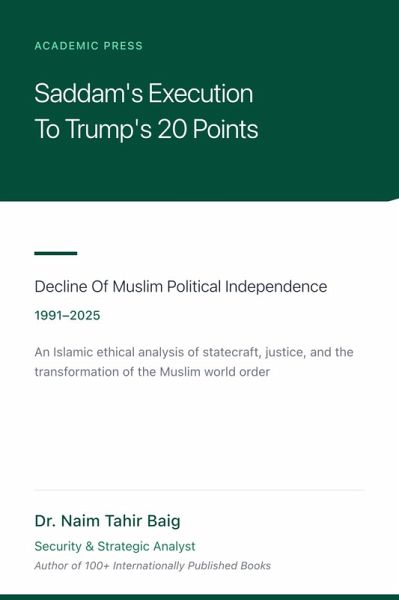
Saddam's Execution to Trump's 20 Points: Decline of Muslim Political Independence (1991-2025)
This research work chronicles the systematic erosion of Muslim political independence over three and a half transformative decades, from the aftermath of Operation Desert Storm in 1991 to the acceptance of President Donald Trump's 20-point Gaza peace plan in 2025. Through rigorous Islamic ethical analysis grounded in Qur'anic principles and authenticated hadith, Dr. Naim Tahir Baig traces how Muslim-majority nations transitioned from limited but real political agency to complete client status under Western hegemony.
The book documents twelve critical junctures that reveal this decline: the 1990-1991 Gulf War, which exposed Muslim nations' inability to resolve intra-regional conflicts without Western military intervention; the devastating decade of sanctions on Iraq (1991-2003) that killed an estimated 500,000 children while Muslim governments remained complicit through silence; the Oslo Accords era (1993-2000) that began the quiet abandonment of Palestinian rights; the 2003 invasion of Iraq, where Muslim states actively facilitated aggression against a fellow Muslim nation; Saddam Hussein's execution in 2006, conducted without regard for Islamic legal requirements; the Arab Spring (2011-2013), which revealed fatal internal divisions and lack of coherent governance vision; the rise and fall of ISIS (2014-2019), demonstrating both ideological crisis and military dependence on non-Muslim powers; the Abraham Accords (2020), representing open normalization with Israel without Palestinian statehood; and finally, the 2025 acceptance of Trump's peace plan, where Arab nations endorsed a framework designed without Palestinian input and chaired by a foreign power.
What distinguishes this work is its application of classical Islamic principles of governance-justice ('adl), consultation (shura), unity of the Muslim community (ummah), protection of the vulnerable (mustad'afin), covenant-keeping ('ahd), and trustworthiness (amanah)-as the measuring standard by which all actors, Muslim and non-Muslim alike, are evaluated. Dr. Baig argues compellingly that the decline resulted not primarily from Western power, but from Muslim nations' systematic abandonment of these foundational Islamic principles in domestic governance and international relations.
The analysis is unflinchingly self-critical, applying Islamic standards most rigorously to Muslim leaders who invoked Islam rhetorically while violating it practically. Drawing on primary sources including UN Security Council resolutions, Arab League communiqués, official government statements, authenticated Islamic scholarship, and peer-reviewed academic research, the book documents how authoritarian governance structures, economic dependency, virulent sectarian divisions, endemic corruption, and educational failures created the conditions for complete political subordination.
Yet this is not a work of despair. The final chapter offers practical, Islamically-grounded solutions: establishing genuine shura-based governance systems that hold leaders accountable; achieving economic independence through Muslim cooperation and integration; transcending Sunni-Shia sectarianism through emphasis on shared principles; fighting corruption as an Islamic obligation; and reforming education to produce citizens who understand both Islamic heritage and modern challenges.
Saddam's Execution to Trump's 20 Points is essential reading for anyone seeking to understand not merely what happened to Muslim political agency over the past three decades, but why it happened-and what can be done to reverse this trajectory. It challenges comfortable narratives on all sides, offering instead a clear-eyed assessment grounded in Islamic principles, historical evidence, and moral courage.
This research work chronicles the systematic erosion of Muslim political independence over three and a half transformative decades, from the aftermath of Operation Desert Storm in 1991 to the acceptance of President Donald Trump's 20-point Gaza peace plan in 2025. Through rigorous Islamic ethical analysis grounded in Qur'anic principles and authenticated hadith, Dr. Naim Tahir Baig traces how Muslim-majority nations transitioned from limited but real political agency to complete client status under Western hegemony.
The book documents twelve critical junctures that reveal this decline: the 1990-1991 Gulf War, which exposed Muslim nations' inability to resolve intra-regional conflicts without Western military intervention; the devastating decade of sanctions on Iraq (1991-2003) that killed an estimated 500,000 children while Muslim governments remained complicit through silence; the Oslo Accords era (1993-2000) that began the quiet abandonment of Palestinian rights; the 2003 invasion of Iraq, where Muslim states actively facilitated aggression against a fellow Muslim nation; Saddam Hussein's execution in 2006, conducted without regard for Islamic legal requirements; the Arab Spring (2011-2013), which revealed fatal internal divisions and lack of coherent governance vision; the rise and fall of ISIS (2014-2019), demonstrating both ideological crisis and military dependence on non-Muslim powers; the Abraham Accords (2020), representing open normalization with Israel without Palestinian statehood; and finally, the 2025 acceptance of Trump's peace plan, where Arab nations endorsed a framework designed without Palestinian input and chaired by a foreign power.
What distinguishes this work is its application of classical Islamic principles of governance-justice ('adl), consultation (shura), unity of the Muslim community (ummah), protection of the vulnerable (mustad'afin), covenant-keeping ('ahd), and trustworthiness (amanah)-as the measuring standard by which all actors, Muslim and non-Muslim alike, are evaluated. Dr. Baig argues compellingly that the decline resulted not primarily from Western power, but from Muslim nations' systematic abandonment of these foundational Islamic principles in domestic governance and international relations.
The analysis is unflinchingly self-critical, applying Islamic standards most rigorously to Muslim leaders who invoked Islam rhetorically while violating it practically. Drawing on primary sources including UN Security Council resolutions, Arab League communiqués, official government statements, authenticated Islamic scholarship, and peer-reviewed academic research, the book documents how authoritarian governance structures, economic dependency, virulent sectarian divisions, endemic corruption, and educational failures created the conditions for complete political subordination.
Yet this is not a work of despair. The final chapter offers practical, Islamically-grounded solutions: establishing genuine shura-based governance systems that hold leaders accountable; achieving economic independence through Muslim cooperation and integration; transcending Sunni-Shia sectarianism through emphasis on shared principles; fighting corruption as an Islamic obligation; and reforming education to produce citizens who understand both Islamic heritage and modern challenges.
Saddam's Execution to Trump's 20 Points is essential reading for anyone seeking to understand not merely what happened to Muslim political agency over the past three decades, but why it happened-and what can be done to reverse this trajectory. It challenges comfortable narratives on all sides, offering instead a clear-eyed assessment grounded in Islamic principles, historical evidence, and moral courage.
Dieser Download kann aus rechtlichen Gründen nur mit Rechnungsadresse in A, B, CY, CZ, D, DK, EW, E, FIN, F, GR, H, IRL, I, LT, L, LR, M, NL, PL, P, R, S, SLO, SK ausgeliefert werden.