11,95 €
inkl. MwSt.
Sofort per Download lieferbar
6 °P sammeln

Andere Kunden interessierten sich auch für
") Pacific Crucible (eBook, ePUB)12,95 €
Pacific Crucible (eBook, ePUB)12,95 €") When the War Was Over (eBook, ePUB)10,99 €
When the War Was Over (eBook, ePUB)10,99 € (eBook, ePUB)") Patton and Rommel: The True Story of Two Generations (The Life and Death of George Smith Patton Jr., #5) (eBook, ePUB)0,00 €
Patton and Rommel: The True Story of Two Generations (The Life and Death of George Smith Patton Jr., #5) (eBook, ePUB)0,00 €") The Taking of K-129 (eBook, ePUB)3,99 €
The Taking of K-129 (eBook, ePUB)3,99 €") Submarine and Anti-submarine (eBook, ePUB)2,00 €
Submarine and Anti-submarine (eBook, ePUB)2,00 €") Surprise Attack (eBook, ePUB)16,95 €
Surprise Attack (eBook, ePUB)16,95 €") The Company (eBook, ePUB)11,95 €
The Company (eBook, ePUB)11,95 €






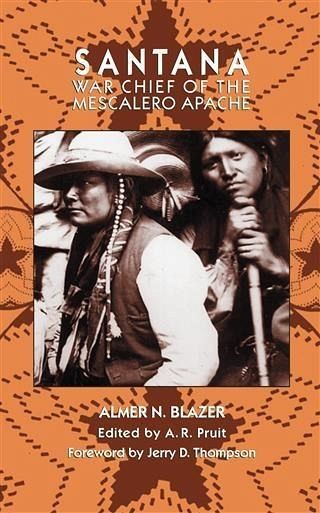
Although known as the most cunning, vicious Mescalero leader waging war against the Anglo invaders, Santana's most notable contribution relates to making peace rather than war. Earlier than most of his contemporaries, Santana understood in the 1860s that the probable result of continued struggle with the white man would be annihilation of his people. He recognized also that he would be among the first to die as punishment for his warlike behavior. He disappeared into the mountains of southern New Mexico for ten years until the army was focused on a new generation of war chiefs. Santana reappeared, led his followers into peace and negotiated a reservation on their traditional homeland in the south-central New Mexico mountains.
Santana needed to learn about the ways of the white world and needed a friend who
would intercede for him with the alien culture. He found that friend in J. H. Blazer, who operated La Manquina (later known as Blazer's Mill) on the Rio Tularoso, a half-mile downstream from the present-day Mescalero Agency. Though their initial meeting in late 1867 or early 1868 was tension-fraught, the two men learned to like and respect each other. They developed an abiding friendship that lasted until Santana succumbed to pneumonia in the winter of 1877. J. H.'s 14-year-old son, Almer N.' Blazer arrived at La Manquina the year after Santana's death. Almer spent the greater part of his life on the Mescalero reservation. He lived among and became friendly with its people, achieving fluency in Apache and Spanish. Almer quickly became "as much Indian as white man," in the words of a grandson. Noted historians of the Mescalero, C. L Sonnichsen and Eve Ball, agreed that Almer Blazer knew and understood the Mescalero better than any other Anglo.
This book includes accounts of J. H. Blazer's interactions with Santana and descriptions of certain aspects of Mescalero life and culture: These come from Almer Blazer's own experiences, and from stories told him by his Mescalero acquaintances, some of them Santana's contemporaries. This is not a conventional academic history. Many events and conversations related herein cannot be verified: They came from memories of people with no written language and an accordingly strong oral tradition. What has resulted is a very believable account, verifiable in many important particulars, of a remarkable man and aspects of the Mescalero culture that shaped him. ·
Perhaps this book could more correctly be called an oral history. Like the Mescalero people he lived among Almer Blazer was a storyteller. By his own admission, he --like all good storytellers -- sometimes fleshed out stories. Using elements derived from his experience that seemed reasonable and appropriate, he made the fundamental elements more comprehensible to his audience. While these characteristics may disappoint the academic-minded, a different reader may find the manuscript more alive and more appealing than conventional historical accounts.
Santana's' absence from historical records led to a spate of early rejections of the
mancript by publishing houses: they questioned whether Santana existed at all. In the late 1980s, Dr. A.: R. Pruit, assisted by Dr. Jerry Thompson, undertook an investigation of army records that successfully documented Santana's existence after 1868. Dr. Pruit's comments and biographical notes on J. H. and Almer N. Blazer are incorporated as appendices in the current volume.
Santana needed to learn about the ways of the white world and needed a friend who
would intercede for him with the alien culture. He found that friend in J. H. Blazer, who operated La Manquina (later known as Blazer's Mill) on the Rio Tularoso, a half-mile downstream from the present-day Mescalero Agency. Though their initial meeting in late 1867 or early 1868 was tension-fraught, the two men learned to like and respect each other. They developed an abiding friendship that lasted until Santana succumbed to pneumonia in the winter of 1877. J. H.'s 14-year-old son, Almer N.' Blazer arrived at La Manquina the year after Santana's death. Almer spent the greater part of his life on the Mescalero reservation. He lived among and became friendly with its people, achieving fluency in Apache and Spanish. Almer quickly became "as much Indian as white man," in the words of a grandson. Noted historians of the Mescalero, C. L Sonnichsen and Eve Ball, agreed that Almer Blazer knew and understood the Mescalero better than any other Anglo.
This book includes accounts of J. H. Blazer's interactions with Santana and descriptions of certain aspects of Mescalero life and culture: These come from Almer Blazer's own experiences, and from stories told him by his Mescalero acquaintances, some of them Santana's contemporaries. This is not a conventional academic history. Many events and conversations related herein cannot be verified: They came from memories of people with no written language and an accordingly strong oral tradition. What has resulted is a very believable account, verifiable in many important particulars, of a remarkable man and aspects of the Mescalero culture that shaped him. ·
Perhaps this book could more correctly be called an oral history. Like the Mescalero people he lived among Almer Blazer was a storyteller. By his own admission, he --like all good storytellers -- sometimes fleshed out stories. Using elements derived from his experience that seemed reasonable and appropriate, he made the fundamental elements more comprehensible to his audience. While these characteristics may disappoint the academic-minded, a different reader may find the manuscript more alive and more appealing than conventional historical accounts.
Santana's' absence from historical records led to a spate of early rejections of the
mancript by publishing houses: they questioned whether Santana existed at all. In the late 1980s, Dr. A.: R. Pruit, assisted by Dr. Jerry Thompson, undertook an investigation of army records that successfully documented Santana's existence after 1868. Dr. Pruit's comments and biographical notes on J. H. and Almer N. Blazer are incorporated as appendices in the current volume.
Dieser Download kann aus rechtlichen Gründen nur mit Rechnungsadresse in A, B, BG, CY, CZ, D, DK, EW, E, FIN, F, GR, HR, H, IRL, I, LT, L, LR, M, NL, PL, P, R, S, SLO, SK ausgeliefert werden.