42,95 €
42,95 €
inkl. MwSt.
Sofort per Download lieferbar

21 °P sammeln
42,95 €
Als Download kaufen
42,95 €
inkl. MwSt.
Sofort per Download lieferbar
21 °P sammeln
Jetzt verschenken
Alle Infos zum eBook verschenken
42,95 €
inkl. MwSt.
Sofort per Download lieferbar
Alle Infos zum eBook verschenken
21 °P sammeln

Andere Kunden interessierten sich auch für
") Saudi-Israeli Normalization (eBook, PDF)42,95 €
Saudi-Israeli Normalization (eBook, PDF)42,95 €") Saudi Arabia in the Anglo-American Press (eBook, ePUB)39,95 €
Saudi Arabia in the Anglo-American Press (eBook, ePUB)39,95 €") Law and the Arab-Israeli Conflict (eBook, ePUB)37,95 €
Law and the Arab-Israeli Conflict (eBook, ePUB)37,95 €") The Early Israeli Settler Movement (eBook, ePUB)42,95 €
The Early Israeli Settler Movement (eBook, ePUB)42,95 €") The New-Old Land of Israel (eBook, ePUB)52,95 €
The New-Old Land of Israel (eBook, ePUB)52,95 €") Iranian-Saudi Rivalry since 1979 (eBook, ePUB)24,95 €
Iranian-Saudi Rivalry since 1979 (eBook, ePUB)24,95 € (eBook, ePUB)") Can We Talk About Israel? (Revised and Updated) (eBook, ePUB)9,95 €
Can We Talk About Israel? (Revised and Updated) (eBook, ePUB)9,95 €




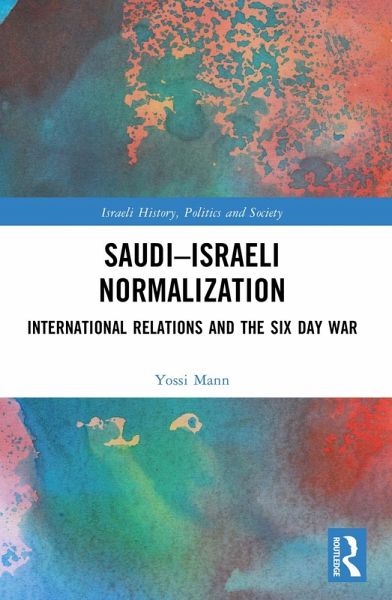
Offering the first in-depth exploration of Saudi Arabia's political, social, and diplomatic role in the Six-Day War, this study sheds light on the kingdom's overlooked but pivotal contributions to one of the most consequential conflicts in modern Middle Eastern history. Drawing on both newly available material and a fresh analytical approach, it also highlights how the war influenced Saudi Arabia's evolving identity and regional positioning.
Far from being a peripheral actor, Saudi Arabia played a crucial role in shaping Arab responses to Israel during and after the 1967 war-from economic warfare via the oil embargo to internal shifts in leadership, ideology, and governance. Drawing on archival material and extensive analysis, this book situates Saudi Arabia's wartime decisions within the broader framework of its internal transformations and evolving regional ambitions. Through a close examination of King Faisal's leadership, domestic tensions, oil diplomacy, and the kingdom's strategic recalibration, this study reveals how the Six-Day War became a pivotal moment in Saudi Arabia's emergence as a regional power. It shows how the conflict reshaped Saudi-Israeli dynamics and laid the foundation for the kingdom's complex-and at times contradictory-approach to Israel in the decades that followed.
Essential reading for scholars and students of Middle East politics, Gulf studies, and international relations, this book also appeals to anyone seeking to understand the historical roots of today's Saudi-Israeli engagement. It offers fresh insights into the intersection of domestic upheaval and regional diplomacy.
Far from being a peripheral actor, Saudi Arabia played a crucial role in shaping Arab responses to Israel during and after the 1967 war-from economic warfare via the oil embargo to internal shifts in leadership, ideology, and governance. Drawing on archival material and extensive analysis, this book situates Saudi Arabia's wartime decisions within the broader framework of its internal transformations and evolving regional ambitions. Through a close examination of King Faisal's leadership, domestic tensions, oil diplomacy, and the kingdom's strategic recalibration, this study reveals how the Six-Day War became a pivotal moment in Saudi Arabia's emergence as a regional power. It shows how the conflict reshaped Saudi-Israeli dynamics and laid the foundation for the kingdom's complex-and at times contradictory-approach to Israel in the decades that followed.
Essential reading for scholars and students of Middle East politics, Gulf studies, and international relations, this book also appeals to anyone seeking to understand the historical roots of today's Saudi-Israeli engagement. It offers fresh insights into the intersection of domestic upheaval and regional diplomacy.
Dieser Download kann aus rechtlichen Gründen nur mit Rechnungsadresse in A, B, BG, CY, CZ, D, DK, EW, E, FIN, F, GR, HR, H, IRL, I, LT, L, LR, M, NL, PL, P, R, S, SLO, SK ausgeliefert werden.