Sie sind bereits eingeloggt. Klicken Sie auf 2. tolino select Abo, um fortzufahren.
Bitte loggen Sie sich zunächst in Ihr Kundenkonto ein oder registrieren Sie sich bei bücher.de, um das eBook-Abo tolino select nutzen zu können.
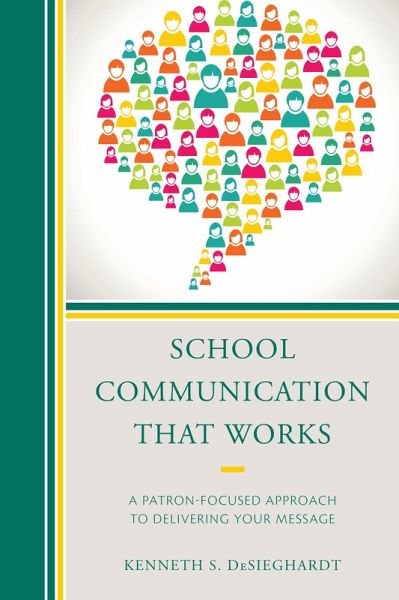
The foundation of successful school district/community relationships is communication that focuses on what most interests average residents - no matter what you, as a school district leader, believe they should be interested in. Communicate in their language, at their level of interest, and at their pace, and you and your patrons will soon be headed in the same direction more often than not. Based on more than 20 years of research data, and filled with real-life examples and specific recommendations, School Communication that Works explains what your patrons really care about (and wish you'd…mehr
The foundation of successful school district/community relationships is communication that focuses on what most interests average residents - no matter what you, as a school district leader, believe they should be interested in. Communicate in their language, at their level of interest, and at their pace, and you and your patrons will soon be headed in the same direction more often than not. Based on more than 20 years of research data, and filled with real-life examples and specific recommendations, School Communication that Works explains what your patrons really care about (and wish you'd talk more about), what they are only somewhat interested in, and what makes them tune you out. Highlights of the book: An easy-to-follow organizing principle (The Patron Information Pyramid(TM)) that sorts school communication topics into three categories - Essential, Important, and As-Needed.Case studies that show the findings in action, drawn from more than 20 years of research with school districts of all shapes, sizes and levels of wealth.Information targeted to special communications situations, such as Hot Topics and Crisis Communications, all focused on how patrons would like their school districts to communicateA summary of Key Points at the end of each chapter, providing an "at a glance" review of the information shared.
Die Herstellerinformationen sind derzeit nicht verfügbar.
Autorenporträt
Ken DeSieghardt is the CEO and partner of Patron Insight, Inc. (www.patroninsight.com), a company that has been helping school districts large, small and in between, better understand how to effectively communicate with their patrons since 1992. Ken is a graduate of The University of Kansas, and he received his research training from The Burke Institute.
Inhaltsangabe
School Communication that Works Table of Contents Preface Introduction Chapter 1 - The 80/20 rule Chapter 2 - Patron-speak versus district-speak: A primer Chapter 3 - The Patron Information Pyramid Chapter 4 - The Top Tier of the Pyramid: Essential Information Chapter 5 - Essential Information: Value for the tax dollars spent Chapter 6 - Essential Information: Quality of school facilities Chapter 7 - Essential Information: Quality of teachers Chapter 8 - Essential Information: Quality of education Chapter 9 - Essential Information: Preparation of students for the future Chapter 10 - Essential Information: Ongoing communication between the district and patrons Chapter 11 - The Middle Tier of the Pyramid: Important Information Chapter 12 - Important Information: Performance of principals Chapter 13 - Important Information: Student safety Chapter 14 - Important Information: Class sizes Chapter 15 - Important Information: Technology available to students in the classroom Chapter 16 - Important Information: District promises made and fulfilled Chapter 17 - Important Information: Spending balance Chapter 18 - The Bottom Tier of the Pyramid: As-Needed Information Chapter 19 - As-Needed Information: Extracurricular activities Chapter 20 - As-Needed Information: Courtesy and responsiveness of staff members (in schools or in the Central Office) Chapter 21 - As-Needed Information: Performance of the Superintendent and the Board of Education Chapter 22 - Special situations: Handling hot topics Chapter 23 - Special situations: What patrons say they want and need in a crisis Chapter 24 - Making your school communications program work Chapter 25 - Some final thoughts
Es gelten unsere Allgemeinen Geschäftsbedingungen: www.buecher.de/agb
Impressum
www.buecher.de ist ein Internetauftritt der buecher.de internetstores GmbH
Geschäftsführung: Monica Sawhney | Roland Kölbl | Günter Hilger
Sitz der Gesellschaft: Batheyer Straße 115 - 117, 58099 Hagen
Postanschrift: Bürgermeister-Wegele-Str. 12, 86167 Augsburg
Amtsgericht Hagen HRB 13257
Steuernummer: 321/5800/1497
USt-IdNr: DE450055826