27,95 €
inkl. MwSt.
Sofort per Download lieferbar
14 °P sammeln

Andere Kunden interessierten sich auch für
") The Greek Philosophers (eBook, PDF)40,95 €
The Greek Philosophers (eBook, PDF)40,95 €") Socrates and his Demise (eBook, PDF)24,95 €
Socrates and his Demise (eBook, PDF)24,95 €") Routledge Library Editions: Socrates (eBook, PDF)544,95 €
Routledge Library Editions: Socrates (eBook, PDF)544,95 €") Blindness and Reorientation (eBook, PDF)34,95 €
Blindness and Reorientation (eBook, PDF)34,95 €") The Oxford Handbook of Hellenistic Philosophy (eBook, PDF)75,95 €
The Oxford Handbook of Hellenistic Philosophy (eBook, PDF)75,95 €") The Oxford Handbook of Aristotle (eBook, PDF)22,95 €
The Oxford Handbook of Aristotle (eBook, PDF)22,95 €") Varieties of Happiness (eBook, PDF)49,95 €
Varieties of Happiness (eBook, PDF)49,95 €







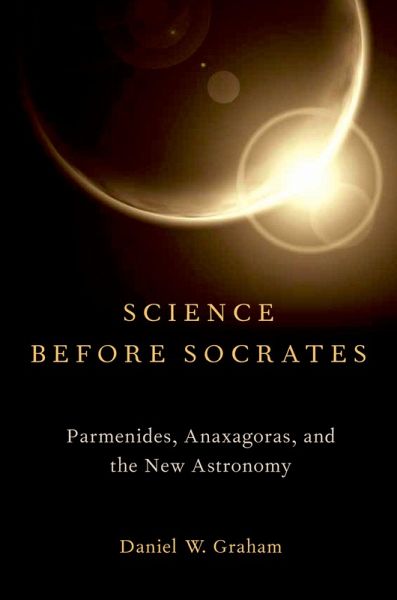
In Science before Socrates, Daniel Graham argues against the prevalent belief that the Presocratic philosophers did not produce any empirical science and that the first major Greek science, astronomy, did not develop until at least the time of Plato. Instead, Graham proposes that the advances made by Presocratic philosophers in the study of astronomy deserve to be considered as scientific contributions. Whereas philosophers of the sixth century BC treated astronomical phenomena as ephemeral events continuous with weather processes, those of the fifth century treated heavenly bodies as independent stony masses whirled in a cosmic vortex. Two historic events help to date and account for the change: a solar eclipse in 478 BC and a meteoroid that fell to earth around 466. Both events influenced Anaxagoras, who transformed insights from Parmenides into explanations of lunar and solar eclipses, meteors, and rainbows. Virtually all philosophers came to accept Anaxagoras' theory of lunar light and eclipses. Aristotle endorsed Anaxagoras' theory of eclipses as a paradigm of scientific explanation. Anaxagoras' theories launched a geometrical approach to astronomy and were accepted as foundational principles by all mathematical astronomers from Aristarchus to Ptolemy to Copernicus and Galileo-and to the present day.
Dieser Download kann aus rechtlichen Gründen nur mit Rechnungsadresse in A, B, BG, CY, CZ, D, DK, EW, E, FIN, F, GR, HR, H, IRL, I, LT, L, LR, M, NL, PL, P, R, S, SLO, SK ausgeliefert werden.