Sie sind bereits eingeloggt. Klicken Sie auf 2. tolino select Abo, um fortzufahren.
Bitte loggen Sie sich zunächst in Ihr Kundenkonto ein oder registrieren Sie sich bei bücher.de, um das eBook-Abo tolino select nutzen zu können.
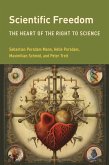
Scientists are supposed to have freedom to choose and conduct their experiments and exchange their ideas. Known as scientific freedom, this idea has been implicated in both wonderful and terrible scientific discoveries. Although it is not new, it has great relevance to contemporary society. In a time of genetic editing, global warming, and a worldwide pandemic, the question of how freely science is and should be conducted is one that has significant practical consequences. Drawing on rigorous interdisciplinary methods, this book defines the concept of scientific freedom, tells its story, and…mehr
Scientists are supposed to have freedom to choose and conduct their experiments and exchange their ideas. Known as scientific freedom, this idea has been implicated in both wonderful and terrible scientific discoveries. Although it is not new, it has great relevance to contemporary society. In a time of genetic editing, global warming, and a worldwide pandemic, the question of how freely science is and should be conducted is one that has significant practical consequences. Drawing on rigorous interdisciplinary methods, this book defines the concept of scientific freedom, tells its story, and asks on what basis scientific freedom is best justified. Based on international human rights law and philosophy, the authors develop a model of scientific freedom as a constitutive element of the human right to enjoy the benefits of the progress of science and its applications. To illustrate its usefulness, they then test and apply this model to a real-life and real-time case study, as well as to two highly important international human rights instruments.
Die Herstellerinformationen sind derzeit nicht verfügbar.
Autorenporträt
Sebastian Porsdam Mann is research fellow at the Faculty of Law, Oxford, and a researcher at UEHIRO Centre of Ethics, University of Oxford. He is Chief Academic Officer at A&BC Consulting and Postdoc fellow at Harvard Medical School Center for Bioethics.
Inhaltsangabe
Opening Vignette: Artificial Intelligence and Introduction PART ONE: Setting the Scene and Providing the Necessary Historical Background Chapter 1: Historical Background and Key Concepts And Definitions Chapter 2: A Systematic Review of The Scholarly Literature On Scientific Freedom: Methods And Results Chapter 3: Taking Human Right to the Next Level: The Right to Science, History and Content Chapter 4: Scientific Freedom: How Does It Relate to Scientific Dissemination and International Co-Operation? PART TWO: SAFIRES: A Conceptual Model of Scientific Freedom Obligations under International Human Rights Law Chapter 5: The SAFIRES (Scientific and Academic Freedom as Integral elements of the Right to Enjoy the benefits of Science) Model Chapter 6: The Scope of 'Science' and 'Scientific Freedom' in Three Human Rights Instruments PART THREE: Working with Scientific Freedom And The Right To Science In Practice Chapter 7: On Drafting the General Comment on Science (2013-2020): A Personal Account, Mikel Mancisidor Chapter 8: Litigating the Right to Science before the CESCR: the View from the Trenches, Cesare P.R. Romano Chapter 9: Defending Science, Knowledge and Facts: The UN And Scientific Freedom Of Expression, Malene Nielsen and Carsten Staur Appendices Index
Es gelten unsere Allgemeinen Geschäftsbedingungen: www.buecher.de/agb
Impressum
www.buecher.de ist ein Internetauftritt der buecher.de internetstores GmbH
Geschäftsführung: Monica Sawhney | Roland Kölbl | Günter Hilger
Sitz der Gesellschaft: Batheyer Straße 115 - 117, 58099 Hagen
Postanschrift: Bürgermeister-Wegele-Str. 12, 86167 Augsburg
Amtsgericht Hagen HRB 13257
Steuernummer: 321/5800/1497
USt-IdNr: DE450055826