Sie sind bereits eingeloggt. Klicken Sie auf 2. tolino select Abo, um fortzufahren.
Bitte loggen Sie sich zunächst in Ihr Kundenkonto ein oder registrieren Sie sich bei bücher.de, um das eBook-Abo tolino select nutzen zu können.
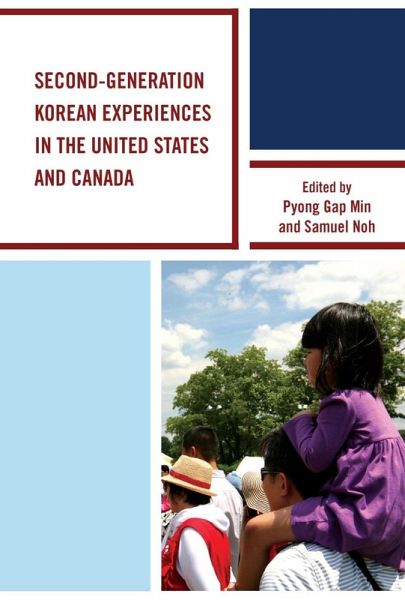
In Second-Generation Korean Experiences in the United States and Canada, Pyong Gap Min and Samuel Noh have compiled a comprehensive examination of 1.5- and second-generation Korean experiences in the United States and Canada. As the chapters demonstrate, comparing younger-generation Koreans with first-generation immigrants highlights generational changes in many areas of life. The contributors discuss socioeconomic attainments, self-employment rates and business patterns, marital patterns, participation in electoral politics, ethnic insularity among Korean Protestants, the relationship between…mehr
In Second-Generation Korean Experiences in the United States and Canada, Pyong Gap Min and Samuel Noh have compiled a comprehensive examination of 1.5- and second-generation Korean experiences in the United States and Canada. As the chapters demonstrate, comparing younger-generation Koreans with first-generation immigrants highlights generational changes in many areas of life. The contributors discuss socioeconomic attainments, self-employment rates and business patterns, marital patterns, participation in electoral politics, ethnic insularity among Korean Protestants, the relationship between perceived discrimination and mental health, the role of ethnic identity as stress moderator, and responses to racial marginalization. Using both quantitative and qualitative data sources, this collection is unique in its examination of several different aspects of second-generation Korean experiences in the United States and Canada. An indispensable source for those scholars and students researching Korean Americans or Korean Canadians, the volume provides insight for students and scholars of minorities, migration, ethnicity and race, and identity formation.
Die Herstellerinformationen sind derzeit nicht verfügbar.
Autorenporträt
Pyong Gap Min is Distinguished Professor of Sociology at Queens College and the Graduate Center of the City University of New York and director of the Research Center for Korean Community at Queens College. Samuel Noh is professor of psychiatry at the University of Toronto, Research Scientist Emeritus at the Centre for Addiction and Mental Health, and co-director of the Social Aetiology of Mental Illness (SAMI).
Inhaltsangabe
Foreword, Yung Duk Kim Introduction, Pyong Gap Min and Samuel Noh Chapter 1: The Generational Differences in Socioeconomic Attainments of Korean Americans, ChangHwan Kim Chapter 2: Intergenerational Shift in Business Patterns among Korean Americans, Pyong Gap Min and Deborah Kim-Lu Chapter 3: Ethnic Insularity among 1.5- and Second-Generation Korean-American Protestants, Jerry Z. Park Chapter 4: The Intergenerational Differences in Marital Patterns among Korean Americans, Pyong Gap Min and Chigon Kim Chapter 5: Group Membership and Context of Participation in Electoral Politics among Korean, Chinese, and Filipino Americans, Sookhee Oh Chapter 6: Perceived Discrimination and Mental Health in Korean-Canadian Youth: Salience of Ethnic Pride as a Moderator, Il-Ho Kim, Neha Ahmed, and Samuel Noh Chapter 7: Psychological Effects of Discrimination among Korean-Canadian Youth: Role and Salience of Ethnic Identity as a Moderator, Samuel Noh, Il-Ho Kim, and Neha Ahmed Chapter 8: Coping with Racialization: Second-Generation Korean-American Responses to Racial Othering, Dae Young Kim Chapter 9: On Being a "Successful Failure": Korean-American Students and the Structural-Cultural Paradox, Nadia Y. Kim and Christine J. Oh Chapter 10: Reassessing the American Dream: Family, Culture and Educational "Success" among Korean and Chinese Americans, Angie Y. ChungandTrivina Kang Chapter 11: Korean Immigrant High School Students' Identities and Their Impact on School Learning, Minjung Ryu Chapter 12: Are Second-Generation Korean-American Women Tiger Mothers? Strategic, Transnational, and Resistant Responses to Racialized Mothering, Miliann Kang
Es gelten unsere Allgemeinen Geschäftsbedingungen: www.buecher.de/agb
Impressum
www.buecher.de ist ein Internetauftritt der buecher.de internetstores GmbH
Geschäftsführung: Monica Sawhney | Roland Kölbl | Günter Hilger
Sitz der Gesellschaft: Batheyer Straße 115 - 117, 58099 Hagen
Postanschrift: Bürgermeister-Wegele-Str. 12, 86167 Augsburg
Amtsgericht Hagen HRB 13257
Steuernummer: 321/5800/1497
USt-IdNr: DE450055826