41,95 €
41,95 €
inkl. MwSt.
Sofort per Download lieferbar

21 °P sammeln
41,95 €
Als Download kaufen
41,95 €
inkl. MwSt.
Sofort per Download lieferbar
21 °P sammeln
Jetzt verschenken
Alle Infos zum eBook verschenken
41,95 €
inkl. MwSt.
Sofort per Download lieferbar
Alle Infos zum eBook verschenken
21 °P sammeln

Andere Kunden interessierten sich auch für
") Securing Health (eBook, PDF)41,95 €
Securing Health (eBook, PDF)41,95 €") Counterterrorism Strategies in Egypt (eBook, ePUB)41,95 €
Counterterrorism Strategies in Egypt (eBook, ePUB)41,95 €") The Securitisation of Climate Change (eBook, ePUB)46,95 €
The Securitisation of Climate Change (eBook, ePUB)46,95 €") Global Health Governance (eBook, ePUB)35,95 €
Global Health Governance (eBook, ePUB)35,95 €") Arab Approaches to Conflict Resolution (eBook, ePUB)47,95 €
Arab Approaches to Conflict Resolution (eBook, ePUB)47,95 €") EU Foreign Policy, Transitional Justice and Mediation (eBook, ePUB)42,95 €
EU Foreign Policy, Transitional Justice and Mediation (eBook, ePUB)42,95 €") EU Security Policy and Crisis Management (eBook, ePUB)41,95 €
EU Security Policy and Crisis Management (eBook, ePUB)41,95 €







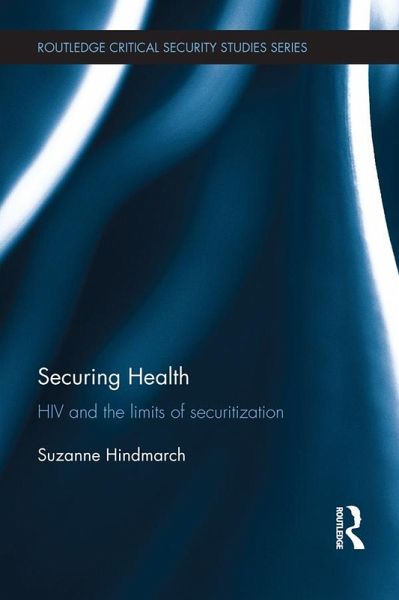
This book offers a critical inquiry into the framing of health and disease as a security issue.
In particular, the book examines what happens in the United Nations when the ostensibly 'low' politics of global health meet the 'high' politics of security, and when the logic of security comes to shape global health initiatives. It offers a critical re-assessment of efforts in the United Nations system to position HIV as a security threat with the hope that this would attract greater attention and resources for the global HIV response. The book advances securitization theory by presenting a new framework for studying HIV as a policy process, uniting several theoretical strands into a single, powerful model for empirical application. It uses this model to draw attention to important, understudied aspects of HIV securitization, including the role played by discourses about Africa, and the evolution of ideas about HIV and security as actors learned over time. On the basis of this empirically grounded assessment of how securitization works as a theory and a political strategy, the book suggests that securitization is inherently limited, and perhaps dangerous, as a strategy for 'securing' social change.
This book will be of much interest to students of critical security studies, global health, development studies, and IR in general.
In particular, the book examines what happens in the United Nations when the ostensibly 'low' politics of global health meet the 'high' politics of security, and when the logic of security comes to shape global health initiatives. It offers a critical re-assessment of efforts in the United Nations system to position HIV as a security threat with the hope that this would attract greater attention and resources for the global HIV response. The book advances securitization theory by presenting a new framework for studying HIV as a policy process, uniting several theoretical strands into a single, powerful model for empirical application. It uses this model to draw attention to important, understudied aspects of HIV securitization, including the role played by discourses about Africa, and the evolution of ideas about HIV and security as actors learned over time. On the basis of this empirically grounded assessment of how securitization works as a theory and a political strategy, the book suggests that securitization is inherently limited, and perhaps dangerous, as a strategy for 'securing' social change.
This book will be of much interest to students of critical security studies, global health, development studies, and IR in general.
Dieser Download kann aus rechtlichen Gründen nur mit Rechnungsadresse in A, B, BG, CY, CZ, D, DK, EW, E, FIN, F, GR, HR, H, IRL, I, LT, L, LR, M, NL, PL, P, R, S, SLO, SK ausgeliefert werden.