17,95 €
17,95 €
inkl. MwSt.
Sofort per Download lieferbar

9 °P sammeln
17,95 €
Als Download kaufen
17,95 €
inkl. MwSt.
Sofort per Download lieferbar
9 °P sammeln
Jetzt verschenken
Alle Infos zum eBook verschenken
17,95 €
inkl. MwSt.
Sofort per Download lieferbar
Alle Infos zum eBook verschenken
9 °P sammeln

Andere Kunden interessierten sich auch für
") Hannah Arendt and Cosmopolitanism (eBook, ePUB)70,95 €
Hannah Arendt and Cosmopolitanism (eBook, ePUB)70,95 €") Equal Citizenship and Public Reason (eBook, ePUB)16,95 €
Equal Citizenship and Public Reason (eBook, ePUB)16,95 €") The Oxford Handbook of Citizenship (eBook, ePUB)23,95 €
The Oxford Handbook of Citizenship (eBook, ePUB)23,95 €") Radical Civility (eBook, ePUB)39,95 €
Radical Civility (eBook, ePUB)39,95 €") Communitarianism and Citizenship (eBook, ePUB)42,95 €
Communitarianism and Citizenship (eBook, ePUB)42,95 €") The Democracy Reader (eBook, ePUB)37,95 €
The Democracy Reader (eBook, ePUB)37,95 €") Exploitation (eBook, ePUB)20,95 €
Exploitation (eBook, ePUB)20,95 €







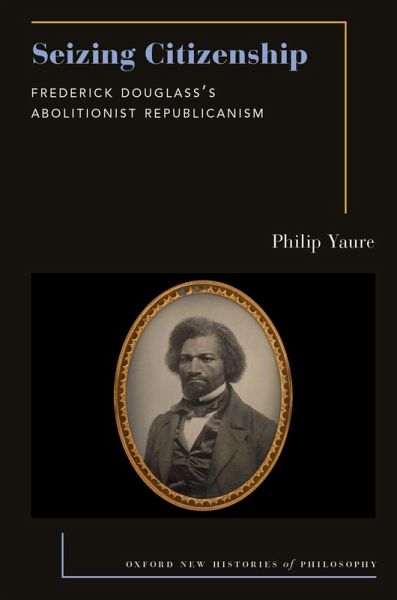
In the years leading up to the U.S. Civil War, former slave and abolitionist Frederick Douglass maintained that enslaved Black Americans were already American citizens. Through a systematic analysis of his political writings from the 1840s through the 1890s, Philip Yaure shows that Douglass' declaration of Black Americans' citizenship is the locus of a profound innovation in republican political philosophy. Seizing Citizenship argues that Frederick Douglass reimagined the republican concept of citizenship, on which persons are citizens because they contribute to the polity, to cast the everyday resistance of Black Americans against slavery and white supremacy as activity that constitutes them as American citizens. The resistance of Black Americans forged them into a people with the collective power to remake America's civic ethos in a racially just and inclusive fashion. Douglass advanced an abolitionist republicanism, on which persons seize standing as free citizens of a free polity through the struggle to dismantle the oppressive institutions that dominate and exploit them. Douglass's republican politics strives not to overcome our vulnerability to one another, but instead to deepen such vulnerability on terms conducive to our shared emancipation and collective flourishing.
Dieser Download kann aus rechtlichen Gründen nur mit Rechnungsadresse in A, B, BG, CY, CZ, D, DK, EW, E, FIN, F, GR, HR, H, IRL, I, LT, L, LR, M, NL, PL, P, R, S, SLO, SK ausgeliefert werden.