39,95 €
inkl. MwSt.
Sofort per Download lieferbar
20 °P sammeln

Andere Kunden interessierten sich auch für
") Self-Reflective Fiction and 4E Cognition (eBook, PDF)39,95 €
Self-Reflective Fiction and 4E Cognition (eBook, PDF)39,95 €") Cognition, Literature, and History (eBook, ePUB)51,95 €
Cognition, Literature, and History (eBook, ePUB)51,95 €") Cervantes and the Early Modern Mind (eBook, ePUB)41,95 €
Cervantes and the Early Modern Mind (eBook, ePUB)41,95 €") 4E Cognition and Eighteenth-Century Fiction (eBook, ePUB)44,95 €
4E Cognition and Eighteenth-Century Fiction (eBook, ePUB)44,95 €") An Introduction to Narratology (eBook, ePUB)39,95 €
An Introduction to Narratology (eBook, ePUB)39,95 €") The Routledge Companion to Literature and Emotion (eBook, ePUB)47,95 €
The Routledge Companion to Literature and Emotion (eBook, ePUB)47,95 €") Language and Law (eBook, ePUB)39,95 €
Language and Law (eBook, ePUB)39,95 €
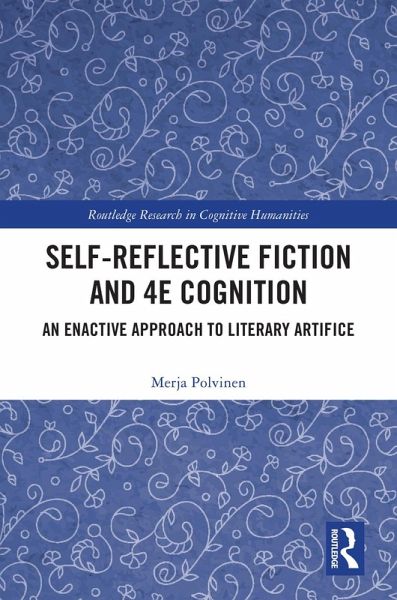
This book brings together the study of self-reflective fiction and the contemporary 4E theories of cognition in order to challenge existing cognitive-theoretical models and approaches to literary phenomena.
Polvinen presents reflective attention on artifice as an integral part of engagement with fictional narratives, rather than as an external viewpoint that would obscure immersive experiences. The detailed analyses included are both of traditionally metafictional texts by John Barth, A.S. Byatt, Dave Eggers, and Ali Smith, as well as of speculative fictions by Ted Chiang, China Miéville, Christopher Priest, and Catherynne M. Valente. Each of the chapters focuses on a specific issue of fictional cognition: on metaphorical representation, spatiality, temporality, and fictionality. As a whole, the book argues that by combining a literary and theoretically complex view of artifice with the enactive paradigm of perception and imagination, practitioners of cognitive literary studies can further sharpen their own conceptual and terminological apparatus and continue to generate fruitful hermeneutic circulation around the study of the imagination in both the sciences and the humanities.
This book will appeal to students and scholars interested in cognitive approaches to literary studies, speculative fiction, metafiction, and narrative studies.
Polvinen presents reflective attention on artifice as an integral part of engagement with fictional narratives, rather than as an external viewpoint that would obscure immersive experiences. The detailed analyses included are both of traditionally metafictional texts by John Barth, A.S. Byatt, Dave Eggers, and Ali Smith, as well as of speculative fictions by Ted Chiang, China Miéville, Christopher Priest, and Catherynne M. Valente. Each of the chapters focuses on a specific issue of fictional cognition: on metaphorical representation, spatiality, temporality, and fictionality. As a whole, the book argues that by combining a literary and theoretically complex view of artifice with the enactive paradigm of perception and imagination, practitioners of cognitive literary studies can further sharpen their own conceptual and terminological apparatus and continue to generate fruitful hermeneutic circulation around the study of the imagination in both the sciences and the humanities.
This book will appeal to students and scholars interested in cognitive approaches to literary studies, speculative fiction, metafiction, and narrative studies.
Dieser Download kann aus rechtlichen Gründen nur mit Rechnungsadresse in A, B, BG, CY, CZ, D, DK, EW, E, FIN, F, GR, HR, H, IRL, I, LT, L, LR, M, NL, PL, P, R, S, SLO, SK ausgeliefert werden.
Merja Polvinen's Self-Reflective Fiction and 4E Cognition productively challenges the idea that immersion in narrative involves losing awareness of literary form. It rethinks the act of reading by combining close discussion of speculative fiction with a sophisticated cognitive theory of narrative.
- Marco Caracciolo, Associate Professor of English, Ghent University, Belgium
Fictional worlds that pull you in by showing you how they are made, self-referential narrators and a double-take on perception through literary texts: Drawing on cutting-edge cognitive science and literary studies, Merja Polvinen lifts the curtain on how literature works its magic.
- Professor Karin Kukkonen, University of Oslo, Norway.
- Marco Caracciolo, Associate Professor of English, Ghent University, Belgium
Fictional worlds that pull you in by showing you how they are made, self-referential narrators and a double-take on perception through literary texts: Drawing on cutting-edge cognitive science and literary studies, Merja Polvinen lifts the curtain on how literature works its magic.
- Professor Karin Kukkonen, University of Oslo, Norway.