0,49 €
inkl. MwSt.
Sofort per Download lieferbar
0 °P sammeln

Andere Kunden interessierten sich auch für
 (eBook, ePUB)") Emma (Summarized Edition) (eBook, ePUB)0,49 €
Emma (Summarized Edition) (eBook, ePUB)0,49 € (eBook, ePUB)") Pride & Prejudice (Summarized Edition) (eBook, ePUB)0,49 €
Pride & Prejudice (Summarized Edition) (eBook, ePUB)0,49 € (eBook, ePUB)") Celtic Legends & Myths (Summarized Edition) (eBook, ePUB)0,49 €
Celtic Legends & Myths (Summarized Edition) (eBook, ePUB)0,49 € (eBook, ePUB)") Gone to Earth (Summarized Edition) (eBook, ePUB)0,49 €
Gone to Earth (Summarized Edition) (eBook, ePUB)0,49 € (eBook, ePUB)") Lorna Doone (Summarized Edition) (eBook, ePUB)0,49 €
Lorna Doone (Summarized Edition) (eBook, ePUB)0,49 € (eBook, ePUB)") Lord of the World (Summarized Edition) (eBook, ePUB)0,49 €
Lord of the World (Summarized Edition) (eBook, ePUB)0,49 € (eBook, ePUB)") Queen Margot (Summarized Edition) (eBook, ePUB)0,49 €
Queen Margot (Summarized Edition) (eBook, ePUB)0,49 €



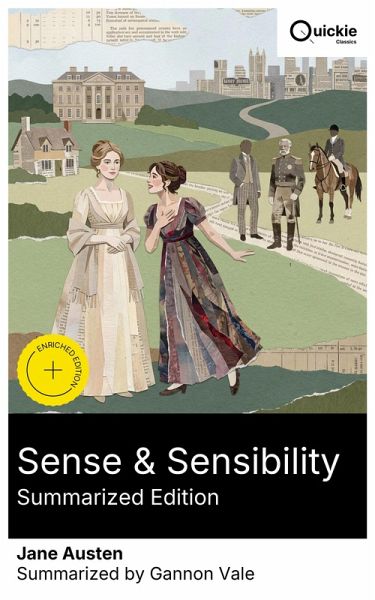
Sense & Sensibility (1811) traces Elinor and Marianne Dashwood from dispossession at Norland Park to Barton Cottage and London, staging the friction between prudence and passion in ties with Edward Ferrars, Colonel Brandon, and John Willoughby. In poised irony and early free indirect style, Austen reworks the sentimental novel into a comedy of manners alert to money, rank, and reputation, exposing entail and primogeniture as engines that commodify feeling. A clergyman's daughter from Hampshire (1775-1817), Austen began the tale in the 1790s as the epistolary "Elinor and Marianne," revising it at Chawton before publishing anonymously as "By a Lady." Family brushes with financial insecurity and long observation of gentry sociability, conduct books, and circulating-library fiction sharpen her ethical realism and her measured skepticism toward fashionable displays of sensibility. Read this novel for a lucid account of how hearts and fortunes are schooled by society. It welcomes newcomers to Austen's art while rewarding scholars of the British novel, gendered economics, and narrative technique. Wise, witty, and unsentimental about sentiment, Sense & Sensibility remains a bracing study of sisterhood, prudence, and desire under the constraints of custom, capital, and reputation. Quickie Classics summarizes timeless works with precision, preserving the author's voice and keeping the prose clear, fast, and readable-distilled, never diluted. Enriched Edition extras: Introduction · Synopsis · Historical Context · Author Biography · Brief Analysis · 4 Reflection Q&As · Editorial Footnotes.
Dieser Download kann aus rechtlichen Gründen nur mit Rechnungsadresse in A, B, BG, CY, CZ, D, DK, EW, E, FIN, F, GR, H, IRL, I, LT, L, LR, M, NL, PL, P, R, S, SLO, SK ausgeliefert werden.