0,49 €
inkl. MwSt.
Sofort per Download lieferbar
0 °P sammeln

Andere Kunden interessierten sich auch für
") Sextus Empiricus and Greek Scepticism (eBook, ePUB)1,99 €
Sextus Empiricus and Greek Scepticism (eBook, ePUB)1,99 €") Sextus Empiricus and Ancient Physics (eBook, ePUB)16,95 €
Sextus Empiricus and Ancient Physics (eBook, ePUB)16,95 €") Epistemology After Sextus Empiricus (eBook, ePUB)38,95 €
Epistemology After Sextus Empiricus (eBook, ePUB)38,95 €") Early Greek philosophy (eBook, ePUB)1,99 €
Early Greek philosophy (eBook, ePUB)1,99 €") Sextus Empiricus - Eine kleine Einführung in die pyrrhonische Skepsis (eBook, ePUB)3,99 €
Sextus Empiricus - Eine kleine Einführung in die pyrrhonische Skepsis (eBook, ePUB)3,99 €") Greek and Roman Political Ideas (eBook, ePUB)8,49 €
Greek and Roman Political Ideas (eBook, ePUB)8,49 €") Paideia: The Ideals of Greek Culture (eBook, ePUB)36,95 €
Paideia: The Ideals of Greek Culture (eBook, ePUB)36,95 €

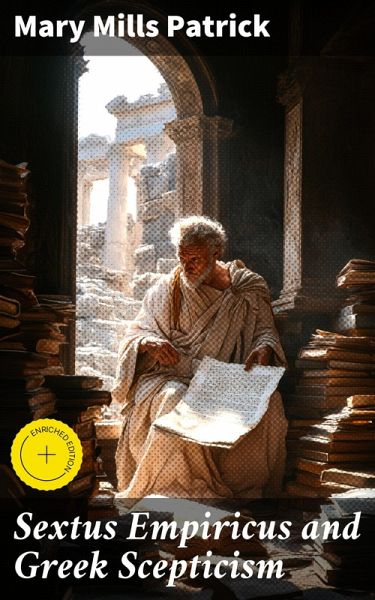
In "Sextus Empiricus and Greek Scepticism," Mary Mills Patrick provides a comprehensive analysis of the philosophical contributions of Sextus Empiricus, a pivotal figure in the development of Skepticism. Patrick deftly articulates the nuances of Empiricus's work, exploring the historical context of Hellenistic philosophy and its intellectual rivalries. Employing a meticulous literary style, she dissects key texts, illuminating the techniques employed by Empiricus to challenge dogmatic assertions and advocate for a life guided by inquiry rather than certainty. Her scholarly examination intertwines linguistic precision with philosophical rigor, making a compelling case for the relevance of Skepticism in contemporary discourse. Mary Mills Patrick, a noted scholar in ancient philosophy, is particularly known for her efforts to bring attention to marginalized voices within the philosophical canon. Educated at Brown University and the University of Chicago, her rigorous academic background informs her focus on how Skepticism shaped philosophical thought in classical antiquity. Patrick's passion for philosophical inquiry and her commitment to uncovering underlying principles made her an ideal conduit for re-examining Empiricus's contributions. This book is an essential resource for anyone interested in the history of philosophy, the evolution of Skepticism, or the intricate dialogues of Hellenistic thought. Patrick's insightful analysis not only enriches the understanding of Sextus Empiricus but also invites readers to engage with the broader implications of Skepticism in their own intellectual journeys. In this enriched edition, we have carefully created added value for your reading experience: - Hand-picked Memorable Quotes shine a spotlight on moments of literary brilliance. - Interactive footnotes clarify unusual references, historical allusions, and archaic phrases for an effortless, more informed read.
Dieser Download kann aus rechtlichen Gründen nur mit Rechnungsadresse in A, B, BG, CY, CZ, D, DK, EW, FIN, F, GR, H, IRL, I, LT, L, LR, M, NL, PL, P, R, S, SLO, SK ausgeliefert werden.