42,95 €
42,95 €
inkl. MwSt.
Sofort per Download lieferbar

21 °P sammeln
42,95 €
Als Download kaufen
42,95 €
inkl. MwSt.
Sofort per Download lieferbar
21 °P sammeln
Jetzt verschenken
Alle Infos zum eBook verschenken
42,95 €
inkl. MwSt.
Sofort per Download lieferbar
Alle Infos zum eBook verschenken
21 °P sammeln

Andere Kunden interessierten sich auch für
") Shakespeare in the World (eBook, ePUB)42,95 €
Shakespeare in the World (eBook, ePUB)42,95 €") Shakespeare and Indian Nationalism (eBook, PDF)38,95 €
Shakespeare and Indian Nationalism (eBook, PDF)38,95 €") Victorian Coral Islands of Empire, Mission, and the Boys' Adventure Novel (eBook, PDF)42,95 €
Victorian Coral Islands of Empire, Mission, and the Boys' Adventure Novel (eBook, PDF)42,95 €") At the Titan's Breakfast (eBook, PDF)26,95 €
At the Titan's Breakfast (eBook, PDF)26,95 € (eBook, PDF)") Routledge Revivals: Shakespeare and Feminist Criticism (1991) (eBook, PDF)39,95 €
Routledge Revivals: Shakespeare and Feminist Criticism (1991) (eBook, PDF)39,95 €") Childhood in the Contemporary English Novel (eBook, PDF)42,95 €
Childhood in the Contemporary English Novel (eBook, PDF)42,95 € (eBook, PDF)") Routledge Revivals: The Shakespearean Metaphor (1990) (eBook, PDF)33,95 €
Routledge Revivals: The Shakespearean Metaphor (1990) (eBook, PDF)33,95 €
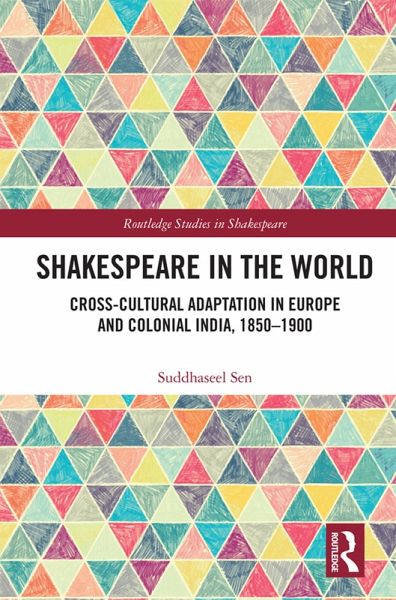
Shakespeare in the World traces the reception histories and adaptations of Shakespeare in the nineteenth century, when his works became well-known to non-Anglophone communities in both Europe and colonial India. Sen provides thorough and searching examinations of nineteenth-century theatrical, operatic, novelistic, and prose adaptations that are still read and performed, in order to argue that, crucial to the transmission and appeal of Shakespeare's plays were the adaptations they generated in a wide range of media. These adaptations, in turn, made the absorption of the plays into different "national" cultural traditions possible, contributing to the development of "nationalist cosmopolitanisms" in the receiving cultures. Sen challenges the customary reading of Shakespeare reception in terms of "hegemony" and "mimicry," showing instead important parallels in the practices of Shakespeare adaptation in Europe and colonial India. Shakespeare in the World strikes a fine balance between the Bard's iconicity and his colonial and post-colonial afterlives, and is an important contribution to Shakespeare studies.
Dieser Download kann aus rechtlichen Gründen nur mit Rechnungsadresse in A, B, BG, CY, CZ, D, DK, EW, E, FIN, F, GR, HR, H, IRL, I, LT, L, LR, M, NL, PL, P, R, S, SLO, SK ausgeliefert werden.
"This comparative and interdisciplinary study of the historical spread of Shakespeare among non-Anglophone nations in Europe and India sheds important new light on individual novelistic, operatic, and dramatic adaptations, while at the same time both theorising a major revision to postcolonial thinking and offering a new vision for Shakespeare studies. Sen's concept of 'performative transculturation' allows for a welcome and more encompassing vision of artistic innovation over time and across cultures. He complicates simple binaries, especially of European/Indian acceptance or rejection of Western culture/Shakespeare, revealing instead the rich middle ground in between these extremes of reception. In the process, Sen's innovative 'relational' approach to reading cross-cultural adaptations also makes a major contribution to adaptation theory."
--Linda Hutcheon, University Professor Emeritus, English and Comparative Literature, University of Toronto
"Shakespeare in the World is a notable contribution to Shakespeare studies in general, and the study of Shakespeare in non-Anglophone, non-Western, post/ colonial locations in particular, because it traces the afterlife of Shakespeare's plays in the genres of drama/theatre and opera in Indian as well as European languages. In his immersive use of adaptation studies for this purpose, Suddhaseel Sen effectively deconstructs the paradigms of 'hegemony,' 'conquest,' 'subalternity,' 'subjection,' 'mimicry,' and 'vernacular' cultural expression that have dominated the study of colonial power relations, the presence of English, and the dissemination of the English literary canon in India. He then offers counterconcepts such as 'nationalist cosmopolitanisms,' 'performative transculturation,' 'artistic self-fashioning,' and 'epistemic decolonisation' to construct and present an alternative narrative of cultural relations. These moves imply a refreshing restoration of agency to the colonial subject, and a recognition of multiple layers of complexity in the reception and absorption of a 'universal' figure such as Shakespeare."
--Aparna Dharwadker, Professor of English and Interdisciplinary, Theatre Studies, University of Wisconsin-Madison
"This is a richly rewarding book, suggesting important adjustments to the manner in which adaptations, in reaction against discourses of fidelity, have served diverse cultural formations. Sen insists eloquently on attention to individuals and specific circumstances and goals, rather than vague pigeonholing of artists and audiences in accordance with (admittedly) well-intentioned liberal consensus"
--Russell Jackson, Shakespeare Survey
"In many ways, Shakespeare in the World is an unconventional, and at times daring, work... [Shakespeare in the World] makes a significant contribution to the recent move towards decolonizing Shakespeare studies. It importantly attempts to shake basic Anglo-centric assumptions about global Shakespeares as a phenomenon, going back to one of the foundational moments of Shakespeare transmission in colonial India."
--Amrita Sen, Shakespeare Quarterly
"Sen tells us that "Much more will be gained if such scholars come together, using a methodologically open-ended tool such as adaptation theory, to produce collaborative and genuinely interdisciplinary research" (196). This may be one of the most important points of the book, for it takes a difficult subject and discussion and concludes it with hope and optimism. The end of the book is not the end of the conversation; Sen has offered us a way forward that expands the way we read, watch, listen, and respond to Shakespeare's works in all its forms. As a Shakespeare scholar, professor, and actor, I applaud and appreciate his message."
--Sharon Emmerichs, University of Alaska Anchorage
--Linda Hutcheon, University Professor Emeritus, English and Comparative Literature, University of Toronto
"Shakespeare in the World is a notable contribution to Shakespeare studies in general, and the study of Shakespeare in non-Anglophone, non-Western, post/ colonial locations in particular, because it traces the afterlife of Shakespeare's plays in the genres of drama/theatre and opera in Indian as well as European languages. In his immersive use of adaptation studies for this purpose, Suddhaseel Sen effectively deconstructs the paradigms of 'hegemony,' 'conquest,' 'subalternity,' 'subjection,' 'mimicry,' and 'vernacular' cultural expression that have dominated the study of colonial power relations, the presence of English, and the dissemination of the English literary canon in India. He then offers counterconcepts such as 'nationalist cosmopolitanisms,' 'performative transculturation,' 'artistic self-fashioning,' and 'epistemic decolonisation' to construct and present an alternative narrative of cultural relations. These moves imply a refreshing restoration of agency to the colonial subject, and a recognition of multiple layers of complexity in the reception and absorption of a 'universal' figure such as Shakespeare."
--Aparna Dharwadker, Professor of English and Interdisciplinary, Theatre Studies, University of Wisconsin-Madison
"This is a richly rewarding book, suggesting important adjustments to the manner in which adaptations, in reaction against discourses of fidelity, have served diverse cultural formations. Sen insists eloquently on attention to individuals and specific circumstances and goals, rather than vague pigeonholing of artists and audiences in accordance with (admittedly) well-intentioned liberal consensus"
--Russell Jackson, Shakespeare Survey
"In many ways, Shakespeare in the World is an unconventional, and at times daring, work... [Shakespeare in the World] makes a significant contribution to the recent move towards decolonizing Shakespeare studies. It importantly attempts to shake basic Anglo-centric assumptions about global Shakespeares as a phenomenon, going back to one of the foundational moments of Shakespeare transmission in colonial India."
--Amrita Sen, Shakespeare Quarterly
"Sen tells us that "Much more will be gained if such scholars come together, using a methodologically open-ended tool such as adaptation theory, to produce collaborative and genuinely interdisciplinary research" (196). This may be one of the most important points of the book, for it takes a difficult subject and discussion and concludes it with hope and optimism. The end of the book is not the end of the conversation; Sen has offered us a way forward that expands the way we read, watch, listen, and respond to Shakespeare's works in all its forms. As a Shakespeare scholar, professor, and actor, I applaud and appreciate his message."
--Sharon Emmerichs, University of Alaska Anchorage