160,95 €
160,95 €
inkl. MwSt.
Sofort per Download lieferbar

80 °P sammeln
160,95 €
Als Download kaufen
160,95 €
inkl. MwSt.
Sofort per Download lieferbar
80 °P sammeln
Jetzt verschenken
Alle Infos zum eBook verschenken
160,95 €
inkl. MwSt.
Sofort per Download lieferbar
Alle Infos zum eBook verschenken
80 °P sammeln

Andere Kunden interessierten sich auch für
") Plant-Environment Interactions (eBook, PDF)112,95 €
Plant-Environment Interactions (eBook, PDF)112,95 €") General Index (eBook, PDF)72,95 €
General Index (eBook, PDF)72,95 €") Progress in Botany (eBook, PDF)40,95 €
Progress in Botany (eBook, PDF)40,95 €") Progress in Botany (eBook, PDF)232,95 €
Progress in Botany (eBook, PDF)232,95 €") Iron Nutrition in Plants and Rhizospheric Microorganisms (eBook, PDF)175,95 €
Iron Nutrition in Plants and Rhizospheric Microorganisms (eBook, PDF)175,95 €") Communication in Plants (eBook, PDF)191,95 €
Communication in Plants (eBook, PDF)191,95 €") Reactive Oxygen Species in Plant Signaling (eBook, PDF)112,95 €
Reactive Oxygen Species in Plant Signaling (eBook, PDF)112,95 €
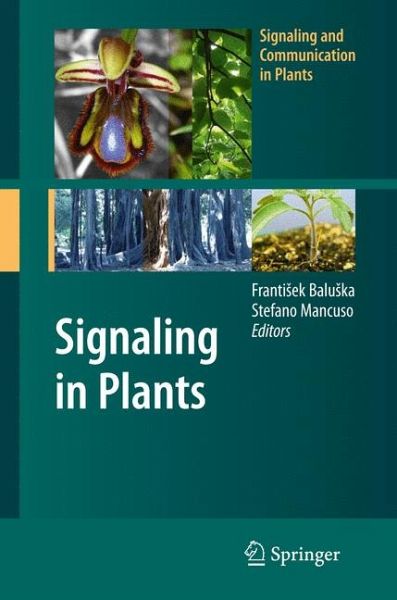
Plants are unique as their development and morphogenesis are plastic throughout their lives. They continuously monitor diverse biotic and abiotic parameters of their environment and these sensory perceptions shape their organs and bodies. Although genes are critical, the final form and architecture of above-ground organs, and es- cially of root systems, are determined by their sensory activities associated with motoric responses (Friml 2003; Hodge 2009). Sensory plant biology and plant el- trophysiology were two lively disciplines until the late 1970s (Bünning 1959; Haupt and Feinleib 1979) but then, for somewhat obscure reasons, they showed no further development. In the last few years, however, there have been numerous advances in plant sciences. These necessitate not just a revival of plant electrophysiology and sensory biology, but also the introduction of plant neurobiology, which includes also plant sensory ecology (BaluSka et al. 2006a; Brenner et al. 2006). First of all, and contrary to all "mechanistic" predictions based on the high turgor pressure of plant cells, endocytosis has been found to be an essential process of plant cells which impinges upon almost all aspects of plant life (samaj et al. 2005, 2006). Moreover, recent advances in plant molecular biology have identified, besides classic n- rotransmitters, also several proteins typical of animal neuronal systems, such as acetylcholine esterases, glutamate receptors, GABA receptors, and endocannabinoid signaling components, as well as indicating signaling roles for ATP, NO, and re- tive oxygen species (BaluSka et al. 2006b).
Dieser Download kann aus rechtlichen Gründen nur mit Rechnungsadresse in A, B, BG, CY, CZ, D, DK, EW, E, FIN, F, GR, HR, H, IRL, I, LT, L, LR, M, NL, PL, P, R, S, SLO, SK ausgeliefert werden.
From the reviews: "This book provides detailed coverage of a wide range of aspects of signalling and emphasizes the critical importance of such signalling to plants, which as sessile organisms are at the mercy of their biotic and abiotic environment. ... The book provides a valuable perspective to the dynamic nature of plants. ... The illustrations are of high quality ... . It will serve as an excellent resource for advanced graduate students and post-graduates who wish to obtain a detailed insight into plant cell signalling." (Zoe A. Wilson, Annals of Botany, Vol. 105 (5), May, 2010)