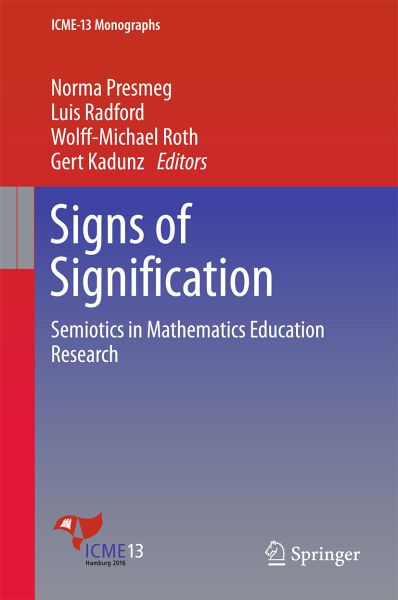
Signs of Signification (eBook, PDF)
Semiotics in Mathematics Education Research
Redaktion: Presmeg, Norma; Kadunz, Gert; Roth, Wolff-Michael; Radford, Luis
88,95 €
88,95 €
inkl. MwSt.
Sofort per Download lieferbar

44 °P sammeln

88,95 €
Als Download kaufen
88,95 €
inkl. MwSt.
Sofort per Download lieferbar
44 °P sammeln
Jetzt verschenken
Alle Infos zum eBook verschenken
88,95 €
inkl. MwSt.
Sofort per Download lieferbar
Alle Infos zum eBook verschenken
44 °P sammeln
Signs of Signification (eBook, PDF)
Semiotics in Mathematics Education Research
Redaktion: Presmeg, Norma; Kadunz, Gert; Roth, Wolff-Michael; Radford, Luis
- Format: PDF
- Merkliste
- Auf die Merkliste
- Bewerten Bewerten
- Teilen
- Produkt teilen
- Produkterinnerung
- Produkterinnerung

Bitte loggen Sie sich zunächst in Ihr Kundenkonto ein oder registrieren Sie sich bei
bücher.de, um das eBook-Abo tolino select nutzen zu können.
Hier können Sie sich einloggen
Sie sind bereits eingeloggt. Klicken Sie auf 2. tolino select Abo, um fortzufahren.

Bitte loggen Sie sich zunächst in Ihr Kundenkonto ein oder registrieren Sie sich bei bücher.de, um das eBook-Abo tolino select nutzen zu können.
Discusses a significant area of mathematics education research in the last two decades
Highlights the types of semiotic theory that are employed in mathematics education
Shows how these theories are being used in empirical research
- Geräte: PC
- ohne Kopierschutz
- eBook Hilfe
- Größe: 7.68MB
Andere Kunden interessierten sich auch für
English Teaching and New Literacies Pedagogy (eBook, PDF)35,95 €
Advances in Mathematics Education Research on Proof and Proving (eBook, PDF)120,95 €
Mathematics Lesson Study Around the World (eBook, PDF)88,95 €
Scripting Approaches in Mathematics Education (eBook, PDF)72,95 €
Jürgen MaaßMathematical Modelling for Teachers (eBook, PDF)60,95 €
Research Advances in the Mathematical Education of Pre-service Elementary Teachers (eBook, PDF)72,95 €
Language and Communication in Mathematics Education (eBook, PDF)40,95 €-
-
-
Discusses a significant area of mathematics education research in the last two decades
Highlights the types of semiotic theory that are employed in mathematics education
Shows how these theories are being used in empirical research
Highlights the types of semiotic theory that are employed in mathematics education
Shows how these theories are being used in empirical research
Dieser Download kann aus rechtlichen Gründen nur mit Rechnungsadresse in A, B, BG, CY, CZ, D, DK, EW, E, FIN, F, GR, HR, H, IRL, I, LT, L, LR, M, NL, PL, P, R, S, SLO, SK ausgeliefert werden.
Produktdetails
- Produktdetails
- Verlag: Springer International Publishing
- Seitenzahl: 372
- Erscheinungstermin: 23. Januar 2018
- Englisch
- ISBN-13: 9783319702872
- Artikelnr.: 52940625
- Verlag: Springer International Publishing
- Seitenzahl: 372
- Erscheinungstermin: 23. Januar 2018
- Englisch
- ISBN-13: 9783319702872
- Artikelnr.: 52940625
- Herstellerkennzeichnung Die Herstellerinformationen sind derzeit nicht verfügbar.
Chapter 1. Introduction. The editors.- Section 1: Sociocultural perspectives on semiosis.- Chapter 1. Introduction to Section 1.- Chapter 2. Semiosis and subjectification: The classroom constitution of mathematical objects.- Chapter 3. Birth of signs: A (Spinozist-Marxian) materialist approach.- Chapter 4. Relating computational Cartesian graphs to a real motion: An analysis of high school students' activity.- Chapter 5. Joint attention in resolving the ambiguity of different presentations: A dual eye-tracking study of the teaching-learning process.- Chapter 6. Attention catching: Connecting the space of joint action and togethering.- Section 2: Language and text orientations.- Introduction to Section 2.- Chapter 7. A matter of translation.- Chapter 8. Using social semiotics to explore institutional assumptions about mathematics students and teachers.- Chapter 9. Semiotics, epistemology, and mathematics.- Chapter 10. A semiotic-conceptual analysis of conceptual development in learningmathematics.- Section 3: Peircean semiotics, including semiotic chaining and representations.- Introduction to Section 3.- Chapter 11. Adalira Sáenz-Ludlow: Iconicity and diagrammatic reasoning in meaning-making.- Chapter 12. Semiotic representations: A study of dynamic figural register.- Chapter 13. Progressive visualization tasks and semiotic chaining for mathematics teacher preparation: Towards a conceptual framework.- Chapter 14. Primary teachers' semiotics praxis: Windows into the handling of division tasks.- Section 4: Semiotic resources including gesturing and tools.- Introduction to Section 4.- Chapter 15. Gradual change of perception: Signs, tools, and meaning-making of fractions.- Chapter 16. On the role of gestures for the descriptive analysis of 'Grundvorstellungen': A case of linear functions.- Chapter 17. Diagramming and gesturing during mathematizing: Kinesthetic and haptic interactions support mathematical ideation.- Chapter 18. Objectifying the inclusion relationshipof quadrilaterals in a synchronic-interactive and collaborative computer supported environment.- Chapter 19. Discussion and conclusions.