39,95 €
39,95 €
inkl. MwSt.
Sofort per Download lieferbar

20 °P sammeln
39,95 €
Als Download kaufen
39,95 €
inkl. MwSt.
Sofort per Download lieferbar
20 °P sammeln
Jetzt verschenken
Alle Infos zum eBook verschenken
39,95 €
inkl. MwSt.
Sofort per Download lieferbar
Alle Infos zum eBook verschenken
20 °P sammeln

Andere Kunden interessierten sich auch für
") Silent Teachers (eBook, ePUB)39,95 €
Silent Teachers (eBook, ePUB)39,95 €") Iranian Immigration to Israel (eBook, PDF)41,95 €
Iranian Immigration to Israel (eBook, PDF)41,95 €") The Rum Seljuqs (eBook, PDF)51,95 €
The Rum Seljuqs (eBook, PDF)51,95 €") Early Mystics in Turkish Literature (eBook, PDF)55,95 €
Early Mystics in Turkish Literature (eBook, PDF)55,95 €") America's Arab Nationalists (eBook, PDF)39,95 €
America's Arab Nationalists (eBook, PDF)39,95 €") The Abbasid House of Wisdom (eBook, PDF)21,95 €
The Abbasid House of Wisdom (eBook, PDF)21,95 €") Flashpoint Hagia Sophia (eBook, PDF)38,95 €
Flashpoint Hagia Sophia (eBook, PDF)38,95 €

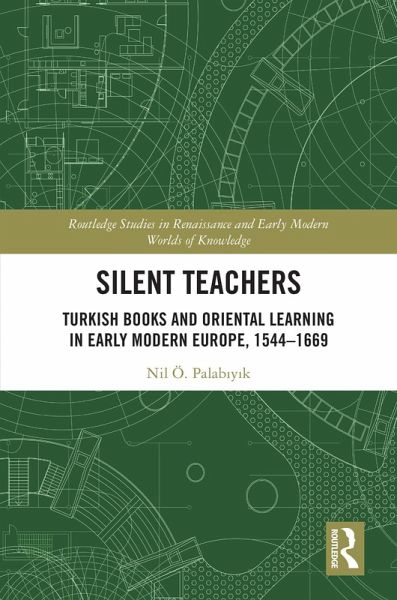
Silent Teachers considers for the first time the influence of Ottoman scholarly practices and reference tools on oriental learning in early modern Europe. Telling the story of oriental studies through the annotations, study notes, and correspondence of European scholars, it demonstrates the central but often overlooked role that Turkish-language manuscripts played in the achievements of early orientalists. Dispersing the myths and misunderstandings found in previous scholarship, this book offers a fresh history of Turkish studies in Europe and new insights into how Renaissance intellectuals studied Arabic and Persian through contemporaneous Turkish sources.
This story hardly has any dull moments: the reader will encounter many larger-than-life figures, including an armchair expert who turned his alleged captivity under the Ottomans into bestselling books; a drunken dragoman who preferred enjoying the fruits of the vine to his duties at the Sublime Porte; and a curmudgeonly German physician whose pugnacious pamphlets led to the erasure of his name from history.
Taking its title from the celebrated humanist Joseph Scaliger's comment that books from the Muslim world are 'silent teachers' and need to be explained orally to be understood, this study gives voice to the many and varied Turkish-language books that circulated in early modern Europe and proposes a paradigm-shift in our understanding of early modern erudite culture.
This story hardly has any dull moments: the reader will encounter many larger-than-life figures, including an armchair expert who turned his alleged captivity under the Ottomans into bestselling books; a drunken dragoman who preferred enjoying the fruits of the vine to his duties at the Sublime Porte; and a curmudgeonly German physician whose pugnacious pamphlets led to the erasure of his name from history.
Taking its title from the celebrated humanist Joseph Scaliger's comment that books from the Muslim world are 'silent teachers' and need to be explained orally to be understood, this study gives voice to the many and varied Turkish-language books that circulated in early modern Europe and proposes a paradigm-shift in our understanding of early modern erudite culture.
Dieser Download kann aus rechtlichen Gründen nur mit Rechnungsadresse in A, B, BG, CY, CZ, D, DK, EW, E, FIN, F, GR, HR, H, IRL, I, LT, L, LR, M, NL, PL, P, R, S, SLO, SK ausgeliefert werden.
'Nil Palabiyik's elegantly written, masterfully researched, and deeply impressive [book] provides a vivid account of the many failures, misfortunes, successes, and accomplishments in the history of early modern European Turkish learning ... Silent Teachers is a remarkable lesson in academic rigour, erudite ingeniousness, attentive close-reading, and material sensibility, that critically reassesses key texts, figures, and turning points in the history of European Turkish learning. Through impressive language skills, the author brings together secondary literature in more than nine languages with Arabic, Turkish, Latin, and Persian manuscript material from 28 libraries across 12 countries' - H-Soz-Kult.
'Nil Ö. Palabiyik's Silent Teachers is a wonderful scholarly excursion through the challenges of learning Turkish in early-modern Europe and it will most likely become a standard title for intellectual history and cross-cultural interactions between Europe and the Ottoman Empire' - Revue des études sud-est européennes.
'With her book Palabiyik has done much to open a new field of research' - Erudition and the Republic of Letters 9 (2024).
'Silent Teachers is a rousing revision to our understanding of the scholarly practices of early modern orientalists, recovering their study of Ottoman Turkish language and texts, and placing it at the center of their scholarship. That Palabiyik conveys this story through a series of compelling vignettes of fascinating individuals, both Ottoman and European, and with an accessible style, only makes it more exciting. Such a corrective to a long-established narrative about the unimportance of Turkish to European scholarship is no doubt made possible by Palabiyik's mastery of both Ottoman Turkish and Latin language and paleography, on display throughout the text and its numerous appendices' - Zemin: Literature, Language and Culture Studies.
'Nil Ö. Palabiyik's Silent Teachers is a wonderful scholarly excursion through the challenges of learning Turkish in early-modern Europe and it will most likely become a standard title for intellectual history and cross-cultural interactions between Europe and the Ottoman Empire' - Revue des études sud-est européennes.
'With her book Palabiyik has done much to open a new field of research' - Erudition and the Republic of Letters 9 (2024).
'Silent Teachers is a rousing revision to our understanding of the scholarly practices of early modern orientalists, recovering their study of Ottoman Turkish language and texts, and placing it at the center of their scholarship. That Palabiyik conveys this story through a series of compelling vignettes of fascinating individuals, both Ottoman and European, and with an accessible style, only makes it more exciting. Such a corrective to a long-established narrative about the unimportance of Turkish to European scholarship is no doubt made possible by Palabiyik's mastery of both Ottoman Turkish and Latin language and paleography, on display throughout the text and its numerous appendices' - Zemin: Literature, Language and Culture Studies.