72,95 €
inkl. MwSt.
Sofort per Download lieferbar
36 °P sammeln

Andere Kunden interessierten sich auch für
") Properties and Applications of Nanocrystalline Alloys from Amorphous Precursors (eBook, PDF)232,95 €
Properties and Applications of Nanocrystalline Alloys from Amorphous Precursors (eBook, PDF)232,95 €") IUTAM Symposium on Physicochemical and Electromechanical, Interactions in Porous Media (eBook, PDF)112,95 €
IUTAM Symposium on Physicochemical and Electromechanical, Interactions in Porous Media (eBook, PDF)112,95 €") Optical Detectors For Astronomy II (eBook, PDF)112,95 €
Optical Detectors For Astronomy II (eBook, PDF)112,95 €") Wafer Bonding (eBook, PDF)272,95 €
Wafer Bonding (eBook, PDF)272,95 €") Physics of Low Dimensional Systems (eBook, PDF)112,95 €
Physics of Low Dimensional Systems (eBook, PDF)112,95 €") Helium Atom Scattering from Surfaces (eBook, PDF)40,95 €
Helium Atom Scattering from Surfaces (eBook, PDF)40,95 €") Physics of Spin in Solids: Materials, Methods and Applications (eBook, PDF)232,95 €
Physics of Spin in Solids: Materials, Methods and Applications (eBook, PDF)232,95 €

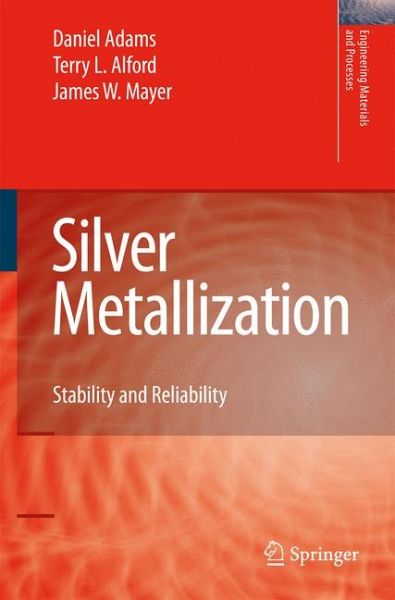
With the lowest resistivity of all metals, silver is an attractive interconnect material for higher current densities and faster switching speeds in integrated circuits. Over the past ten years, extensive research has been conducted to address the thermal and electrical stability issues and the processing issues that have prevented silver from being used as an interconnect metal. Here is the first book to discuss the current understanding of silver metallization and its potential as a future interconnect material for integrated circuit technology. The authors provide details on a wide range of experimental, characterization, and analysis techniques. In addition, they discuss novel approaches used to overcome the thermal and electrical stability issues associated with silver metallization. The book is written for students, scientists, engineers, and technologists in the fields of integrated circuits and microelectronics research and development.
Dieser Download kann aus rechtlichen Gründen nur mit Rechnungsadresse in A, B, BG, CY, CZ, D, DK, EW, E, FIN, F, GR, HR, H, IRL, I, LT, L, LR, M, NL, PL, P, R, S, SLO, SK ausgeliefert werden.
From the reviews:
"This book is aimed at addressing and reviewing the engineering aspects of improving the thermal and electrical stability of silver with a view to use as an interconnect material in integrated circuits. ... this book can provide a quick overview of the state of the art, current trends and hurdles yet to be overcome." (Contemporary Physics, Vol. 51 (6), 2010)
"This book is aimed at addressing and reviewing the engineering aspects of improving the thermal and electrical stability of silver with a view to use as an interconnect material in integrated circuits. ... this book can provide a quick overview of the state of the art, current trends and hurdles yet to be overcome." (Contemporary Physics, Vol. 51 (6), 2010)