160,95 €
160,95 €
inkl. MwSt.
Sofort per Download lieferbar

80 °P sammeln
160,95 €
Als Download kaufen
160,95 €
inkl. MwSt.
Sofort per Download lieferbar
80 °P sammeln
Jetzt verschenken
Alle Infos zum eBook verschenken
160,95 €
inkl. MwSt.
Sofort per Download lieferbar
Alle Infos zum eBook verschenken
80 °P sammeln

Andere Kunden interessierten sich auch für
") The Geometry of Lagrange Spaces: Theory and Applications (eBook, PDF)112,95 €
The Geometry of Lagrange Spaces: Theory and Applications (eBook, PDF)112,95 €") Quantum Riemannian Geometry (eBook, PDF)72,95 €
Quantum Riemannian Geometry (eBook, PDF)72,95 €") Natural and Gauge Natural Formalism for Classical Field Theorie (eBook, PDF)72,95 €
Natural and Gauge Natural Formalism for Classical Field Theorie (eBook, PDF)72,95 €") The Physical and Mathematical Foundations of the Theory of Relativity (eBook, PDF)40,95 €
The Physical and Mathematical Foundations of the Theory of Relativity (eBook, PDF)40,95 €") Gravitation and Cosmology (eBook, PDF)40,95 €
Gravitation and Cosmology (eBook, PDF)40,95 €") Classical Mechanics with Mathematica® (eBook, PDF)46,95 €
Classical Mechanics with Mathematica® (eBook, PDF)46,95 €") Mathematical Implications of Einstein-Weyl Causality (eBook, PDF)40,95 €
Mathematical Implications of Einstein-Weyl Causality (eBook, PDF)40,95 €
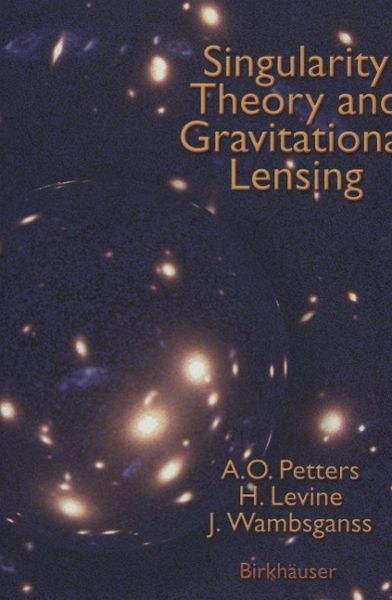
First monograph to develop a mathematical theory of gravitational lensing. Introductory chapters present historical highlights and astrophysical aspects of the subject. Main part of the book employs ideas and results of singularity theory to put gravitational lensing on a rigorous mathematical foundation to solve certain key lensing problems. Many results published for the first time. Includes examples, illustrations, bibliography and index. For a wide audience of students, mathematicians, mathematical physicists, astrophysicists, and physicists.
Dieser Download kann aus rechtlichen Gründen nur mit Rechnungsadresse in A, B, BG, CY, CZ, D, DK, EW, E, FIN, F, GR, HR, H, IRL, I, LT, L, LR, M, NL, PL, P, R, S, SLO, SK ausgeliefert werden.
"The time is ripe for a comprehensive volume explaining gravitational lensing to mathematicians and reviewing relevant singularity theory for astrophysicists. This is such a book. [It] . . . is accessible and attractive, . . . ranging widely through the history, physics and mathematics to paint a full picture of this . . . theory. This most attractively presented book summarizes current mathematical methods in the field and sets the stage for further exciting developments . . . A collaboration between a mathematical physicist, a mathematician, and a physicist, it has something for everybody."
-Mathematical Reviews
"This is a well-developed monograph on gravitational lensing both from the observational and from the mathematical points of view. However, also independent of the present interest in gravitational lensing, this book is a good source for several types of singularity theories . . . index and bibliography are very well done."
-Zentralblatt Math
"The rather voluminous monograph to be reviewed here covers both astrophysical and mathematicsl aspects of gravitational lensing. The scientific backgrohnd of the three authors guarantees that they are the right persons for such an enterprise. Arlie Petters is one of very few scientists who are competent in mathematics as well as in astrophysics. His coauthors are a pure astrophysicist and a pure matheamtician: Joachim Wambsganss is aleading expert on gravitational lensing as a tool in astrophysics and Harold Levine has made important contributions to the theory of signularities of maps in the 1960s. . . "It is not much of an exaggeration to say that large parts of this monograph can serve as a self-contained matheamtics text-book on the theory of singularites of maps and related subjects, and even a particularly well-written one. So I would not hesitate to recommend it to pure matheamticians who will find a fineexposistion of a subject from their field, along with applicaions to astrophysics which should be very well readable for them. I also recommend the book to pure astrophysicists, because it contains a lot of material which has a high atrophysical relevance. . . If one compares to tbook by Petters, Leven and Wambsganss with the earlier mongraph on gravtiational lenses by Schneider, Ehlers and Falco, one finds that there is not very much overlap. The two books rather complement each other."
---Gen. Relativ. Gravit.
-Mathematical Reviews
"This is a well-developed monograph on gravitational lensing both from the observational and from the mathematical points of view. However, also independent of the present interest in gravitational lensing, this book is a good source for several types of singularity theories . . . index and bibliography are very well done."
-Zentralblatt Math
"The rather voluminous monograph to be reviewed here covers both astrophysical and mathematicsl aspects of gravitational lensing. The scientific backgrohnd of the three authors guarantees that they are the right persons for such an enterprise. Arlie Petters is one of very few scientists who are competent in mathematics as well as in astrophysics. His coauthors are a pure astrophysicist and a pure matheamtician: Joachim Wambsganss is aleading expert on gravitational lensing as a tool in astrophysics and Harold Levine has made important contributions to the theory of signularities of maps in the 1960s. . . "It is not much of an exaggeration to say that large parts of this monograph can serve as a self-contained matheamtics text-book on the theory of singularites of maps and related subjects, and even a particularly well-written one. So I would not hesitate to recommend it to pure matheamticians who will find a fineexposistion of a subject from their field, along with applicaions to astrophysics which should be very well readable for them. I also recommend the book to pure astrophysicists, because it contains a lot of material which has a high atrophysical relevance. . . If one compares to tbook by Petters, Leven and Wambsganss with the earlier mongraph on gravtiational lenses by Schneider, Ehlers and Falco, one finds that there is not very much overlap. The two books rather complement each other."
---Gen. Relativ. Gravit.