79,95 €
79,95 €
inkl. MwSt.
Sofort per Download lieferbar

40 °P sammeln
79,95 €
Als Download kaufen
79,95 €
inkl. MwSt.
Sofort per Download lieferbar
40 °P sammeln
Jetzt verschenken
Alle Infos zum eBook verschenken
79,95 €
inkl. MwSt.
Sofort per Download lieferbar
Alle Infos zum eBook verschenken
40 °P sammeln

Andere Kunden interessierten sich auch für
") Transportation, Land Use, and Environmental Planning (eBook, ePUB)79,95 €
Transportation, Land Use, and Environmental Planning (eBook, ePUB)79,95 €") Electric Vehicles for Smart Cities (eBook, ePUB)79,95 €
Electric Vehicles for Smart Cities (eBook, ePUB)79,95 €") Technology in Supply Chain Management and Logistics (eBook, ePUB)79,95 €
Technology in Supply Chain Management and Logistics (eBook, ePUB)79,95 €") Big Data Analytics for Cyber-Physical Systems (eBook, ePUB)79,95 €
Big Data Analytics for Cyber-Physical Systems (eBook, ePUB)79,95 €") Sustainable Urban Mobility Pathways (eBook, ePUB)79,95 €
Sustainable Urban Mobility Pathways (eBook, ePUB)79,95 €") The Sharing Economy and the Relevance for Transport (eBook, ePUB)122,95 €
The Sharing Economy and the Relevance for Transport (eBook, ePUB)122,95 €") Population Loss: The Role of Transportation and Other Issues (eBook, ePUB)122,95 €
Population Loss: The Role of Transportation and Other Issues (eBook, ePUB)122,95 €
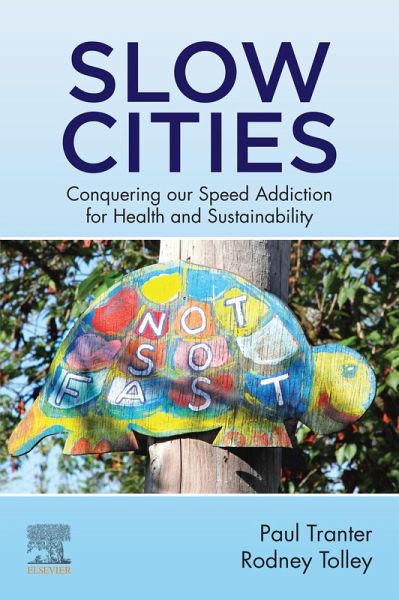
Slow Cities: Conquering Our Speed Addiction for Health and Sustainability demonstrates, counterintuitively, that reducing the speed of travel within cities saves time for residents and creates more sustainable, liveable, prosperous and healthy environments. This book examines the ways individuals and societies became dependent on transport modes that required investment in speed. Using research from multiple disciplinary perspectives, the book demonstrates ways in which human, economic and environmental health are improved with a slowing of city transport. It identifies effective methods, strategies and policies for decreasing the speed of motorised traffic and encouraging a modal shift to walking, cycling and public transport. This book also offers a holistic assessment of the impact of speed on daily behaviours and life choices, and shows how a move to slow down will - perhaps surprisingly - increase accessibility to the city services and activities that support healthy, sustainable lives and cities. - Includes cases from cities in North and South America, Europe, Asia, Africa and Australasia - Uses evidence-based research to support arguments about the benefits of slowing city transport - Adopts a broad view of health, including the health of individuals, neighbourhoods and communities as well as economic health and environmental health - Includes text boxes, diagrams and photos illustrating the slowing of transport in cities throughout the world, and a list of references including both academic sources and valuable websites
Dieser Download kann aus rechtlichen Gründen nur mit Rechnungsadresse in A, B, BG, CY, CZ, D, DK, EW, E, FIN, F, GR, HR, H, IRL, I, LT, L, LR, M, NL, PL, P, R, S, SLO, SK ausgeliefert werden.
"This book challenges paradigms suggesting personal independence depends on high-speed automobile travel. The book is densely referenced and introduces key terms such as "complete streets." The authors also discuss the difficulty of adopting their recommendations, but this book will become an important contribution." --© Doody's Review Service, 2020, John T. Pierce, MBBS(MD) PhD(Navy Environmental Health Center) reviewer, expert opinion
"Slow cities give you more time. How that works goes to how we conceive and colonise planet Earth. Two new works bookend this question in a way that seems tailored to this particular historical instant. One is David Attenborough's extraordinary new film, A Life on Our Planet, which recounts humanity's "greatest mistake" - and how we can fix it. The other is a book - Slow Cities by Paul Tranter and Rodney Tolley - examining the same issue from the other end of the telescope.
The 20th century was focused largely on burning the past to expand the present. For a century, speed and efficiency have been our gods. But they're dangerous and duplicitous deities, making us destroy our cities and our planet and still not delivering the promised time savings.
Our speed addiction is every bit as destructive as dependence on speed of the other sort. As with most destructive behaviours, the excuse is economic, but Tranter and Tolley point out that this too is illusory. Slow cities foster cafe economies: resilient, small-scale, healthy, with far lower health, land, infrastructure and transport costs. Plus there's the economic benefit of actually surviving.
Planners, listen up. There's not much point in building our way out of pandemic if it drives us over the cliff of climate change. The future, if we're to have one, will be slower, closer and inestimably more interesting." --Farrelly, E. 2020, Build slower cities or keep careering towards disaster, Sydney Morning Herald, 17 October, 2020. A Sydney Morning Herald article by Elizabeth Farrelly provides a commentary on Slow Cities: Conquering our speed addiction for health and sustainability relating the ideas in the book to David Attenborough's new film A Life On Our Planet.
"Slow cities give you more time. How that works goes to how we conceive and colonise planet Earth. Two new works bookend this question in a way that seems tailored to this particular historical instant. One is David Attenborough's extraordinary new film, A Life on Our Planet, which recounts humanity's "greatest mistake" - and how we can fix it. The other is a book - Slow Cities by Paul Tranter and Rodney Tolley - examining the same issue from the other end of the telescope.
The 20th century was focused largely on burning the past to expand the present. For a century, speed and efficiency have been our gods. But they're dangerous and duplicitous deities, making us destroy our cities and our planet and still not delivering the promised time savings.
Our speed addiction is every bit as destructive as dependence on speed of the other sort. As with most destructive behaviours, the excuse is economic, but Tranter and Tolley point out that this too is illusory. Slow cities foster cafe economies: resilient, small-scale, healthy, with far lower health, land, infrastructure and transport costs. Plus there's the economic benefit of actually surviving.
Planners, listen up. There's not much point in building our way out of pandemic if it drives us over the cliff of climate change. The future, if we're to have one, will be slower, closer and inestimably more interesting." --Farrelly, E. 2020, Build slower cities or keep careering towards disaster, Sydney Morning Herald, 17 October, 2020. A Sydney Morning Herald article by Elizabeth Farrelly provides a commentary on Slow Cities: Conquering our speed addiction for health and sustainability relating the ideas in the book to David Attenborough's new film A Life On Our Planet.