
86,95 €
86,95 €
inkl. MwSt.
Sofort per Download lieferbar

43 °P sammeln
86,95 €
Als Download kaufen
86,95 €
inkl. MwSt.
Sofort per Download lieferbar
43 °P sammeln
Jetzt verschenken
Alle Infos zum eBook verschenken
86,95 €
inkl. MwSt.
Sofort per Download lieferbar
Alle Infos zum eBook verschenken
43 °P sammeln

Andere Kunden interessierten sich auch für
") Smart Cities and Artificial Intelligence (eBook, ePUB)79,95 €
Smart Cities and Artificial Intelligence (eBook, ePUB)79,95 €") Smart Cities and the UN SDGs (eBook, ePUB)79,95 €
Smart Cities and the UN SDGs (eBook, ePUB)79,95 €") Personal Data-Smart Cities: How cities can Utilise their Citizen's Personal Data to Help them Become Climate Neutral (eBook, ePUB)0,00 €
Personal Data-Smart Cities: How cities can Utilise their Citizen's Personal Data to Help them Become Climate Neutral (eBook, ePUB)0,00 €") Collective Intelligence for Smart Cities (eBook, ePUB)79,95 €
Collective Intelligence for Smart Cities (eBook, ePUB)79,95 €") AI Morality (eBook, ePUB)10,95 €
AI Morality (eBook, ePUB)10,95 €") Artificial Intelligence and Evaluation (eBook, ePUB)39,95 €
Artificial Intelligence and Evaluation (eBook, ePUB)39,95 €") Smart Cities (eBook, ePUB)11,95 €
Smart Cities (eBook, ePUB)11,95 €
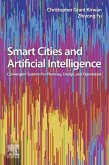

Smart Cities and Artificial Intelligence: Convergent Systems for Planning, Design, and Operations, Second Edition presents an integrated perspective on how cities are evolving as intelligent ecosystems shaped by the convergence of human, technological, and environmental systems. Drawing on developments in machine learning, neural networks, geospatial intelligence, data analytics and visualization, sensors, and smart connected objects, the book explains how these elements combine to form a new urban collective intelligence. By framing cities as real-time, adaptive, living systems, and by introducing tools such as generative design and living lab models, the book equips readers with the conceptual and practical foundation needed to plan, design, and operate next-generation smart cities. Adopting a multidisciplinary and systems-based approach, it provides a holistic understanding of smart cities through interconnected theory, planning and design methodologies, system architecture, and applied smart city functions, all aimed at enabling more liveable, sustainable, and self-regulating urban environments.The second edition introduces a new section in each chapter framed as reflections and projections, offering insights across the ten-year window from 2020, when the first edition was published, through 2030. These additions align the book with recent developments in AI and urban technologies and include an expanded comparison of global smart cities in the City DNA section, examining how different cities evolve, adopt technology, and shape distinctive global identities and competitive positions. Additional updates include new material on Digital Twins and the Metaverse as emerging extensions of the smart city operating system, select new use cases, refreshed references, and an expanded glossary to improve clarity and accessibility. Together, these enhancements ensure that the book remains current and useful for practitioners, policymakers, researchers, and educators shaping the future of urban intelligence. - Features diverse smart city examples and initiatives from around the globe - Includes best practices and guidelines for planning, designing, and implementing smart city projects, as well as how to measure and evaluate their effectiveness - Provides numerous diagrams to illustrate and explain complex smart city systems and solutions - Discusses the role of citizens and communities in the design and implementation of smart city initiatives and citizen-centric smart cities - New to the second edition: Revised content throughout the book, including updated references, refreshed case studies, and an expanded glossary of terms. The second edition also strengthens several core discussions-reflecting the rapid acceleration of AI since the first edition-and introduces new material on Digital Twins, the Metaverse, and reflections/projections on convergence spanning 2020-2025-2030. Together, these updates support a broader perspective on how cities are evolving toward more adaptive, citizen-centric, and self-regulating systems
Dieser Download kann aus rechtlichen Gründen nur mit Rechnungsadresse in A, B, BG, CY, CZ, D, DK, EW, E, FIN, F, GR, HR, H, IRL, I, LT, L, LR, M, NL, PL, P, R, S, SLO, SK ausgeliefert werden.