Sie sind bereits eingeloggt. Klicken Sie auf 2. tolino select Abo, um fortzufahren.
Bitte loggen Sie sich zunächst in Ihr Kundenkonto ein oder registrieren Sie sich bei bücher.de, um das eBook-Abo tolino select nutzen zu können.
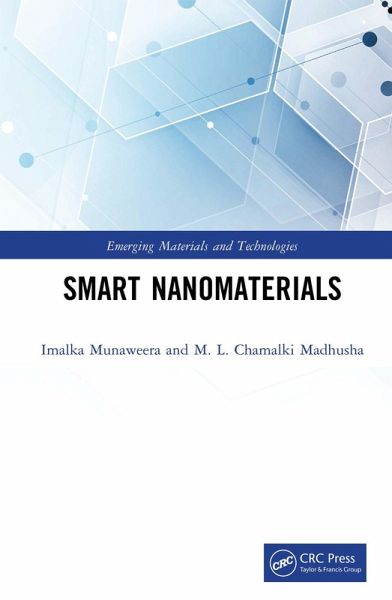
Smart nanomaterials are the basis of diverse emerging applications, and this book covers their technological advances, innovations, and practical applications. It covers advances in the most critical aspects in chemistry and material fabrication of nanomaterials including engineering/prospective applications. The application of smart nanomaterials in the biomedical field, agriculture, food industry, and apparel industry is covered with practical examples. It discusses the future of smart nanomaterials and the pros and cons associated with smart nanomaterials in a detailed…mehr
Smart nanomaterials are the basis of diverse emerging applications, and this book covers their technological advances, innovations, and practical applications. It covers advances in the most critical aspects in chemistry and material fabrication of nanomaterials including engineering/prospective applications. The application of smart nanomaterials in the biomedical field, agriculture, food industry, and apparel industry is covered with practical examples. It discusses the future of smart nanomaterials and the pros and cons associated with smart nanomaterials in a detailed manner.
Features:
Reviews synthesis methods, characterization techniques, and applications of smart nanomaterials.
Explores the significance of using smart nanomaterials in futuristic life including examples.
Covers bionsensor sensitivity, selectivity, and stability for long-term operation and nanotechnology technique for possibly detecting hazardous viruses.
Provides the manufacturing advantages, energy and electronic advantages, medical benefits, environmental effects, and economic issues.
Explains risk assessment on humans in detail.
This book is aimed at researchers and graduate students in nanomaterials and materials science.
Dieser Download kann aus rechtlichen Gründen nur mit Rechnungsadresse in A, B, BG, CY, CZ, D, DK, EW, E, FIN, F, GR, HR, H, IRL, I, LT, L, LR, M, NL, PL, P, R, S, SLO, SK ausgeliefert werden.
Die Herstellerinformationen sind derzeit nicht verfügbar.
Autorenporträt
Dr. Imalka Munaweera is a winner of the 2021 OWSD-Elsevier Foundation Award for Early-Career Women Scientists in the Developing World for her research in Chemistry, Mathematics, and Physics especially for her research contribution to the nanotechnology-related projects. Currently, she is a Senior Lecturer at the Department of Chemistry at the University of Sri Jayewardenepura in Sri Lanka. She has over 10+ years of teaching experience in Nanotechnology, Application of Nanotechnology, Inorganic Chemistry, Polymer Chemistry, and Instrumental Analysis. She has over 15+ years of research experience in the field of Nanotechnology, Inorganic Chemistry, and Materials Science. She obtained her PhD in Chemistry at The University of Texas at Dallas, USA in 2015. She has served as an Assistant Professor in Chemistry, Prairie View A&M University, Prairie View, Texas, USA. She was a Postdoctoral Researcher at the University of Texas Southwestern Medical Center, Dallas, Texas, USA. Her research interests are nanotechnology for drug delivery/pharmaceutical applications, agricultural applications, and water purification applications. Furthermore, she also pursues research toward development of nanomaterials from natural resources for various industrial applications. She has authored many publications in indexed journals and is also an inventor of four US-granted patents (licensed and commercialized), international patents, and Sri Lankan-granted patents related to nanoscience and nanotechnology-based research. Further, she is a recipient of many awards related to nanoscience and nanotechnology research. In addition, she is a principal investigator (PI) for a research grant which was awarded by World Academy of Sciences (TWAS) and a core PI for two more grants (NRC PPP-Sri Lanka and TWAS). Apart from being awarded many accolades in both the USA and Sri Lanka, including scholarships, she has also taken part in paper review and many conference presentations and contributed to abstract awards as well. Some of her awards include the National Science & Technology Award in Sri Lanka in 2010 under the category of innovative advanced technologies with commercial potential that was awarded by the President of Sri Lanka and several graduate competition awards awarded by the American Chemical Society.
Ms. Chamalki Madhusha is a graduate research assistant, and she has obtained her BSc degree in Chemistry from the University of Sri Jayewardenepura, Sri Lanka. Currently, she is working toward a sustainable future through green chemistry and nanotechnology-based findings. Her research interests include materials chemistry, food chemistry, green chemistry, and nanotechnology with high-impact journal publications. She is engaged in generating new research ideas and devising feasible solutions to broadly relevant problems. She is an author of eight indexed publications, two local and international patents, and four international conference abstracts.
Inhaltsangabe
1. What are smart nanomaterials (SNM)? 1.1 Definitions for SNM 1.2 Synthesis methods 1.3 Characterization techniques 2. Why SNM play a significant role today? 2.1 Progress in SNM 2.2 Safe and sustainable innovations of nanomaterials 3. SNM for bio-medical applications 3.1 Nanoparticle based biosensors 3.2 Smart nanoparticles for photodynamic therapy 3.3 Smart nanoparticle for passive and active gene delivery 3.4 Magnetic nanoparticles and their applications in tissue engineering 4. SNM for pharmaceutical applications and analysis 4.1 Physical responsive nanomaterials 4.2 Temperature-responsive nanomaterials 4.3 Electrical and electrochemical stimuli-responsive nanomaterials 4.4 Light-responsive nanomaterials 4.5 Magnetic-responsive nanomaterials 4.6 Chemical-responsive nanomaterials 4.7 pH-responsive nanomaterials 4.8 Biological-responsive nanomaterials 5. SNM for agricultural applications 5.1 Nanofertilizers 5.2 Nanopesticides/nanoherbicides/nanobactericides 5.3 Nanosensors 6. SNM in food preservation 6.1 Smart food packaging and security 6.2 Food functionality 6.3 Enhance shelf life of postharvest crops 7. SNM in apparel industry 7.1 Current research trends for smart textile 7.2 Antimicrobial textiles 7.3 Hydrophobicity and oleophobicity in textiles 7.4 Ultraviolet-resistant textiles 7.5 Antistatic properties in textiles 7.6 Electrically conductive textiles 7.7 Energy storage by textiles 7.8 Photonics in textiles 7.9 Self-cleaning textiles 7.10 Sensors on textile 8. SNM in catalysis and energy applications 8.1 Photovoltaics and solar cells 8.2 Fuel cells and batteries 8.3 Application of SNM in renewable energy such as in CO2 conversion, water splitting, etc. 9. Biogenic/bio-inspired nanomaterials 9.1 Use of biogenic /bio-inspired nanomaterials in chemical engineering, tissue engineering, textile manufacturing, nanomedicine, clinical diagnostics (nanobots), electronics, organ implantations biosensors, biological imaging, biomarkers, and cell labeling 10. Pros and Cons of SNM 10.1 Manufacturing advantages 10.2 Energy and electronic advantages 10.3 Medical benefits 10.4 Environmental effects and economic issues 10.5 Risk assessment on humans 11. Can we imagine tomorrow without SNM? 11.1 Future of SNM 11.2 A New Frontier; the convergence of nanotechnology in machine learning and artificial intelligence 11.3 Conclusions
1. What are smart nanomaterials (SNM)? 1.1 Definitions for SNM 1.2 Synthesis methods 1.3 Characterization techniques 2. Why SNM play a significant role today? 2.1 Progress in SNM 2.2 Safe and sustainable innovations of nanomaterials 3. SNM for bio-medical applications 3.1 Nanoparticle based biosensors 3.2 Smart nanoparticles for photodynamic therapy 3.3 Smart nanoparticle for passive and active gene delivery 3.4 Magnetic nanoparticles and their applications in tissue engineering 4. SNM for pharmaceutical applications and analysis 4.1 Physical responsive nanomaterials 4.2 Temperature-responsive nanomaterials 4.3 Electrical and electrochemical stimuli-responsive nanomaterials 4.4 Light-responsive nanomaterials 4.5 Magnetic-responsive nanomaterials 4.6 Chemical-responsive nanomaterials 4.7 pH-responsive nanomaterials 4.8 Biological-responsive nanomaterials 5. SNM for agricultural applications 5.1 Nanofertilizers 5.2 Nanopesticides/nanoherbicides/nanobactericides 5.3 Nanosensors 6. SNM in food preservation 6.1 Smart food packaging and security 6.2 Food functionality 6.3 Enhance shelf life of postharvest crops 7. SNM in apparel industry 7.1 Current research trends for smart textile 7.2 Antimicrobial textiles 7.3 Hydrophobicity and oleophobicity in textiles 7.4 Ultraviolet-resistant textiles 7.5 Antistatic properties in textiles 7.6 Electrically conductive textiles 7.7 Energy storage by textiles 7.8 Photonics in textiles 7.9 Self-cleaning textiles 7.10 Sensors on textile 8. SNM in catalysis and energy applications 8.1 Photovoltaics and solar cells 8.2 Fuel cells and batteries 8.3 Application of SNM in renewable energy such as in CO2 conversion, water splitting, etc. 9. Biogenic/bio-inspired nanomaterials 9.1 Use of biogenic /bio-inspired nanomaterials in chemical engineering, tissue engineering, textile manufacturing, nanomedicine, clinical diagnostics (nanobots), electronics, organ implantations biosensors, biological imaging, biomarkers, and cell labeling 10. Pros and Cons of SNM 10.1 Manufacturing advantages 10.2 Energy and electronic advantages 10.3 Medical benefits 10.4 Environmental effects and economic issues 10.5 Risk assessment on humans 11. Can we imagine tomorrow without SNM? 11.1 Future of SNM 11.2 A New Frontier; the convergence of nanotechnology in machine learning and artificial intelligence 11.3 Conclusions
1. What are smart nanomaterials (SNM)? 1.1 Definitions for SNM 1.2 Synthesis methods 1.3 Characterization techniques 2. Why SNM play a significant role today? 2.1 Progress in SNM 2.2 Safe and sustainable innovations of nanomaterials 3. SNM for bio-medical applications 3.1 Nanoparticle based biosensors 3.2 Smart nanoparticles for photodynamic therapy 3.3 Smart nanoparticle for passive and active gene delivery 3.4 Magnetic nanoparticles and their applications in tissue engineering 4. SNM for pharmaceutical applications and analysis 4.1 Physical responsive nanomaterials 4.2 Temperature-responsive nanomaterials 4.3 Electrical and electrochemical stimuli-responsive nanomaterials 4.4 Light-responsive nanomaterials 4.5 Magnetic-responsive nanomaterials 4.6 Chemical-responsive nanomaterials 4.7 pH-responsive nanomaterials 4.8 Biological-responsive nanomaterials 5. SNM for agricultural applications 5.1 Nanofertilizers 5.2 Nanopesticides/nanoherbicides/nanobactericides 5.3 Nanosensors 6. SNM in food preservation 6.1 Smart food packaging and security 6.2 Food functionality 6.3 Enhance shelf life of postharvest crops 7. SNM in apparel industry 7.1 Current research trends for smart textile 7.2 Antimicrobial textiles 7.3 Hydrophobicity and oleophobicity in textiles 7.4 Ultraviolet-resistant textiles 7.5 Antistatic properties in textiles 7.6 Electrically conductive textiles 7.7 Energy storage by textiles 7.8 Photonics in textiles 7.9 Self-cleaning textiles 7.10 Sensors on textile 8. SNM in catalysis and energy applications 8.1 Photovoltaics and solar cells 8.2 Fuel cells and batteries 8.3 Application of SNM in renewable energy such as in CO2 conversion, water splitting, etc. 9. Biogenic/bio-inspired nanomaterials 9.1 Use of biogenic /bio-inspired nanomaterials in chemical engineering, tissue engineering, textile manufacturing, nanomedicine, clinical diagnostics (nanobots), electronics, organ implantations biosensors, biological imaging, biomarkers, and cell labeling 10. Pros and Cons of SNM 10.1 Manufacturing advantages 10.2 Energy and electronic advantages 10.3 Medical benefits 10.4 Environmental effects and economic issues 10.5 Risk assessment on humans 11. Can we imagine tomorrow without SNM? 11.1 Future of SNM 11.2 A New Frontier; the convergence of nanotechnology in machine learning and artificial intelligence 11.3 Conclusions
1. What are smart nanomaterials (SNM)? 1.1 Definitions for SNM 1.2 Synthesis methods 1.3 Characterization techniques 2. Why SNM play a significant role today? 2.1 Progress in SNM 2.2 Safe and sustainable innovations of nanomaterials 3. SNM for bio-medical applications 3.1 Nanoparticle based biosensors 3.2 Smart nanoparticles for photodynamic therapy 3.3 Smart nanoparticle for passive and active gene delivery 3.4 Magnetic nanoparticles and their applications in tissue engineering 4. SNM for pharmaceutical applications and analysis 4.1 Physical responsive nanomaterials 4.2 Temperature-responsive nanomaterials 4.3 Electrical and electrochemical stimuli-responsive nanomaterials 4.4 Light-responsive nanomaterials 4.5 Magnetic-responsive nanomaterials 4.6 Chemical-responsive nanomaterials 4.7 pH-responsive nanomaterials 4.8 Biological-responsive nanomaterials 5. SNM for agricultural applications 5.1 Nanofertilizers 5.2 Nanopesticides/nanoherbicides/nanobactericides 5.3 Nanosensors 6. SNM in food preservation 6.1 Smart food packaging and security 6.2 Food functionality 6.3 Enhance shelf life of postharvest crops 7. SNM in apparel industry 7.1 Current research trends for smart textile 7.2 Antimicrobial textiles 7.3 Hydrophobicity and oleophobicity in textiles 7.4 Ultraviolet-resistant textiles 7.5 Antistatic properties in textiles 7.6 Electrically conductive textiles 7.7 Energy storage by textiles 7.8 Photonics in textiles 7.9 Self-cleaning textiles 7.10 Sensors on textile 8. SNM in catalysis and energy applications 8.1 Photovoltaics and solar cells 8.2 Fuel cells and batteries 8.3 Application of SNM in renewable energy such as in CO2 conversion, water splitting, etc. 9. Biogenic/bio-inspired nanomaterials 9.1 Use of biogenic /bio-inspired nanomaterials in chemical engineering, tissue engineering, textile manufacturing, nanomedicine, clinical diagnostics (nanobots), electronics, organ implantations biosensors, biological imaging, biomarkers, and cell labeling 10. Pros and Cons of SNM 10.1 Manufacturing advantages 10.2 Energy and electronic advantages 10.3 Medical benefits 10.4 Environmental effects and economic issues 10.5 Risk assessment on humans 11. Can we imagine tomorrow without SNM? 11.1 Future of SNM 11.2 A New Frontier; the convergence of nanotechnology in machine learning and artificial intelligence 11.3 Conclusions
Es gelten unsere Allgemeinen Geschäftsbedingungen: www.buecher.de/agb
Impressum
www.buecher.de ist ein Internetauftritt der buecher.de internetstores GmbH
Geschäftsführung: Monica Sawhney | Roland Kölbl | Günter Hilger
Sitz der Gesellschaft: Batheyer Straße 115 - 117, 58099 Hagen
Postanschrift: Bürgermeister-Wegele-Str. 12, 86167 Augsburg
Amtsgericht Hagen HRB 13257
Steuernummer: 321/5800/1497
USt-IdNr: DE450055826