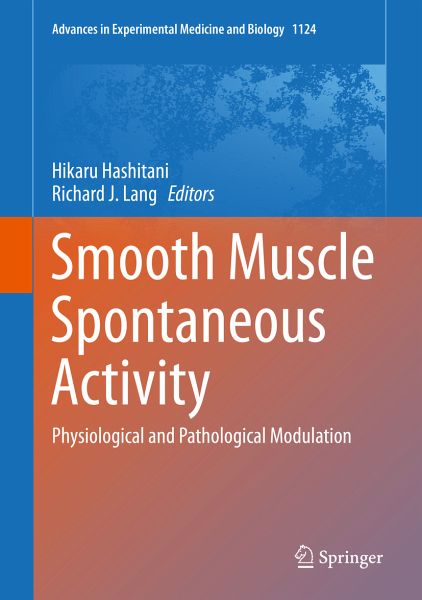
Smooth Muscle Spontaneous Activity (eBook, PDF)
Physiological and Pathological Modulation
Redaktion: Hashitani, Hikaru; Lang, Richard J.
128,95 €
128,95 €
inkl. MwSt.
Sofort per Download lieferbar

64 °P sammeln
128,95 €
Als Download kaufen
128,95 €
inkl. MwSt.
Sofort per Download lieferbar
64 °P sammeln
Jetzt verschenken
Alle Infos zum eBook verschenken
128,95 €
inkl. MwSt.
Sofort per Download lieferbar
Alle Infos zum eBook verschenken
64 °P sammeln

Smooth Muscle Spontaneous Activity (eBook, PDF)
Physiological and Pathological Modulation
Redaktion: Hashitani, Hikaru; Lang, Richard J.
- Format: PDF
- Merkliste
- Auf die Merkliste
- Bewerten Bewerten
- Teilen
- Produkt teilen
- Produkterinnerung
- Produkterinnerung

Bitte loggen Sie sich zunächst in Ihr Kundenkonto ein oder registrieren Sie sich bei
bücher.de, um das eBook-Abo tolino select nutzen zu können.
Hier können Sie sich einloggen
Sie sind bereits eingeloggt. Klicken Sie auf 2. tolino select Abo, um fortzufahren.

Bitte loggen Sie sich zunächst in Ihr Kundenkonto ein oder registrieren Sie sich bei bücher.de, um das eBook-Abo tolino select nutzen zu können.
Detailed, up-to-date information on smooth muscle function
Systematically organized by body systems and organs
Explanation of commonalities and differences between organs
Clarification of the role of smooth muscle in disease
Exploration of contractile mechanisms as therapeutic targets
- Geräte: PC
- ohne Kopierschutz
- eBook Hilfe
- Größe: 22.25MB
Andere Kunden interessierten sich auch für
Reviews of Physiology, Biochemistry and Pharmacology Vol. 174 (eBook, PDF)96,95 €
Arterial Chemoreceptors in Physiology and Pathophysiology (eBook, PDF)72,95 €
Nobuyuki InuiSystematic Changes in Body Image Following Formation of Phantom Limbs (eBook, PDF)40,95 €
Airways Smooth Muscle: Development, and Regulation of Contractility (eBook, PDF)72,95 €
Veins (eBook, PDF)40,95 €
Regulation of the Contractile Cycle in Smooth Muscle (eBook, PDF)72,95 €
Airways Smooth Muscle (eBook, PDF)72,95 €-
-
-
Detailed, up-to-date information on smooth muscle function
Systematically organized by body systems and organs
Explanation of commonalities and differences between organs
Clarification of the role of smooth muscle in disease
Exploration of contractile mechanisms as therapeutic targets
Systematically organized by body systems and organs
Explanation of commonalities and differences between organs
Clarification of the role of smooth muscle in disease
Exploration of contractile mechanisms as therapeutic targets
Dieser Download kann aus rechtlichen Gründen nur mit Rechnungsadresse in A, B, BG, CY, CZ, D, DK, EW, E, FIN, F, GR, HR, H, IRL, I, LT, L, LR, M, NL, PL, P, R, S, SLO, SK ausgeliefert werden.
Produktdetails
- Produktdetails
- Verlag: Springer Nature Singapore
- Seitenzahl: 427
- Erscheinungstermin: 10. Juni 2019
- Englisch
- ISBN-13: 9789811358951
- Artikelnr.: 56953578
- Verlag: Springer Nature Singapore
- Seitenzahl: 427
- Erscheinungstermin: 10. Juni 2019
- Englisch
- ISBN-13: 9789811358951
- Artikelnr.: 56953578
- Herstellerkennzeichnung Die Herstellerinformationen sind derzeit nicht verfügbar.
Hikaru Hashitani has been Professor of Cell Physiology at Nagoya City University since 2010. He received his medical degree from Kyushu University, completed his PhD at Nagoya City University, and then studied at Melbourne University and University of Oxford. His research interests have primarily focused on cellular mechanisms underlying spontaneous electrical and calcium signalling in smooth muscle of the genitourinary, gastrointestinal and microvascular systems. Richard Lang received his PhD at Monash University in 1979. He was an MRC Research Officer and Fellow at St George's Hospital Medical School, London. He returned to Monash University as a Research Fellow and has continued as a Senior Research Fellow. Throughout, he has been interested in the role membrane ion channels and calcium play in pacemaker and tone generation in both gastrointestinal and urogenital organs. Hikaru Hashitani and Richard Lang have collaborated for over 20 years, exchanging a number of graduate students for short term visits and one PhD graduate on a JSPS Fellowship. Over this time, we have together published 20 papers and numerous conference abstracts on the electrical and calcium signalling properties of the renal pelvis, urethra and prostate. This collaboration is a continuation of a long-held tradition of international collaboration between British, Japanese and Australian smooth muscle researchers that originated by our mentors in Oxford University in the 1960s.
PART I: Gastrointestinal tract.- Phasic muscle.- Spontaneous electrical activity and rhythmicity in gastrointestinal smooth muscles.- Tonic muscle (Sphincters) .- Generation of tone by gastrointestinal sphincters.- PART II: Urinary tract.- Renal pelvis.- Pacemaker mechanisms driving pyeloureteric peristalsis: modulatory role of interstitial cells.- Ureter.- Excitation-contraction coupling in ureteric smooth muscle: mechanisms driving ureteric peristalsis.- Urinary Bladder.- Spontaneous activity and the urinary bladder.- Urethra.- Spontaneous activity in urethral smooth muscle.- PART III: Reproductive organs.- Corporal tissue.- Ion channels and intracellular calcium signalling in corpus cavernosum.- Prostate.- Generation and regulation of spontaneous contractions in the prostate gland.- Seminal vesicle.- Mucosa-dependent, stretch-sensitive spontaneous activity in seminal vesicle.- Uterus.- The myometrium - from excitation to contractions and labour.- Oviducts.- Myosalpinx contractions are essential for egg transport along the oviduct and are disrupted in reproductive tract diseases.- PART IV: Blood vessels.- Artery.- Cellular and Ionic Mechanisms of Arterial Vasomotion.- Vein.- Venous Vasomotion.- Microvasculature.- Role of pericytes in the initiation and propagation of spontaneous activity in the microvasculature.- Lymphatic vessels.- Lymphatic vessel pumping.- PART V: Airways.- Regulation of airway smooth muscle contraction in health and disease.