42,95 €
42,95 €
inkl. MwSt.
Sofort per Download lieferbar

21 °P sammeln
42,95 €
Als Download kaufen
42,95 €
inkl. MwSt.
Sofort per Download lieferbar
21 °P sammeln
Jetzt verschenken
Alle Infos zum eBook verschenken
42,95 €
inkl. MwSt.
Sofort per Download lieferbar
Alle Infos zum eBook verschenken
21 °P sammeln

Andere Kunden interessierten sich auch für
") Social Exclusion and the Criminal Justice System (eBook, ePUB)42,95 €
Social Exclusion and the Criminal Justice System (eBook, ePUB)42,95 €") Problem-Solving Courts, Criminal Justice, and the International Gold Standard (eBook, PDF)41,95 €
Problem-Solving Courts, Criminal Justice, and the International Gold Standard (eBook, PDF)41,95 €") The Structural Exclusion of Rape Complainants in South Africa's Criminal Justice System (eBook, PDF)42,95 €
The Structural Exclusion of Rape Complainants in South Africa's Criminal Justice System (eBook, PDF)42,95 €") Introduction to Criminal Justice (eBook, PDF)77,95 €
Introduction to Criminal Justice (eBook, PDF)77,95 €") Remorse and Criminal Justice (eBook, PDF)41,95 €
Remorse and Criminal Justice (eBook, PDF)41,95 €") Prisoner Reentry in the 21st Century (eBook, PDF)41,95 €
Prisoner Reentry in the 21st Century (eBook, PDF)41,95 €") Decolonising Justice for Aboriginal youth with Fetal Alcohol Spectrum Disorders (eBook, PDF)21,95 €
Decolonising Justice for Aboriginal youth with Fetal Alcohol Spectrum Disorders (eBook, PDF)21,95 €







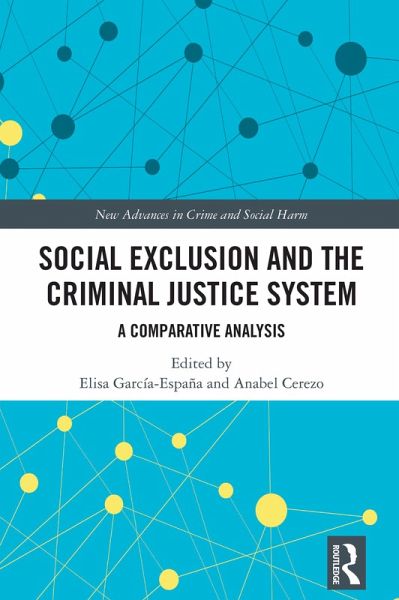
This book presents the results of the latest in a long-running research project using the RIMES instrument, developed by scholars in Spain. Here, RIMES is used to measure the extent of social exclusion resulting from the penal system in comparative perspective. The volume shows the results of the application of the instrument in seven criminal justice systems: Germany, Italy, Spain, Poland, England and Wales, California, and New York.
Divided into two parts, the first provides a general overview of the RIMES instrument, including a discussion of the theoretical model and the methodology. The second part focuses on the results of the application of RIMES in the seven jurisdictions. The comparative results are organised according to the nine dimensions included in the RIMES instrument: control of public spaces; legal safeguards; sentencing and sanctions systems; harshest penalties; prison rules; preventive intervention; legal and social status of offenders and ex-offenders; police and criminal records; and youth criminal justice. The last chapter summarizes the comparative results and ranks them in terms of the findings on social exclusion.
The book will be of interest to academics, researchers and policy-makers working in the areas of Comparative Criminal Justice, Criminology, Criminal Law and Policy.
Divided into two parts, the first provides a general overview of the RIMES instrument, including a discussion of the theoretical model and the methodology. The second part focuses on the results of the application of RIMES in the seven jurisdictions. The comparative results are organised according to the nine dimensions included in the RIMES instrument: control of public spaces; legal safeguards; sentencing and sanctions systems; harshest penalties; prison rules; preventive intervention; legal and social status of offenders and ex-offenders; police and criminal records; and youth criminal justice. The last chapter summarizes the comparative results and ranks them in terms of the findings on social exclusion.
The book will be of interest to academics, researchers and policy-makers working in the areas of Comparative Criminal Justice, Criminology, Criminal Law and Policy.
Dieser Download kann aus rechtlichen Gründen nur mit Rechnungsadresse in A, B, BG, CY, CZ, D, DK, EW, E, FIN, F, GR, HR, H, IRL, I, LT, L, LR, M, NL, PL, P, R, S, SLO, SK ausgeliefert werden.
"In his recent survey of the sociology of punishment field, David Garland identified the absence of an agreed set of metrics as one of our key challenges. Our progress along this path has been considerably advanced by the impressive body of work undertaken by the RIMES team."
Professor Claire Hamilton, Maynooth University, Republic of Ireland
"Scholars interested in making criminal justice systems more able to reduce exclusion and favour reintegration of offenders will benefit from reading a book that explains a new tool to assess the level of exclusion of criminal justice systems. The authors of the RIMES instrument have made an outstanding contribution to the progress of comparative penology."
Josep Cid, Universitat Autónoma de Barcelona, Spain
"The Rimes instrument emerged from a pioneering research approach. The research team first applied social exclusion to measure punitiveness in criminal justice systems. The findings promise new insights that go beyond the expected and provide an outstanding contribution to comparative criminal policy studies."
Prof. Dr. Rita Haverkamp, University of Tübingen, Germany
Professor Claire Hamilton, Maynooth University, Republic of Ireland
"Scholars interested in making criminal justice systems more able to reduce exclusion and favour reintegration of offenders will benefit from reading a book that explains a new tool to assess the level of exclusion of criminal justice systems. The authors of the RIMES instrument have made an outstanding contribution to the progress of comparative penology."
Josep Cid, Universitat Autónoma de Barcelona, Spain
"The Rimes instrument emerged from a pioneering research approach. The research team first applied social exclusion to measure punitiveness in criminal justice systems. The findings promise new insights that go beyond the expected and provide an outstanding contribution to comparative criminal policy studies."
Prof. Dr. Rita Haverkamp, University of Tübingen, Germany