29,95 €
inkl. MwSt.
Sofort per Download lieferbar
15 °P sammeln

Andere Kunden interessierten sich auch für
") Social infrastructure and left behind places (eBook, PDF)29,95 €
Social infrastructure and left behind places (eBook, PDF)29,95 €") Climate Adaptation Finance and Investment in California (eBook, ePUB)0,00 €
Climate Adaptation Finance and Investment in California (eBook, ePUB)0,00 €") Engineering, Science, and Sustainability (eBook, ePUB)41,95 €
Engineering, Science, and Sustainability (eBook, ePUB)41,95 €") Solar Energy, Mini-grids and Sustainable Electricity Access (eBook, ePUB)22,95 €
Solar Energy, Mini-grids and Sustainable Electricity Access (eBook, ePUB)22,95 €") The Circular Economy in Europe (eBook, ePUB)0,00 €
The Circular Economy in Europe (eBook, ePUB)0,00 €") The Political Economy of Global Warming (eBook, ePUB)45,95 €
The Political Economy of Global Warming (eBook, ePUB)45,95 €") South Asia and Climate Change (eBook, ePUB)44,95 €
South Asia and Climate Change (eBook, ePUB)44,95 €





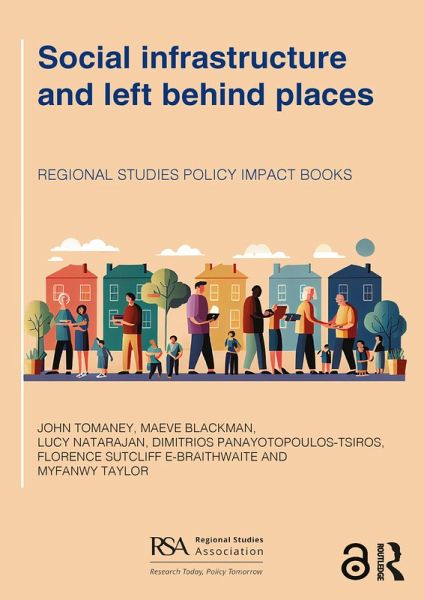
This book explores the making, unmaking and remaking of social infrastructure in 'left-behind places'. Such places, typically once flourishing industrial communities that have been excluded from recent economic growth, now attract academic and policy attention as sites of a political backlash against globalisation and liberal democracy. The book focuses on the role of social infrastructure as a key component of this story.
Seeking to move beyond a narrowly economistic of reading 'left behind places', the book addresses the understudied affective dimensions of 'left-behindness'. It develops an analytical framework that emphasises the importance of place attachments and the consequences of their disruption; considers 'left behind places' as 'moral communities' and the making of social infrastructure as an expression of this; views the unmaking of social infrastructure through the lens of 'root shock'; and explains efforts at remaking it in terms of the articulation of 'radical hope'.
The analysis builds upon a case study of a former mining community in County Durham, North East England. Using mixed methods, it offers a 'deep place study' of a single village to understand more fully the making, unmaking and remaking of social infrastructure. It shows how a place once richly endowed with social infrastructure, saw this endowment wither and the effects this had on the community. However, it also records efforts of the local people to rebuild social infrastructure, typically drawing the lessons of the past. Although the story of one village, the methods, results and policy recommendation have much wider applicability.
The book will be of interest to researchers, policy makers and others concerned with the fate of 'left behind places'.
The Open Access version of this book, available at http://www.taylorfrancis.com, has been made available under a Creative Commons Attribution-Non Commercial (CC-BY-NC) 4.0 license.
Seeking to move beyond a narrowly economistic of reading 'left behind places', the book addresses the understudied affective dimensions of 'left-behindness'. It develops an analytical framework that emphasises the importance of place attachments and the consequences of their disruption; considers 'left behind places' as 'moral communities' and the making of social infrastructure as an expression of this; views the unmaking of social infrastructure through the lens of 'root shock'; and explains efforts at remaking it in terms of the articulation of 'radical hope'.
The analysis builds upon a case study of a former mining community in County Durham, North East England. Using mixed methods, it offers a 'deep place study' of a single village to understand more fully the making, unmaking and remaking of social infrastructure. It shows how a place once richly endowed with social infrastructure, saw this endowment wither and the effects this had on the community. However, it also records efforts of the local people to rebuild social infrastructure, typically drawing the lessons of the past. Although the story of one village, the methods, results and policy recommendation have much wider applicability.
The book will be of interest to researchers, policy makers and others concerned with the fate of 'left behind places'.
The Open Access version of this book, available at http://www.taylorfrancis.com, has been made available under a Creative Commons Attribution-Non Commercial (CC-BY-NC) 4.0 license.
Dieser Download kann aus rechtlichen Gründen nur mit Rechnungsadresse in A, B, BG, CY, CZ, D, DK, EW, E, FIN, F, GR, HR, H, IRL, I, LT, L, LR, M, NL, PL, P, R, S, SLO, SK ausgeliefert werden.