46,95 €
inkl. MwSt.
Sofort per Download lieferbar
23 °P sammeln

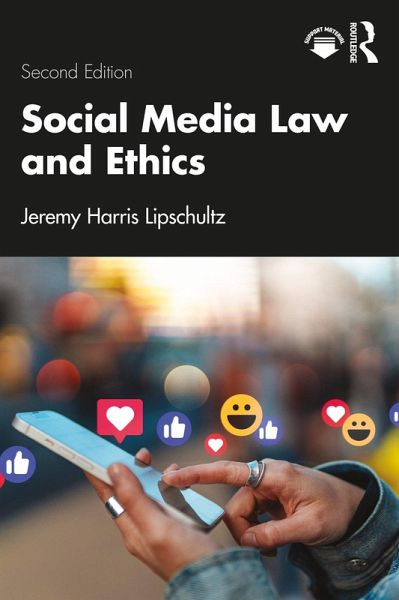
In this textbook, social media professor Jeremy Harris Lipschultz introduces students to the study of social media law and ethics, integrating legal concepts and ethical theories.
This second edition explores freedom of expression, as it applies to students, media industry professionals, content creators and audience members. Key issues and practices covered include copyright law, data privacy, defamation, global law and ethics, generative AI, government censorship, social media platform rules and employer policies. The book also addresses the U.S. government's TikTok law and other recent regulations. Research techniques are also used to suggest future trends in social media law and ethics. Touching on themes and topics of significant contemporary relevance, this accessible textbook can be used in standalone law and ethics courses, as well as emerging social media courses that are disrupting traditional public relations, advertising, marketing and journalism curricula.
Case studies, discussion questions, and online resources help students engage with the practicalities, complexities and ambiguities of this future-oriented area of media law, making this an ideal textbook for students of media law, policy and ethics, mass media, and communication studies.
This second edition explores freedom of expression, as it applies to students, media industry professionals, content creators and audience members. Key issues and practices covered include copyright law, data privacy, defamation, global law and ethics, generative AI, government censorship, social media platform rules and employer policies. The book also addresses the U.S. government's TikTok law and other recent regulations. Research techniques are also used to suggest future trends in social media law and ethics. Touching on themes and topics of significant contemporary relevance, this accessible textbook can be used in standalone law and ethics courses, as well as emerging social media courses that are disrupting traditional public relations, advertising, marketing and journalism curricula.
Case studies, discussion questions, and online resources help students engage with the practicalities, complexities and ambiguities of this future-oriented area of media law, making this an ideal textbook for students of media law, policy and ethics, mass media, and communication studies.
Dieser Download kann aus rechtlichen Gründen nur mit Rechnungsadresse in A, B, BG, CY, CZ, D, DK, EW, E, FIN, F, GR, HR, H, IRL, I, LT, L, LR, M, NL, PL, P, R, S, SLO, SK ausgeliefert werden.
Lipschultz's second edition is a tour de force combining intellectual rigor with real-world relevance, addressing contemporary challenges-from freedom of expression and copyright law to generative AI and government censorship, including timely issues like the U.S. TikTok law. In a time when the interplay between social media and ethical practice is more critical than ever, this text is essential for anyone looking to navigate current and future media law and ethics trends.
Regina M. Luttrell, Senior Associate Dean, S.I. Newhouse School of Public Communications, Syracuse University, USA
Dr. Lipschultz has once again delivered an effective and timely text that addresses the fast-paced changes in the communication landscape. This second edition is well done and much welcomed.
Tim P. McMahon, Assoc. Prof. of Practice Heider College of Business, Creighton University, USA
Regina M. Luttrell, Senior Associate Dean, S.I. Newhouse School of Public Communications, Syracuse University, USA
Dr. Lipschultz has once again delivered an effective and timely text that addresses the fast-paced changes in the communication landscape. This second edition is well done and much welcomed.
Tim P. McMahon, Assoc. Prof. of Practice Heider College of Business, Creighton University, USA