0,00 €
0,00 €
inkl. MwSt.
Sofort per Download lieferbar

0 °P sammeln
0,00 €
Als Download kaufen
0,00 €
inkl. MwSt.
Sofort per Download lieferbar
0 °P sammeln
Jetzt verschenken
Alle Infos zum eBook verschenken
0,00 €
inkl. MwSt.
Sofort per Download lieferbar
Alle Infos zum eBook verschenken
0 °P sammeln

Andere Kunden interessierten sich auch für
") Societies at an AI Crossroads (eBook, ePUB)0,00 €
Societies at an AI Crossroads (eBook, ePUB)0,00 €") Artificial Intelligence in Cultural Production (eBook, PDF)37,95 €
Artificial Intelligence in Cultural Production (eBook, PDF)37,95 €") Queer Reflections on AI (eBook, PDF)0,00 €
Queer Reflections on AI (eBook, PDF)0,00 €") The Dark Social (eBook, PDF)42,95 €
The Dark Social (eBook, PDF)42,95 €") Ethics of Virtual Reality (eBook, PDF)64,95 €
Ethics of Virtual Reality (eBook, PDF)64,95 €") Digital Ethics (eBook, PDF)36,95 €
Digital Ethics (eBook, PDF)36,95 €") AI Aesthetics (eBook, PDF)0,00 €
AI Aesthetics (eBook, PDF)0,00 €




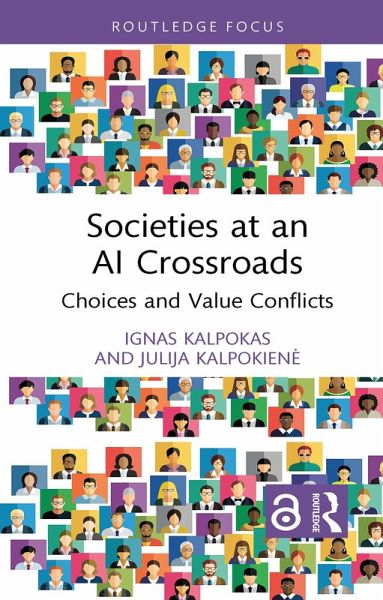
This book highlights some of the crucial crossroads - moments in which choices as to the future relationship between humans and digital technologies have to be made - that societies face in light of the growing development and adoption of AI.
As contemporary societies undergo profound transformations driven by artificial intelligence and related technologies, a unilinear vision of inevitable 'progress' and development increasingly dominates public discourse. This book offers a counterpoint, challenging such deterministic narratives by mapping out the complex crossroads where futures ought to be shaped rather than passively received. Exploring a multiplicity of domains as diverse as education, heritage, creativity, the biological and technological boundaries of humans, work, war, and space colonialism, both the dominant (typically progressivist) and alternative (critical) ways of framing the present and the future are outlined, identifying choices to be made. The book teases out the underlying tendencies and underscores a recurring necessity to make value choices as to our further development, not only as societies but also as humanity, and in terms of regulatory choices. It reveals how decisions in these domains are shaped by ingrained intellectual, ideological, political, value-based, and economic assumptions, often hidden beneath the rhetoric of inevitability. These crossroads are not just technical or economic choices, but moral and societal: Between maximising efficiency and safeguarding plurality; between treating technological possibilities as imperatives and critically evaluating their desirability; between moral blindness and care. By illuminating the options available, the book invites readers to take an active role in choosing the future shape of societies and of humanity itself.
This interdisciplinary and creative text will benefit all graduate-level and scholarly readers working on AI within the fields of media and communication, cultural studies, sociology, and cultural anthropology.
The Open Access version of this book, available at http://www.taylorfrancis.com, has been made available under a Creative Commons Attribution-Non Commercial-No Derivatives (CC BY-NC-ND) 4.0 license.
As contemporary societies undergo profound transformations driven by artificial intelligence and related technologies, a unilinear vision of inevitable 'progress' and development increasingly dominates public discourse. This book offers a counterpoint, challenging such deterministic narratives by mapping out the complex crossroads where futures ought to be shaped rather than passively received. Exploring a multiplicity of domains as diverse as education, heritage, creativity, the biological and technological boundaries of humans, work, war, and space colonialism, both the dominant (typically progressivist) and alternative (critical) ways of framing the present and the future are outlined, identifying choices to be made. The book teases out the underlying tendencies and underscores a recurring necessity to make value choices as to our further development, not only as societies but also as humanity, and in terms of regulatory choices. It reveals how decisions in these domains are shaped by ingrained intellectual, ideological, political, value-based, and economic assumptions, often hidden beneath the rhetoric of inevitability. These crossroads are not just technical or economic choices, but moral and societal: Between maximising efficiency and safeguarding plurality; between treating technological possibilities as imperatives and critically evaluating their desirability; between moral blindness and care. By illuminating the options available, the book invites readers to take an active role in choosing the future shape of societies and of humanity itself.
This interdisciplinary and creative text will benefit all graduate-level and scholarly readers working on AI within the fields of media and communication, cultural studies, sociology, and cultural anthropology.
The Open Access version of this book, available at http://www.taylorfrancis.com, has been made available under a Creative Commons Attribution-Non Commercial-No Derivatives (CC BY-NC-ND) 4.0 license.
Dieser Download kann aus rechtlichen Gründen nur mit Rechnungsadresse in A, B, BG, CY, CZ, D, DK, EW, E, FIN, F, GR, HR, H, IRL, I, LT, L, LR, M, NL, PL, P, R, S, SLO, SK ausgeliefert werden.