7,99 €
7,99 €
inkl. MwSt.
Sofort per Download lieferbar

0 °P sammeln
7,99 €
Als Download kaufen
7,99 €
inkl. MwSt.
Sofort per Download lieferbar
0 °P sammeln
Jetzt verschenken
Alle Infos zum eBook verschenken
7,99 €
inkl. MwSt.
Sofort per Download lieferbar
Alle Infos zum eBook verschenken
0 °P sammeln

Andere Kunden interessierten sich auch für
") Every Time I Find the Meaning of Life, They Change It (eBook, ePUB)7,90 €
Every Time I Find the Meaning of Life, They Change It (eBook, ePUB)7,90 €") Way Beyond Happiness (eBook, ePUB)5,99 €
Way Beyond Happiness (eBook, ePUB)5,99 €") The Mahabharataof Krishna-Dwaipayana Vyasa Vol.4 Book 13 (eBook, ePUB)0,99 €
The Mahabharataof Krishna-Dwaipayana Vyasa Vol.4 Book 13 (eBook, ePUB)0,99 €") The Art of Being Happy (eBook, ePUB)4,99 €
The Art of Being Happy (eBook, ePUB)4,99 €") The Three Gods: Security, Status, and Sensation (eBook, ePUB)8,99 €
The Three Gods: Security, Status, and Sensation (eBook, ePUB)8,99 €") Meditazioni di Marco Aurelio: Una Guida Alla Filosofia Stoica Per Trovare Forza Interiore, Resilienza E Calma Nella Vita Quotidiana (eBook, ePUB)4,49 €
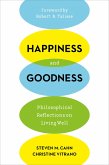
Meditazioni di Marco Aurelio: Una Guida Alla Filosofia Stoica Per Trovare Forza Interiore, Resilienza E Calma Nella Vita Quotidiana (eBook, ePUB)4,49 €") Happiness and Goodness (eBook, ePUB)9,95 €
Happiness and Goodness (eBook, ePUB)9,95 €



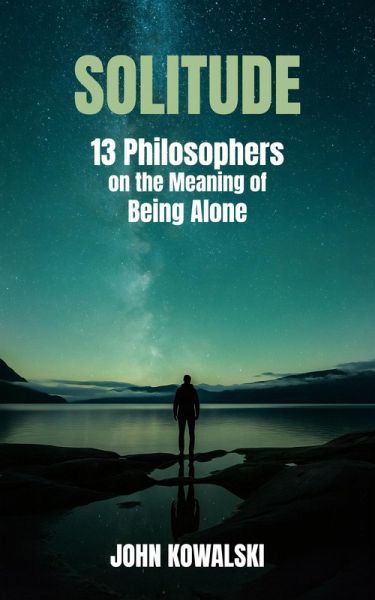
In a world that equates constant connectivity with happiness and endless social engagement with success, Solitude: 13 Philosophers on the Meaning of Being Alone offers a counterpoint: throughout history, many of the world's greatest thinkers discovered that deliberately stepping back from society opens the door to freedom, clarity, and creativity.
Across two millennia, this book explores thirteen philosophers who defended solitude as a conscious act of strength rather than a social weakness:
This is not a guide to becoming antisocial, nor is it tied to personality types. Instead, it is a philosophical toolkit for anyone who feels socially exhausted, digitally overwhelmed, or simply curious about why stepping away from the crowd has always been celebrated as a path to authenticity.
By reframing solitude as choice rather than failure, Solitude: 13 Philosophers on the Meaning of Being Alone shows why learning to be comfortable alone-without loneliness, anxiety, or the need for validation-remains one of the most essential skills for living well in a hyperconnected age.
Across two millennia, this book explores thirteen philosophers who defended solitude as a conscious act of strength rather than a social weakness:
- Lao Tzu - the effortless solitude of Taoist wisdom
- Diogenes - radical independence from social convention
- Epicurus - the Garden as a retreat for selective companionship
- Seneca - letters on the luxury of philosophical retirement
- Marcus Aurelius - inner solitude while ruling an empire
- Pascal - on humanity's struggle to sit quietly in a room
- Montaigne - essays of self-discovery from his tower library
- Rousseau - exile transformed into chosen wisdom
- Schopenhauer - solitude as the mark of a strong mind
- Kierkegaard - becoming "the single one" in authentic existence
- Thoreau - deliberate living at Walden Pond
- Nietzsche - the solitude of the free spirit
- Emerson - self-reliance and the solitary soul
This is not a guide to becoming antisocial, nor is it tied to personality types. Instead, it is a philosophical toolkit for anyone who feels socially exhausted, digitally overwhelmed, or simply curious about why stepping away from the crowd has always been celebrated as a path to authenticity.
By reframing solitude as choice rather than failure, Solitude: 13 Philosophers on the Meaning of Being Alone shows why learning to be comfortable alone-without loneliness, anxiety, or the need for validation-remains one of the most essential skills for living well in a hyperconnected age.
Dieser Download kann aus rechtlichen Gründen nur mit Rechnungsadresse in A, B, CY, CZ, D, DK, EW, E, FIN, F, GR, H, IRL, I, LT, L, LR, M, NL, PL, P, R, S, SLO, SK ausgeliefert werden.