45,95 €
inkl. MwSt.
Sofort per Download lieferbar
23 °P sammeln

Andere Kunden interessierten sich auch für
") The Politics of Southeast Asia's New Media (eBook, PDF)94,95 €
The Politics of Southeast Asia's New Media (eBook, PDF)94,95 €") The Changing Village Environment in Southeast Asia (eBook, PDF)43,95 €
The Changing Village Environment in Southeast Asia (eBook, PDF)43,95 €") Challenging Southeast Asian Development (eBook, PDF)57,95 €
Challenging Southeast Asian Development (eBook, PDF)57,95 €") Changing Constellations of Southeast Asia (eBook, PDF)43,95 €
Changing Constellations of Southeast Asia (eBook, PDF)43,95 €") Men and Masculinities in Southeast Asia (eBook, PDF)51,95 €
Men and Masculinities in Southeast Asia (eBook, PDF)51,95 €") Southeast Asia's Credit Revolution (eBook, ePUB)45,95 €
Southeast Asia's Credit Revolution (eBook, ePUB)45,95 €") Routledge Handbook of Urbanization in Southeast Asia (eBook, PDF)45,95 €
Routledge Handbook of Urbanization in Southeast Asia (eBook, PDF)45,95 €
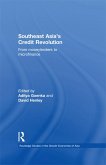
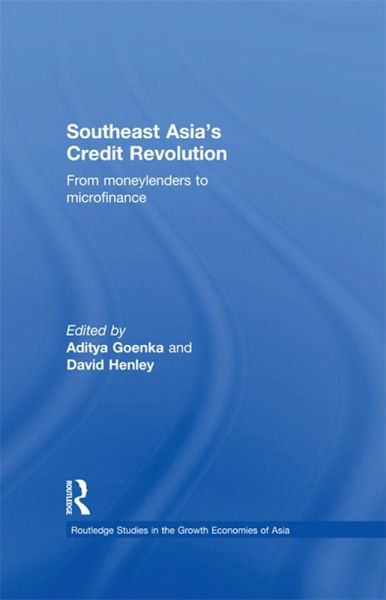
Southeast Asia's Credit Revolution describes and explains the rise of microfinance - the provision of credit and other financial services for the poor - in Southeast Asia, over the past four decades the most consistently successful region of the developing world. In recent years microfinance has come to be seen as a key weapon in the battle against global poverty, generating more enthusiasm and optimism than any other development strategy.
Southeast Asia has a special place in the history of microfinance. Historically, Southeast Asian societies and economies were perceived as almost uniquely debt-ridden and credit-constrained. In the twentieth century, however, the region was in the forefront of the modern microfinance revolution. This book asks what factors have made it possible for formal microfinance institutions to replace moneylenders and other traditional credit providers.
Bringing together economists, sociologists, anthropologists and historians, the book covers seven Southeast Asian countries. The topic is explored from cultural and institutional as well as economic perspectives, and policy-relevant lessons are offered for the design of successful microfinance institutions. Focusing on recent developments while putting them in historical context, this will be an important text for scholars and students of economic history, finance, institutional economics, and Asian Studies.
Southeast Asia has a special place in the history of microfinance. Historically, Southeast Asian societies and economies were perceived as almost uniquely debt-ridden and credit-constrained. In the twentieth century, however, the region was in the forefront of the modern microfinance revolution. This book asks what factors have made it possible for formal microfinance institutions to replace moneylenders and other traditional credit providers.
Bringing together economists, sociologists, anthropologists and historians, the book covers seven Southeast Asian countries. The topic is explored from cultural and institutional as well as economic perspectives, and policy-relevant lessons are offered for the design of successful microfinance institutions. Focusing on recent developments while putting them in historical context, this will be an important text for scholars and students of economic history, finance, institutional economics, and Asian Studies.
Dieser Download kann aus rechtlichen Gründen nur mit Rechnungsadresse in A, B, BG, CY, CZ, D, DK, EW, E, FIN, F, GR, HR, H, IRL, I, LT, L, LR, M, NL, PL, P, R, S, SLO, SK ausgeliefert werden.