Sie sind bereits eingeloggt. Klicken Sie auf 2. tolino select Abo, um fortzufahren.
Bitte loggen Sie sich zunächst in Ihr Kundenkonto ein oder registrieren Sie sich bei bücher.de, um das eBook-Abo tolino select nutzen zu können.
Its unique ability to sway the masses has led many observers to consider cinema the artform with the greatest political force. The images it produces can bolster leaders or contribute to their undoing. Soviet filmmakers often had to face great obstacles as they struggled to make art in an authoritarian society that put them not only under ideological pressure but also imposed rigid economic constraints on the industry. But while the Brezhnev era of Soviet filmmaking is often depicted as a period of great repression, Soviet Art House reveals that the films made at the prestigious Lenfilm studio…mehr
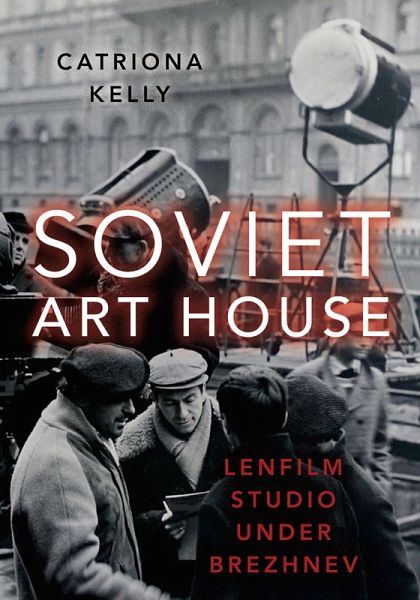
Its unique ability to sway the masses has led many observers to consider cinema the artform with the greatest political force. The images it produces can bolster leaders or contribute to their undoing. Soviet filmmakers often had to face great obstacles as they struggled to make art in an authoritarian society that put them not only under ideological pressure but also imposed rigid economic constraints on the industry. But while the Brezhnev era of Soviet filmmaking is often depicted as a period of great repression, Soviet Art House reveals that the films made at the prestigious Lenfilm studio in this period were far more imaginative than is usually suspected. In this pioneering study of a Soviet film studio, author Catriona Kelly delves into previously unpublished archival documents and interviews, memoirs, and the films themselves to illuminate the ideological, economic, and aesthetic dimensions of filmmaking in the Brezhnev era. She argues that especially the young filmmakers who joined the studio after its restructuring in 1961 revitalized its output and helped establish Leningrad as a leading center of oppositional art. This unique insight into Soviet film production shows not only the inner workings of Soviet institutions before the system collapsed but also traces how filmmakers tirelessly dodged and negotiated contradictory demands to create sophisticated and highly original movies.
Dieser Download kann aus rechtlichen Gründen nur mit Rechnungsadresse in A, B, BG, CY, CZ, D, DK, EW, E, FIN, F, GR, HR, H, IRL, I, LT, L, LR, M, NL, PL, P, R, S, SLO, SK ausgeliefert werden.
Die Herstellerinformationen sind derzeit nicht verfügbar.
Autorenporträt
Catriona Kelly is Professor of Russian at the University of Oxford and a leading historian of Russian culture and society. She is the author of numerous books on Russian modernism, gender history, the history of childhood, national identity, and the recent history of Leningrad/St Petersburg, some of which have been translated into Russian.
Inhaltsangabe
* Preface and Acknowledgments * Terminology, Abbreviations, and Transliteration * List of Illustrations * Introduction: The Art House * Chapter 1. Big Hopes and Trouble, 1961-1969 * Chapter 2. "Serious" Movies and the Box Office, 1970-1985 * Chapter 3. The Cinema-Centaur: Lenfilm as Film Factory * Chapter 4. Non-Existent Reality: The Lenfilm Aesthetic * Chapter 5. Pleasure and Danger: Yuly Fait, A Boy and a Girl (1966) * Chapter 6. The Indifference of Time: Gennady Shpalikov, A Long Happy Life (1967) * Chapter 7. Regulated Immediacy: Viktor Sokolov, A Day of Sunshine and Rain (1967) * Chapter 8. More in Expectation than Hope: Naum Birman, Chronicle of a Divebomber (1968) * Chapter 9. Cold War Fears: Savva Kulish, The Dead Season (1968) * Chapter 10. Personal Happiness: Vitaly Melnikov, Mother's Got Married (1969) * Chapter 11. Trust in Talent: Ilya Averbakh, Monologue (1972) * Chapter 12. Spontaneous Music: Dinara Asanova, Woodpeckers Don't Get Headaches (1974) * Chapter 13. Fervor and Tenderness: Gleb Panfilov, May I Speak? (1976) * Chapter 14. Private Grief, Public Mourning: Sergei Mikaelyan, The Widows (1977) * Chapter 15. Ludic Love: Kira Muratova, Getting to Know the Wide World (1978) * Chapter 16. Cast a Cold Eye: Boris Frumin, Errors of Youth (1978) * Chapter 17. Socialist Embarrassment: Viktor Tregubovich, Go If You're Going (1978) * Chapter 18. The Powers of Irony: Igor Maslennikov, The Queen of Spades (1982) * Chapter 19. Hystoria: Aleksei German, My Friend Ivan Lapshin (1984) * Conclusion: Arthouse Beyond the Art House * Filmography
Es gelten unsere Allgemeinen Geschäftsbedingungen: www.buecher.de/agb
Impressum
www.buecher.de ist ein Internetauftritt der buecher.de internetstores GmbH
Geschäftsführung: Monica Sawhney | Roland Kölbl | Günter Hilger
Sitz der Gesellschaft: Batheyer Straße 115 - 117, 58099 Hagen
Postanschrift: Bürgermeister-Wegele-Str. 12, 86167 Augsburg
Amtsgericht Hagen HRB 13257
Steuernummer: 321/5800/1497
USt-IdNr: DE450055826