39,95 €
39,95 €
inkl. MwSt.
Sofort per Download lieferbar

20 °P sammeln
39,95 €
Als Download kaufen
39,95 €
inkl. MwSt.
Sofort per Download lieferbar
20 °P sammeln
Jetzt verschenken
Alle Infos zum eBook verschenken
39,95 €
inkl. MwSt.
Sofort per Download lieferbar
Alle Infos zum eBook verschenken
20 °P sammeln

Andere Kunden interessierten sich auch für
") Spatial Governance and Planning in Latin America (eBook, ePUB)39,95 €
Spatial Governance and Planning in Latin America (eBook, ePUB)39,95 €") Planning in the Soviet Union (eBook, PDF)32,95 €
Planning in the Soviet Union (eBook, PDF)32,95 €") Kolkata - The Colonial City in Transition (eBook, PDF)39,95 €
Kolkata - The Colonial City in Transition (eBook, PDF)39,95 €") Urban Theory and the Urban Experience (eBook, PDF)79,95 €
Urban Theory and the Urban Experience (eBook, PDF)79,95 €") Cities of the Global South Reader (eBook, PDF)61,95 €
Cities of the Global South Reader (eBook, PDF)61,95 €") Cities and Nature (eBook, PDF)49,95 €
Cities and Nature (eBook, PDF)49,95 €") The Urban Condition (eBook, PDF)45,95 €
The Urban Condition (eBook, PDF)45,95 €




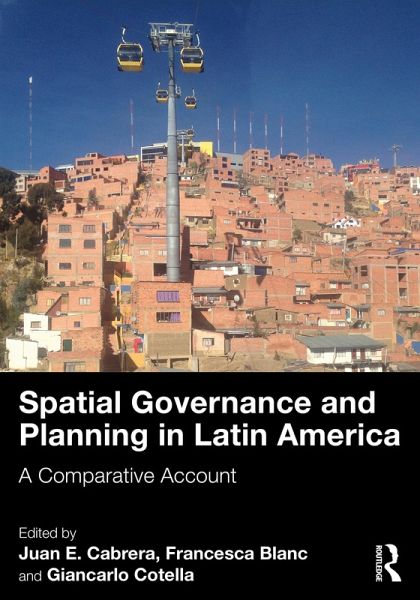
This book is the first to provide an in-depth discussion of spatial governance and planning systems (SGPSs) in Latin America, with analysis and comparison across 10 different countries: Argentina, Bolivia, Brazil, Chile, Colombia, Cuba, Ecuador, Mexico, Peru, and Uruguay. The primary function of SPGSs is to empower the public sector to exert control over spatial development. Originally understood mainly through a legal paradigm, it is now acknowledged that a range of informal institutions also play a role, responding to societal and community needs that the state or market is unable to address. This collection teases out these contrasting influences, highlighting the role of indigenous culture in certain contexts, and the increase of participatory processes in others. The book features not only individual country case studies, but also chapters discussing the broader themes, as well as how the Latin American context compares to the European one. A timely contribution to this evolving topic, the book will appeal to students and scholars in the fields of planning, urban and regional studies, public policy, and human geography.
Dieser Download kann aus rechtlichen Gründen nur mit Rechnungsadresse in A, B, BG, CY, CZ, D, DK, EW, E, FIN, F, GR, HR, H, IRL, I, LT, L, LR, M, NL, PL, P, R, S, SLO, SK ausgeliefert werden.