Sie sind bereits eingeloggt. Klicken Sie auf 2. tolino select Abo, um fortzufahren.
Bitte loggen Sie sich zunächst in Ihr Kundenkonto ein oder registrieren Sie sich bei bücher.de, um das eBook-Abo tolino select nutzen zu können.
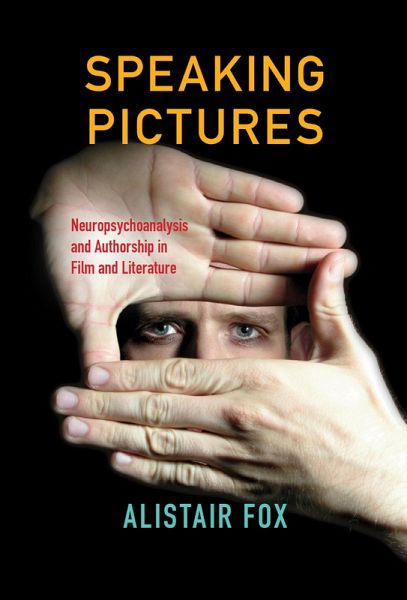
A new way to understand the human longing for stories, informed by both neuroscience and psychoanalytic theory. In this book, Alistair Fox presents a theory of literary and cinematic representation through the lens of neurological and cognitive science in order to understand the origins of storytelling and our desire for fictional worlds. Fox contends that fiction is deeply shaped by emotions and the human capacity for metaphorical thought. Literary and moving images bridge emotional response with the cognitive side of the brain. In a radical move to link the neurosciences with psychoanalysis,…mehr
A new way to understand the human longing for stories, informed by both neuroscience and psychoanalytic theory. In this book, Alistair Fox presents a theory of literary and cinematic representation through the lens of neurological and cognitive science in order to understand the origins of storytelling and our desire for fictional worlds. Fox contends that fiction is deeply shaped by emotions and the human capacity for metaphorical thought. Literary and moving images bridge emotional response with the cognitive side of the brain. In a radical move to link the neurosciences with psychoanalysis, Fox foregrounds the interpretive experience as a way to reach personal emotional equilibrium by working through autobiographical issues within a fictive form.
Die Herstellerinformationen sind derzeit nicht verfügbar.
Autorenporträt
Alistair Fox is Professor Emeritus of English at the University of Otago, New Zealand. He is author of Jane Campion: Authorship and Personal Cinema (IUP, 2011), translator of Anne Gillain's François Truffaut: The Lost Secret (IUP, 2013), and editor (with Raphaëlle Moine, Hilary Radner, and Michel Marie) of A Companion to Contemporary French Cinema.
Inhaltsangabe
Acknowledgments Introduction 1. Changing Configurations in Theories of Fictive Representation 2. Why Does Fictive Representation Exist? 3. The Wellsprings of Fictive Creativity 4. The Materials of Fictive Invention 5. The Informing Role of Fantasy 6. The Shaping of Fictive Scenarios by the Author: Motivations, Strategies, and Outcomes 7. The Exploitation of Generic Templates and Intertexts as Vehicles for Affect-Regulation 8. Theories of Reception in the Twentieth and Twenty-First Centuries 9. A Neuropsychoanalytic Theory of Reception 10. Intersubjective Attunement, Filiation and the Re-creative Process: Jules and Jim-from Henri-Pierre Roché to Francois Truffaut 11. The Conversion of Autobiographical Emotion into Symbolic Figuration: William Shakespeare's Hamlet 12. Tracking a Personal Myth through an Oeuvre: the Films of François Ozon Conclusion Filmography Select Bibliography Index
Es gelten unsere Allgemeinen Geschäftsbedingungen: www.buecher.de/agb
Impressum
www.buecher.de ist ein Internetauftritt der buecher.de internetstores GmbH
Geschäftsführung: Monica Sawhney | Roland Kölbl | Günter Hilger
Sitz der Gesellschaft: Batheyer Straße 115 - 117, 58099 Hagen
Postanschrift: Bürgermeister-Wegele-Str. 12, 86167 Augsburg
Amtsgericht Hagen HRB 13257
Steuernummer: 321/5800/1497
USt-IdNr: DE450055826