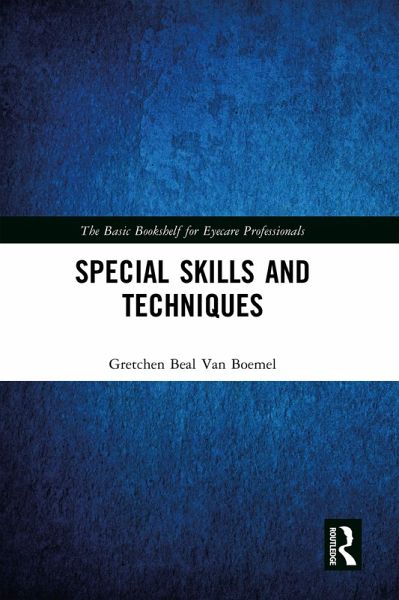
Special Skills and Techniques (eBook, PDF)
Alle Infos zum eBook verschenken
Special Skills and Techniques (eBook, PDF)
- Format: PDF
- Merkliste
- Auf die Merkliste
- Bewerten Bewerten
- Teilen
- Produkt teilen
- Produkterinnerung
- Produkterinnerung

Hier können Sie sich einloggen

Bitte loggen Sie sich zunächst in Ihr Kundenkonto ein oder registrieren Sie sich bei bücher.de, um das eBook-Abo tolino select nutzen zu können.
The Basic Bookshelf for Eyecare Professionals is a series that provides fundamental and advanced material with a clinical approach to clinicians and students. A special effort was made to include information needed for the certification exams in ophthalmic and optometric assisting, as well as for surgical assistants, opticians, plus low vision, and contact lens examiners.
This book moves beyond basic exam skills into the arena of more advanced diagnostic testing. Topics include biometry and echography, electrophysiology, psychophysical testing, and microbiology. Special tests such as…mehr
- Geräte: PC
- mit Kopierschutz
- eBook Hilfe
Lindy DuboisClinical Skills for the Ophthalmic Examination (eBook, PDF)66,95 €
Joseph PanarelliThe Pocket Guide to Glaucoma (eBook, PDF)58,95 €
Ming WangGrow Your Eye Care Practice (eBook, PDF)69,95 €
John M. CorboyThe Retinoscopy Book (eBook, PDF)82,95 €
Al LensOptics, Retinoscopy, and Refractometry (eBook, PDF)61,95 €
Janice K. LedfordThe Complete Guide to Ocular History Taking (eBook, PDF)66,95 €
Aaron ShuklaClinical Optics Primer for Ophthalmic Medical Personnel (eBook, PDF)61,95 €-
-
-
This book moves beyond basic exam skills into the arena of more advanced diagnostic testing. Topics include biometry and echography, electrophysiology, psychophysical testing, and microbiology. Special tests such as exophthalmometry, pachymetry, and ophthalmoscopy are also covered. This is the ultimate how-to book for those performing detailed patient exams.
Dieser Download kann aus rechtlichen Gründen nur mit Rechnungsadresse in A, B, BG, CY, CZ, D, DK, EW, E, FIN, F, GR, HR, H, IRL, I, LT, L, LR, M, NL, PL, P, R, S, SLO, SK ausgeliefert werden.
- Produktdetails
- Verlag: Taylor & Francis eBooks
- Seitenzahl: 270
- Erscheinungstermin: 28. Juni 2024
- Englisch
- ISBN-13: 9781040138892
- Artikelnr.: 72269598
- Verlag: Taylor & Francis eBooks
- Seitenzahl: 270
- Erscheinungstermin: 28. Juni 2024
- Englisch
- ISBN-13: 9781040138892
- Artikelnr.: 72269598
- Herstellerkennzeichnung Die Herstellerinformationen sind derzeit nicht verfügbar.
After several years of working at Doheny, she found that she was fascinated by the other facets of the field of ophthalmology. She first studied for her COT, and received it in 1985. Later she went on for her COMT certification, which she received in 1991. While at the Doheny Eye Institute, Gretchen also conducted original research in the areas of the usefulness of electrophysiology in the evaluation of the traumatized eye, and VER testing for unexplained vision loss. While conducting the later study, she became intrigued with what appeared to be psychogenic blindness in certain refugee women. With the assistance of a colleague specializing in psychology, Gretchen embarked on a research agenda that included investigating the consequences of severe trauma as the likely cause of psychogenic blindness in a group of older Cambodian women. That work resulted in national and international attention with appearances on ABC's 20/20 news program, and CNN evening news segment, British and German equivalents of 20/20, as well as being featured in numerous newspaper articles, including a feature story in the New York Times Magazine.
As a result, Gretchen felt it necessary to continue her education, and she went back to graduate school while maintaining a full-time position as director of the electrophysiology and psychophysiology department at Doheny. She received her doctorate in Social Ecology with an emphasis in Health Psychology from the University of California, Irvine, in 1995.
Since receiving her doctorate, Gretchen has continued to work as director of the electrophysiology and psychophysiology department, but has taken on new responsibilities, as well. She was asked to create a multidisciplinary low vision rehabilitation program that she currently heads. She is also the director of the Continuing Medical Education program at the Doheny Eye Institute. She has coordinated a grant on why preventable blindness occurs in diabetes and is currently investigating barriers to low vision care. Additionally, she has been a principal investigator on a Social Security Administration project aimed at assisting low income blind and visually impaired individuals in receiving appropriate benefits. She continues teaching JCAHPO courses, as well as courses at USA and California State University, Long Beach in the Health Science Department.
Gretchen truly loves the field of ophthalmology. It is her sincere hope that many of you will develop a greater appreciation of the field after reading this book. The areas covered are often considered tedious to get through, she hopes that the care examples she has provided with allow these subjects to "come alive."
Study Icons Part I. Advanced Tests and Techniques Chapter 1. Diagnostic
Testing Exophthalmometry Pachymetry The Photokeratoscope Corneal Topography
Pupillometry Pupillography Ophthalmoscopy Chapter 2. Psychophysical Testing
Overview of Psychophysical Testing Advanced Color Vision Testing Dark
Adaptometry Testing The Macular Photostress Test The Potential Acuity Meter
The Glare Test and the Brightness Acuity Test Contrast Sensitivity Chapter
3. Microbiology Overview Ocular Microbiology Identification of the
Infectious Antigen The Immune System Part II. Biometry and Echography
Chapter 4. Axial Eye Length A-Scans and Intraocular Lens Calculations Axial
Eye Length Techniques of Axial Eye Length A-Scans Brief Review Probe
Placement Calculating Axial Eye Lengths with the A-scan Echo Patterns
Conducting an Axial Eye Length Examination IOL Power Calculations Chapter
5. Diagnostic A- and B- Scan Ultrasonography Basic Principles Standardized
Echography Examination Techniques B-Scan Examination A- and B- Scan Used
Together Indications Part III. Electrophysiology Testing Chapter 6.
Electroretinography Introduction to the Electroretinogram The Full-Field
ERG Materials Needed for Recording the ERG Recording a Full-Field ERG
According to International Standards Recording a Dark-Adapted ERG Recording
a Light-Adapted ERG Concluding the ERG Testing Session Results of ERG
Testing The Clinical Usefulness of the ERG Case Histories - Basic Waveform
Abnormalities Case Histories - Disorders Suggesting Cone Photoreceptor Cell
Abnormality Case Histories - Disorders Suggesting Rod Photoreceptor Cell
Abnormality Case Histories - The ERG in Unexplained Vision Loss Chapter 7.
Electro-Oculography Introduction to the Electro-Oculogram Preparing the
Patient for an EOG Recording the EOG Evaluating the EOG Clinical Usefulness
of the EOG Case Histories Chapter 8. Visual Evoked Response Introduction to
the Visual Evoked Response Stimuli Averaging VER Testing Evaluating Test
Results The Clinical Usefulness of Flash and Pattern VER Testing Case
Histories Appendix A. Disability Determination: Who Qualifies and Who
Doesn't Impairment and Disability Definitions of Vision Loss Importance of
Determining Level of Impairment and Disability Assessing and Documenting
Vision Loss Other Visual System Abnormalities Affecting Disability
Determination Appendix B. Universal Precautions Protecting Patients from
Exposure Protecting Staff and Physicians from Exposure Exposure Index
Study Icons Part I. Advanced Tests and Techniques Chapter 1. Diagnostic
Testing Exophthalmometry Pachymetry The Photokeratoscope Corneal Topography
Pupillometry Pupillography Ophthalmoscopy Chapter 2. Psychophysical Testing
Overview of Psychophysical Testing Advanced Color Vision Testing Dark
Adaptometry Testing The Macular Photostress Test The Potential Acuity Meter
The Glare Test and the Brightness Acuity Test Contrast Sensitivity Chapter
3. Microbiology Overview Ocular Microbiology Identification of the
Infectious Antigen The Immune System Part II. Biometry and Echography
Chapter 4. Axial Eye Length A-Scans and Intraocular Lens Calculations Axial
Eye Length Techniques of Axial Eye Length A-Scans Brief Review Probe
Placement Calculating Axial Eye Lengths with the A-scan Echo Patterns
Conducting an Axial Eye Length Examination IOL Power Calculations Chapter
5. Diagnostic A- and B- Scan Ultrasonography Basic Principles Standardized
Echography Examination Techniques B-Scan Examination A- and B- Scan Used
Together Indications Part III. Electrophysiology Testing Chapter 6.
Electroretinography Introduction to the Electroretinogram The Full-Field
ERG Materials Needed for Recording the ERG Recording a Full-Field ERG
According to International Standards Recording a Dark-Adapted ERG Recording
a Light-Adapted ERG Concluding the ERG Testing Session Results of ERG
Testing The Clinical Usefulness of the ERG Case Histories - Basic Waveform
Abnormalities Case Histories - Disorders Suggesting Cone Photoreceptor Cell
Abnormality Case Histories - Disorders Suggesting Rod Photoreceptor Cell
Abnormality Case Histories - The ERG in Unexplained Vision Loss Chapter 7.
Electro-Oculography Introduction to the Electro-Oculogram Preparing the
Patient for an EOG Recording the EOG Evaluating the EOG Clinical Usefulness
of the EOG Case Histories Chapter 8. Visual Evoked Response Introduction to
the Visual Evoked Response Stimuli Averaging VER Testing Evaluating Test
Results The Clinical Usefulness of Flash and Pattern VER Testing Case
Histories Appendix A. Disability Determination: Who Qualifies and Who
Doesn't Impairment and Disability Definitions of Vision Loss Importance of
Determining Level of Impairment and Disability Assessing and Documenting
Vision Loss Other Visual System Abnormalities Affecting Disability
Determination Appendix B. Universal Precautions Protecting Patients from
Exposure Protecting Staff and Physicians from Exposure Exposure Index